Analytical balance
Measures the mass of a sample very precisely, usually to 0.1 mg or 0.01 mg. Almost every quantitative test in a QC lab starts with a weighing, so the balance is the most used instrument in the lab.
- Pharmaceutical
- Biotech
- Chemicals
- Food & beverage
- Academic research
- Cosmetics
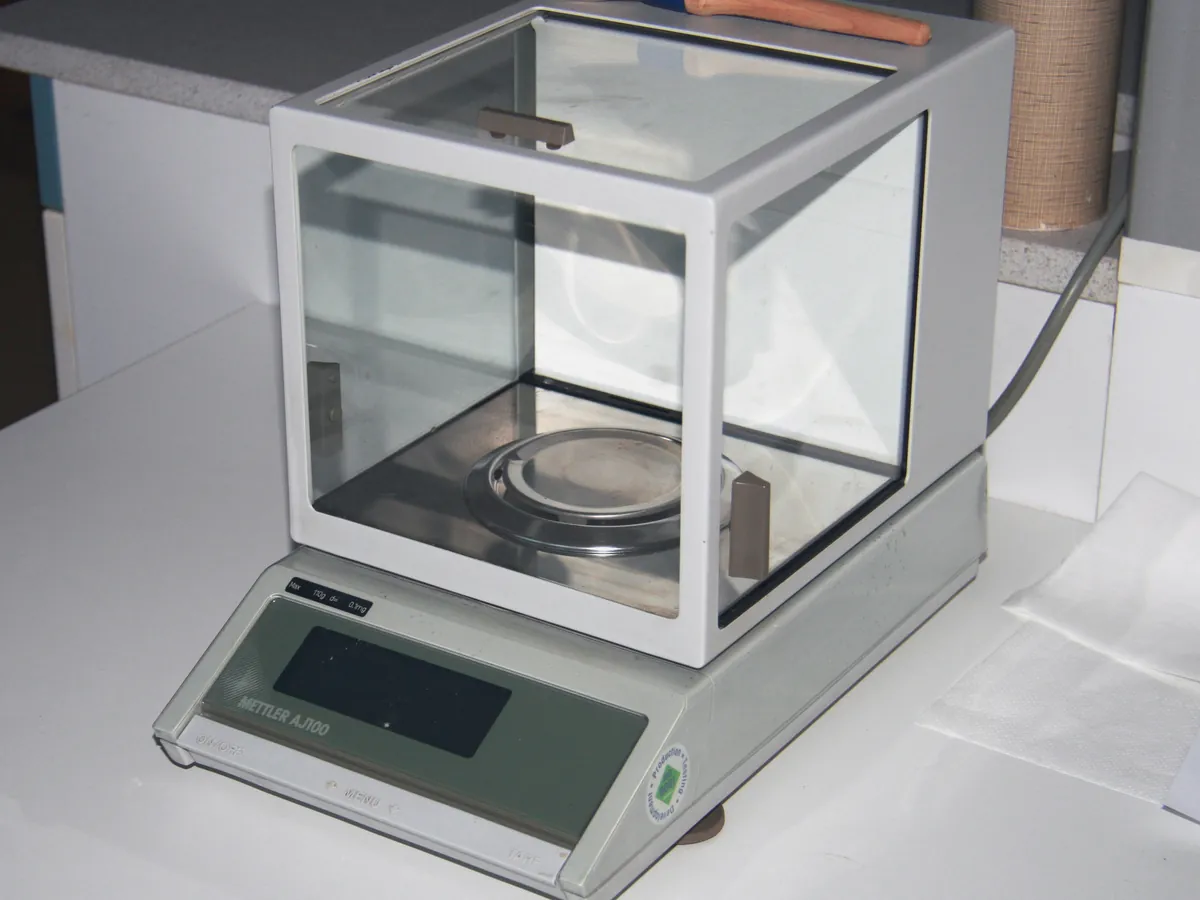
What is Analytical balance?
An analytical balance weighs small amounts of material with high precision. A typical analytical balance has a capacity of about 200–220 g and a readability (d) of 0.1 mg (0.0001 g). A semi-micro balance reads to 0.01 mg, and a microbalance to 0.001 mg or better.
Modern balances do not use counterweights. The pan is held up by an electromagnet. When you place a load on the pan, the balance increases the current in the coil until the pan returns to its original position. The current needed is proportional to the mass, and the balance converts it into a displayed weight.
Because the result of an assay, a standard preparation or a weight variation test can only be as good as the weighing, balances are checked every day, calibrated at set intervals, and used only above their minimum weight.
Used for
- Weighing reference standards and samples for assay and impurity tests
- Preparing volumetric solutions, buffers and mobile phases
- Average weight and weight variation of tablets and capsules
- Loss on drying, sulphated ash and residue on ignition
- Gravimetric checks of pipettes and dispensers
- Fill-weight checks during in-process control
How it works
- 01
Load
The sample is placed on the weighing pan inside the draught shield.
- 02
Displacement
The pan and lever move down very slightly under the weight.
- 03
Position sensor
An optical sensor detects the movement away from the zero position.
- 04
Force restoration
The control circuit increases the coil current until the magnetic force returns the pan to zero.
- 05
Conversion
The coil current is measured, converted to mass using the stored calibration, and filtered for stability.
- 06
Display & record
A stable reading is shown, printed or sent to the LIMS with date, time and balance ID.
Advantages
- Very high precision (readability 0.1 mg or better)
- Fast, direct reading with no calculation needed
- Built-in internal calibration weights on many models
- Can print or send results directly to a LIMS for data integrity
- Tare function makes weighing by difference simple
Limitations
- Sensitive to draughts, vibration, temperature changes and static
- Has a minimum weight below which results are not accurate enough
- Readings are affected by air buoyancy and by warm or cold samples
- Needs a stable, level bench and a controlled room
- Hygroscopic or volatile samples change mass during weighing
6 calibration procedures
Methods that use Analytical balance
- Assay of Paracetamol Tablets by HPLC
- pH of a Solution (Finished Products)
- Average Weight & Weight Variation of Tablets
- Identification by FTIR
- Identification by UV
- Water Content by Karl Fischer Titration (Volumetric)
- Assay of an Acidic API by Potentiometric Titration (Ibuprofen, illustrative)
- Loss on Drying (Oven Method)
- Dissolution of Immediate-Release Tablets (Paracetamol 500 mg example)
- Tablet Hardness (Breaking Force) and Friability
- Residual Solvents by Headspace GC-FID
- Microbial Enumeration Test (TAMC / TYMC) by Plate Count
- Related Substances (Impurities) by HPLC
- Stability-Indicating Assay by HPLC
- Elemental Impurities by ICP-MS
- Specific Optical Rotation (Raw Materials)
- Sulphated Ash / Residue on Ignition
- Particle Size Distribution by Laser Diffraction
- Bulk and Tapped Density of Powders
- Tests for Specified Microorganisms in Non-Sterile Products
- Total Organic Carbon (TOC) in Purified Water
- Limit Tests for Chloride & Sulphate
- Hydrolytic Resistance of Glass Containers (Surface Glass Test)
- Uniformity of dosage units
- Blend uniformity
Keep every Analytical balance in control: usage logs, calibration and maintenance schedules, and automatic blocking of overdue instruments.