Water Content by Karl Fischer Titration (Volumetric)
Determines the percentage of water in a raw material by dissolving a weighed sample in dry methanol and titrating with a standardised Karl Fischer reagent to an electrometric endpoint.
- Volumetric Karl Fischer titration with bivoltametric endpoint
- KF titrator (volumetric)
- Analytical balance
Reference: Typical method based on USP <921> Method I and Ph. Eur. 2.5.12. Use the sample mass, solvent and limit given in your monograph or specification.
Why this method works
Water in the sample reacts with iodine and sulphur dioxide in the presence of a base and methanol, consuming one mole of iodine per mole of water. Once all the water has reacted, excess iodine causes a sharp drop in the voltage across a polarised double platinum electrode, which marks the endpoint. The volume of reagent used, multiplied by its titre in mg of water per mL, gives the mass of water.
Instruments used
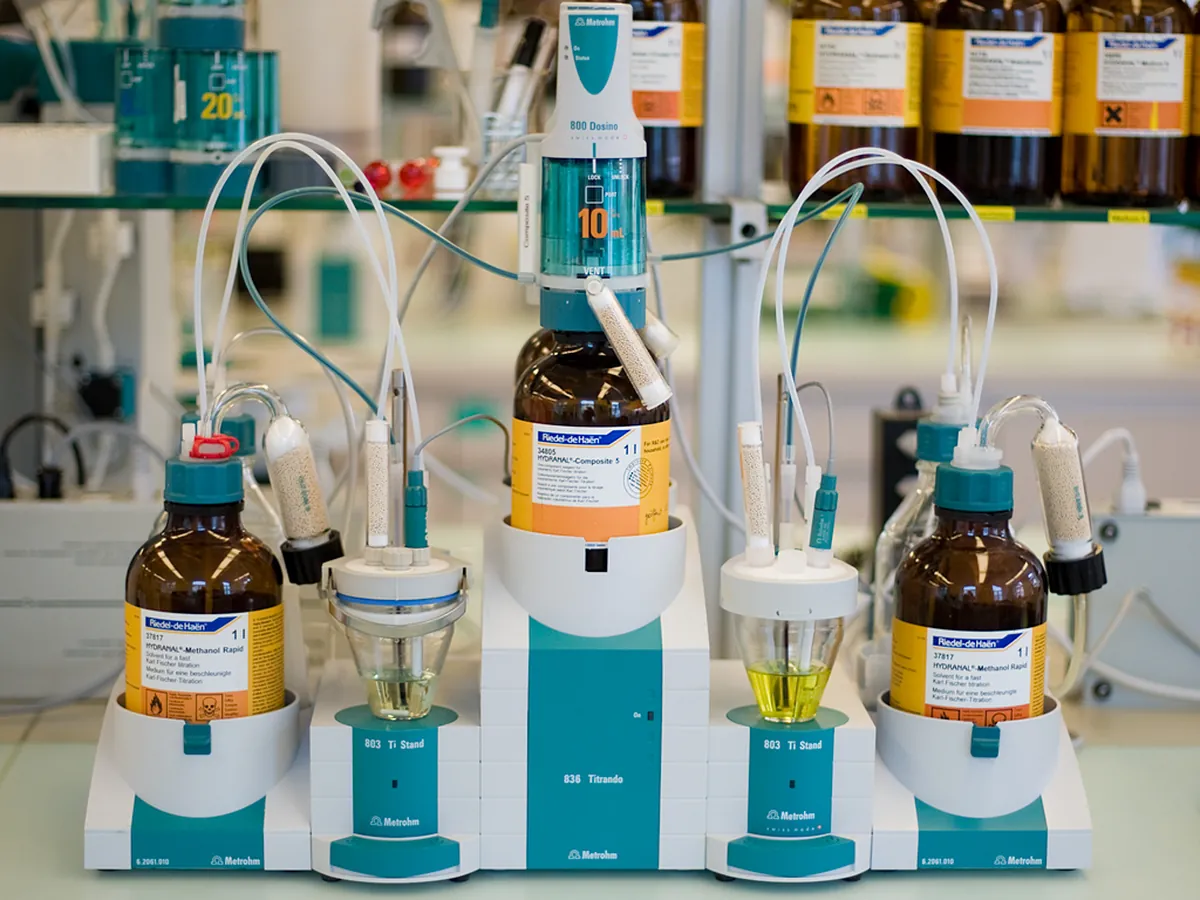

Reagents & standards
| Reagent | Grade / specification |
|---|---|
| KF reagent (titrant) | One-component reagent, nominal titre about 5 mg H₂O/mL, or a two-component titrant |
| Solvent | Dry methanol, or the solvent supplied for two-component reagents |
| Water standard | Sodium tartrate dihydrate (about 15.66% water) or a certified liquid water standard |
Preparing the sample
- 01
Condition cell
Titrate the solvent to dryness; wait for low, stable drift.
- 02
Determine titre
Standardise the reagent with sodium tartrate dihydrate.
- 03
Weigh sample
Weigh about 0.5 g by difference, quickly.
- 04
Add & dissolve
Add through the port and stir until dissolved.
- 05
Titrate
Titrate to the endpoint; the software applies drift correction.
- 06
Repeat
Run a duplicate and report the mean.
Procedure
- 1Fill the titration cell with about 30–50 mL of dry methanol (or the method solvent) and condition it until the drift is low and stable.
- 2Determine the titre of the KF reagent in triplicate using sodium tartrate dihydrate, as described in the titre determination procedure.
- 3Accurately weigh about 0.5 g of the sample (or the mass that consumes a reasonable part of the burette for the expected water content) in a dry weighing boat or syringe.
- 4Transfer the sample quickly into the cell, reweigh the empty container and enter the net sample mass.
- 5Stir for the extraction time set in the method (often 60–180 seconds) and titrate to the endpoint.
- 6Repeat with a second portion of sample.
Standard preparation
- 1Accurately weigh about 150 mg of sodium tartrate dihydrate and titrate it in the conditioned cell.
- 2Calculate the titre: F = (mass × 0.1566) ÷ volume. Repeat in triplicate and use the mean.
Notes for analysts
- Hygroscopic samples pick up water during weighing; weigh quickly or use a glove box.
- Ketones and aldehydes need ketone-compatible reagents and methanol-free solvents.
- Insoluble or interfering samples can be analysed with a KF oven that drives the water into the cell with dry gas.
- Below about 0.1% water, coulometric KF usually gives better precision.
Method parameters (typical)
| Titrant | KF reagent, titre about 5 mg/mL (determined daily) |
|---|---|
| Burette | 10 mL |
| Indication | Bivoltametric (Ipol), for example 50 µA |
| Endpoint | Voltage below about 250 mV with a stop drift or stop delay as per method |
| Drift limit before start | Not more than 20 µg/min |
| Extraction / stirring time | As validated, for example 120 seconds |
| Sample mass | About 0.5 g (adjust to the expected water content) |
System suitability & sequence
| Parameter | Limit |
|---|---|
| Titre %RSD (n = 3) | Not more than 1.0% |
| Drift before sample addition | Not more than 20 µg/min and stable |
| Duplicate agreement | As defined in your SOP (for example not more than 0.1% absolute difference at this level) |
Typical sequence
- 1Condition cell and record drift
- 2Titre determination × 3
- 3Sample preparation 1
- 4Sample preparation 2
Calculation with a worked example
Where
- V
- Volume of KF reagent consumed by the sample (mL), drift-corrected
- F
- Titre of the KF reagent (mg water per mL)
- W
- Weight of sample taken (mg)
Given
- F
- 4.985 mg/mL
- W (prep 1)
- 500.8 mg
- V (prep 1)
- 2.86 mL
- W (prep 2)
- 503.4 mg
- V (prep 2)
- 2.88 mL
Working
- Prep 1: water = 2.86 × 4.985 = 14.257 mg; 14.257 ÷ 500.8 × 100 = 2.847%
- Prep 2: water = 2.88 × 4.985 = 14.357 mg; 14.357 ÷ 503.4 × 100 = 2.852%
- Mean = (2.847 + 2.852) ÷ 2 = 2.849%
Water content = 2.85% w/w (mean of duplicates)
Try it with your numbersWhat result passes
- Compare with the water limit in your specification or monograph (for example 'not more than 3.0%'; the limit depends on the material).
Validation parameters (ICH Q2(R2))
| Parameter | Typical requirement |
|---|---|
| Specificity | No side reactions with the sample (checked by a stable endpoint and normal drift after titration) |
| Accuracy | Recovery of spiked water or water standard typically 97–103% |
| Precision | Repeatability %RSD typically not more than 2% at the specification level |
| Range | Covering the expected water content and the specification limit |
| Robustness | Effect of extraction time, sample mass and solvent volume |
Run this method in LimsPulse: specifications and STPs under version control, results calculated and checked against limits, and a signed Certificate of Analysis.