Bulk and Tapped Density of Powders
Measures how much space a weighed powder takes up before and after mechanical tapping, and calculates bulk density, tapped density, Carr's index and Hausner ratio as indicators of flow.
- Graduated cylinder with tap density tester (USP <616> method 1)
- Tap density tester
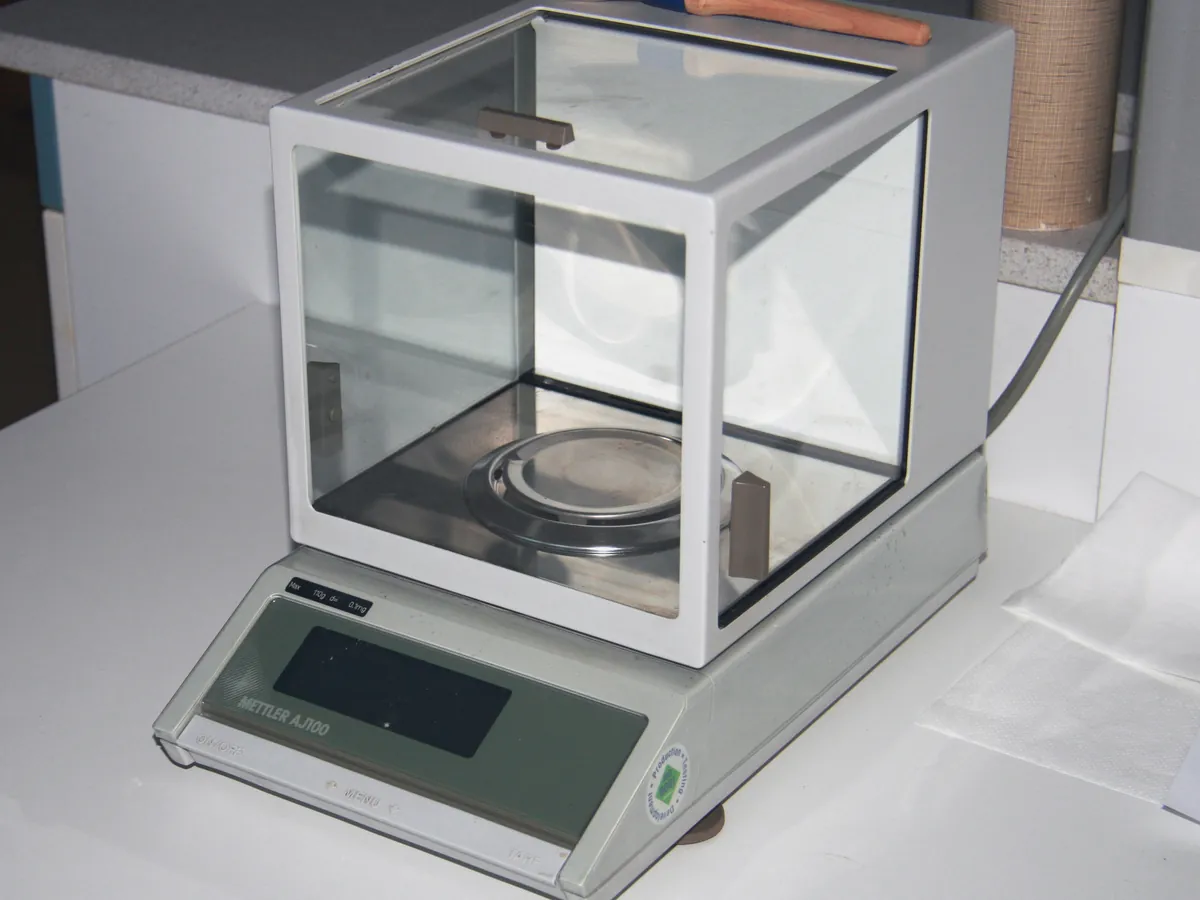
- Analytical balance
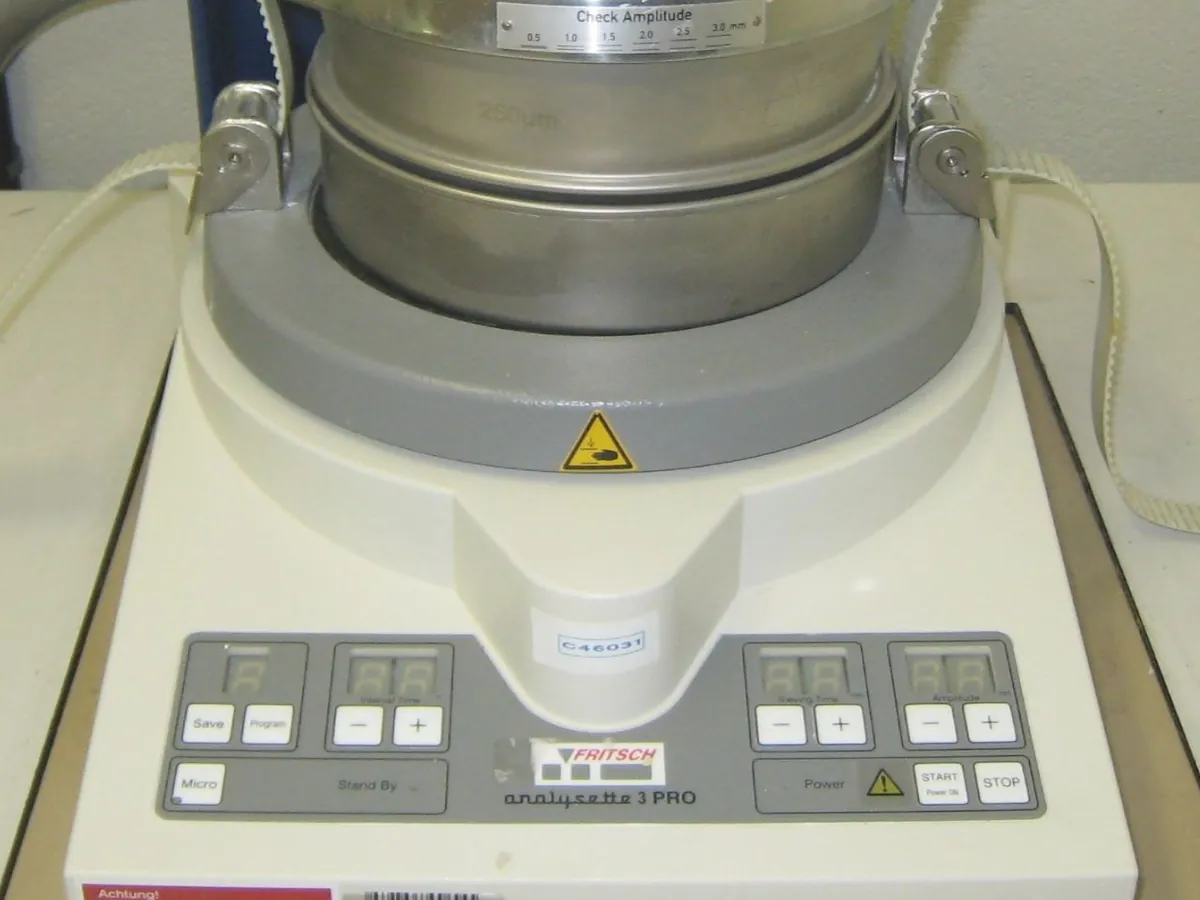
- Sieve shaker
Reference: Typical approach based on USP <616> / Ph. Eur. 2.9.34 method 1. Always follow your approved specification and STP.
Why this method works
Bulk density is the mass of powder divided by its loose, untapped volume, which includes the air spaces between particles. Tapping packs the particles more closely until the volume stops changing; mass divided by this tapped volume is the tapped density. The bigger the drop in volume, the more cohesive the powder and the poorer its flow. Carr's index and Hausner ratio express this drop as single numbers.
Instruments used

Preparing the sample
- 01
Sieve
Pass the sample through a sieve of about 1 mm to break up lumps.
- 02
Weigh
Weigh about 100 g (m) to 0.1% accuracy.
- 03
Fill
Pour gently into a dry 250 mL cylinder without compacting.
- 04
Read V0
Level carefully and read the unsettled volume.
- 05
Tap
Tap 10, 500 and 1250 times, reading volume each time.
- 06
Read Vf
Continue in increments until successive readings agree; record Vf.
Procedure
- 1Pass enough sample through a sieve of about 1.0 mm aperture to break up agglomerates formed in storage.
- 2Weigh about 100 g (m) of the sieved sample. If this does not fit, choose a mass that gives an untapped volume of about 150–250 mL and record it.
- 3Introduce it gently into a dry 250 mL graduated cylinder (readable to 2 mL) without compacting.
- 4Level the powder without compacting and read the unsettled apparent volume V0 to the nearest graduated unit.
- 5Fix the cylinder in the tap density tester and tap 10, 500 and 1250 times, reading volumes V10, V500 and V1250.
- 6If the difference between V500 and V1250 is within the limit in the chapter (commonly 2 mL), take V1250 as the final tapped volume Vf. Otherwise continue tapping in increments (e.g. 1250 taps) until successive readings agree.
- 7Carry out the determination in duplicate or as your STP states.
Notes for analysts
- In the worked example 50.0 g was used to keep the numbers simple; in practice use about 100 g in a 250 mL cylinder.
- Pour, do not tap, when filling: any knock before reading V0 lowers it and makes the powder look better-flowing than it is.
- Method 2 of USP <616> uses a 3 ± 0.2 mm drop at 250 ± 15 taps/min and can give different values; always report which method was used.
Method parameters (typical)
| Cylinder | 250 mL graduated cylinder, readable to 2 mL |
|---|---|
| Sample mass | About 100 g, weighed to 0.1% |
| Drop height | Typically 14 ± 2 mm (method 1) |
| Tap rate | Nominally about 300 taps per minute (method 1) |
| Tap sequence | 10, 500 and 1250 taps, then further increments if needed |
System suitability & sequence
| Parameter | Limit |
|---|---|
| Tap density tester | Drop height and tap rate within calibration due date |
| Balance | Daily check passed |
Typical sequence
- 1Sieve sample
- 2Weigh and fill cylinder
- 3Read V0
- 4Tap and read V10, V500, V1250
- 5Repeat for duplicate
Calculation with a worked example
Where
- m
- Mass of powder (g)
- V0
- Unsettled apparent (bulk) volume (mL)
- Vf
- Final tapped volume (mL)
Given
- m
- 50.0 g
- V0
- 125 mL
- Vf
- 98 mL
Working
- Bulk density = 50.0 ÷ 125 = 0.400 g/mL
- Tapped density = 50.0 ÷ 98 = 0.510 g/mL
- Carr's index = 100 × (125 − 98) ÷ 125 = 100 × 27 ÷ 125 = 21.6%
- Hausner ratio = 125 ÷ 98 = 1.28
Bulk density 0.400 g/mL, tapped density 0.510 g/mL, Carr's index 21.6%, Hausner ratio 1.28. On the usual USP <1174> scale this is 'passable' flow.
Try it with your numbersWhat result passes
- As per the material or product specification (density limits are product-specific).
- Flow character is commonly judged with the USP <1174> scale: Carr's index ≤ 10% (Hausner 1.00–1.11) excellent; 11–15% (1.12–1.18) good; 16–20% (1.19–1.25) fair; 21–25% (1.26–1.34) passable; 26–31% (1.35–1.45) poor; 32–37% (1.46–1.59) very poor; > 38% (> 1.60) very, very poor.
Validation parameters (ICH Q2(R2))
| Parameter | Typical requirement |
|---|---|
| Precision | Duplicate determinations agree within the limit in your STP |
| Ruggedness | Analyst-to-analyst agreement, as filling technique strongly affects V0 |
Run this method in LimsPulse: specifications and STPs under version control, results calculated and checked against limits, and a signed Certificate of Analysis.