Hydrolytic Resistance of Glass Containers (Surface Glass Test)
Measures how much alkali the inner surface of a glass container releases into water under autoclave conditions. The containers are filled with water, autoclaved at 121 °C, and the water is titrated with 0.01 M hydrochloric acid. The result classifies the container and confirms it meets its glass type.
- Autoclave extraction followed by acid–base titration with 0.01 M HCl
- Autoclave
- Burette & glassware
- Analytical balance
Reference: Typical procedure based on USP <660> and Ph. Eur. 3.2.1. Filling volumes, autoclave cycle details and limits depend on container size and glass type; see the current chapter.
Why this method works
When glass is in contact with hot water, alkali ions (mainly sodium) leach from the surface and make the water slightly alkaline. Autoclaving speeds this up in a controlled way. Titrating the extract with dilute acid to a methyl red endpoint measures the alkali released. Type I borosilicate glass releases very little; Type II (surface-treated soda-lime) has a treated inner surface that releases little; Type III soda-lime glass releases more. The surface glass test checks the inner surface as the container will be used.
Instruments used
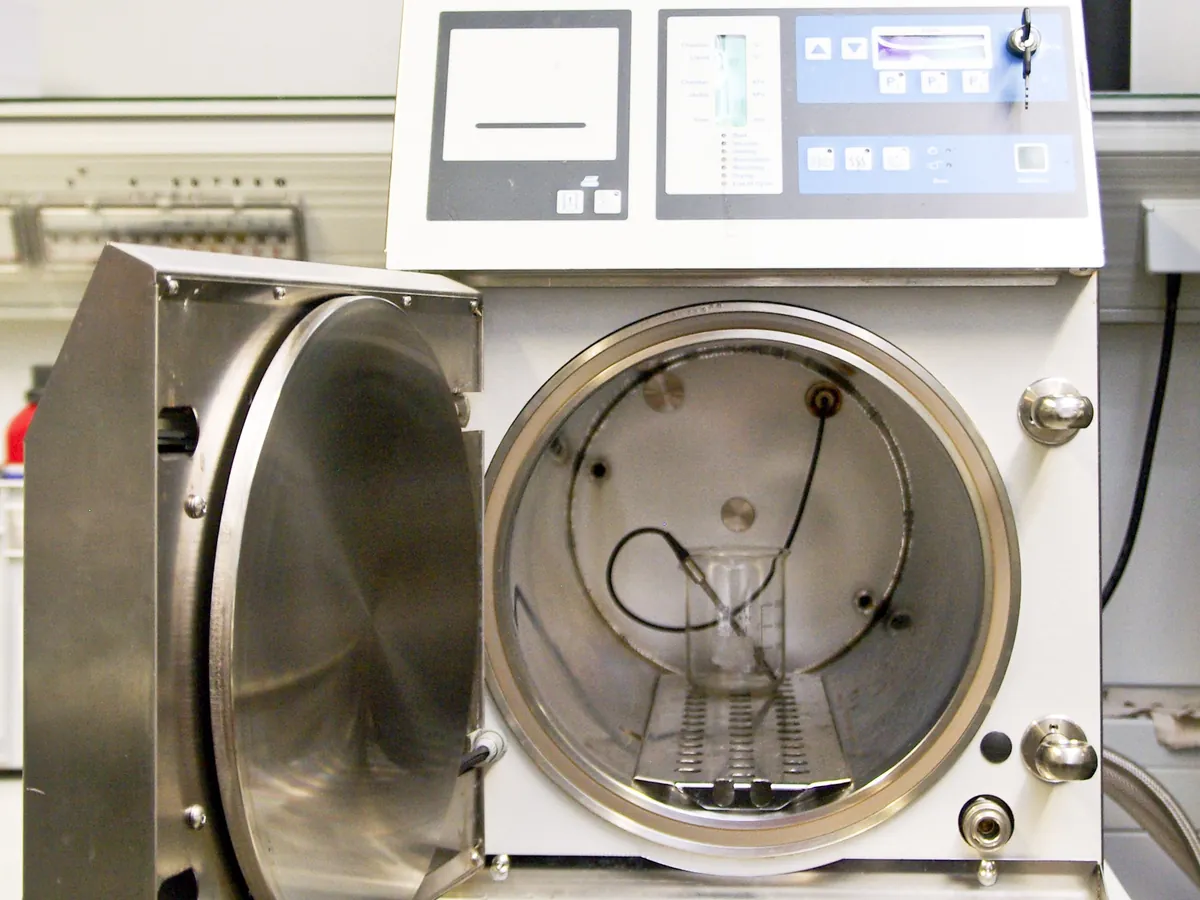
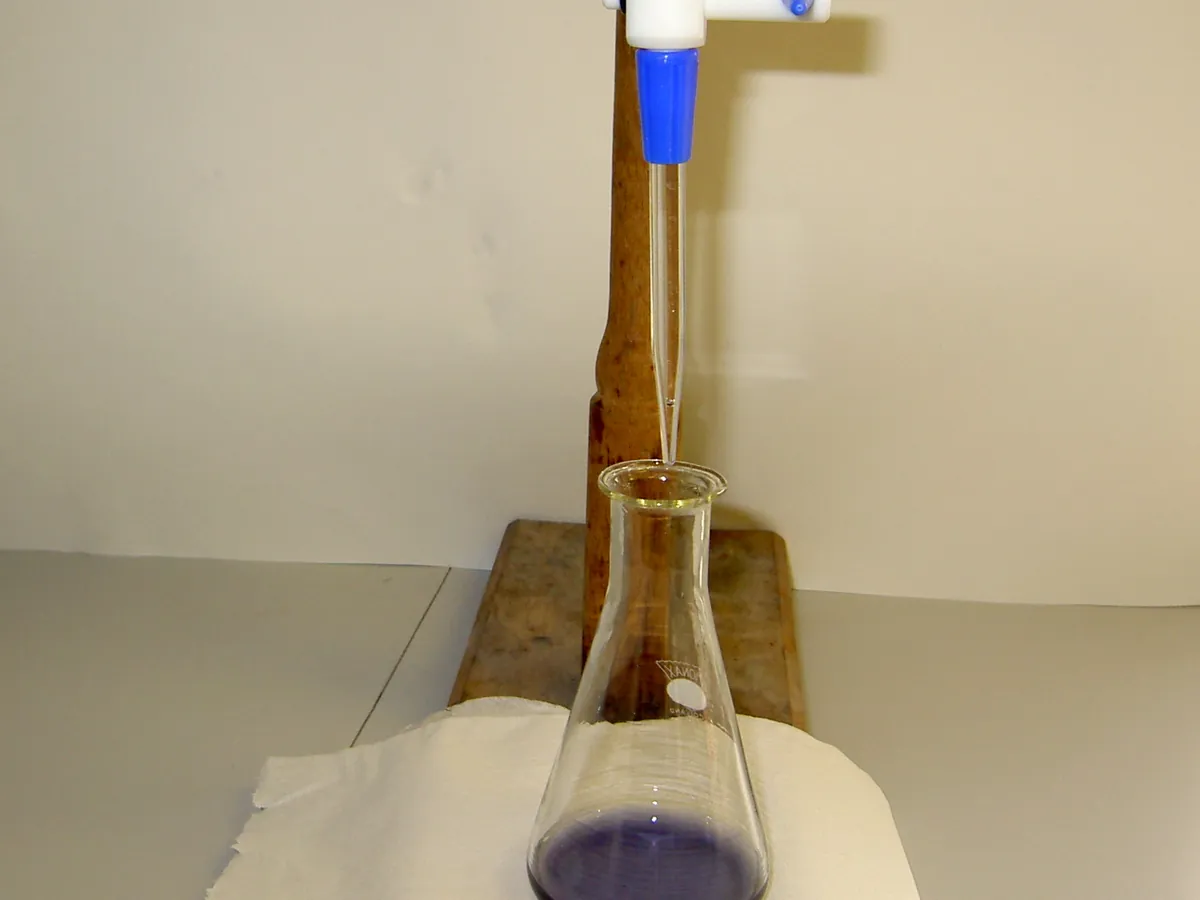

Reagents & standards
| Reagent | Grade / specification |
|---|---|
| Hydrochloric acid | 0.01 M volumetric solution (titrant) |
| Methyl red solution | Indicator |
| Purified water | Freshly boiled and cooled or otherwise CO₂-free, of suitable quality (as specified in the chapter) |
Preparing the sample
- 01
Brimful capacity
Determine the brimful capacity of a few containers by weighing water.
- 02
Rinse
Rinse containers with purified water as specified.
- 03
Fill
Fill to 90% of brimful capacity with purified water.
- 04
Autoclave
Cover and autoclave to 121 °C and hold for 60 minutes.
- 05
Cool
Cool and pool the extract as specified.
- 06
Titrate
Titrate an aliquot with 0.01 M HCl to methyl red endpoint.
Procedure
- 1Take the number of containers stated in the chapter. Determine the average brimful capacity of the type by filling with water and weighing.
- 2Rinse each container with purified water, then fill with purified water to 90% of its brimful capacity.
- 3Cover the containers loosely (for example with inert foil or a watch glass) and place them in the autoclave.
- 4Autoclave following the chapter's cycle: heat to 100 °C and vent steam, raise to 121 °C, hold for 60 minutes, then cool to 100 °C and remove (rates and times as specified).
- 5Cool the containers in water and combine the liquid from the containers as specified.
- 6Transfer the stated aliquot to a conical flask, add methyl red, and titrate with 0.01 M HCl to the endpoint.
- 7Perform a blank titration on the same volume of purified water.
Standard preparation
- 1Standardise or check the factor of 0.01 M HCl as required by your SOP; use a burette suitable for small volumes (for example a 10 mL Class A burette or microburette).
Notes for analysts
- Type I: borosilicate glass with high hydrolytic resistance, for most parenterals. Type II: soda-lime glass with a treated inner surface. Type III: soda-lime glass with moderate resistance, for non-parenteral products or some powders.
- The surface test measures the container as used. The glass grains test measures the bulk glass. The surface etching test (with hydrofluoric acid) shows whether high resistance comes from surface treatment.
- Use CO₂-free water and titrate soon after cooling: carbon dioxide affects small acid–base titrations.
- Small titration volumes need a microburette or a burette with fine graduations.
Method parameters (typical)
| Filling volume | 90% of brimful capacity |
|---|---|
| Autoclave | 121 °C held for 60 minutes (heating and cooling profile as per the chapter) |
| Titrant | 0.01 M hydrochloric acid |
| Indicator | Methyl red |
| Result unit | mL of 0.01 M HCl per 100 mL of extract |
System suitability & sequence
| Parameter | Limit |
|---|---|
| Autoclave cycle | Temperature profile recorded and within the chapter's tolerances |
| Blank | Blank titration on purified water performed and subtracted |
Typical sequence
- 1Brimful capacity determination
- 2Filling and autoclaving of containers
- 3Blank titration
- 4Titration of extract aliquots
Calculation with a worked example
Where
- Vs
- Volume of 0.01 M HCl used for the extract aliquot (mL)
- Vb
- Volume of 0.01 M HCl used for the blank (mL)
- Va
- Volume of extract titrated (mL)
Given
- Va
- 50.0 mL
- Vs
- 0.42 mL
- Vb
- 0.02 mL
Working
- Net titre = 0.42 − 0.02 = 0.40 mL
- Per 100 mL = 0.40 × 100 ÷ 50.0 = 0.80 mL of 0.01 M HCl per 100 mL
- Compare 0.80 mL with the limit in the current chapter for this filling volume and glass type
0.80 mL of 0.01 M HCl per 100 mL of extract (illustrative). Judge against the limit table for the container size and glass type in the current chapter.
What result passes
- The result does not exceed the limit given in the current USP <660> / Ph. Eur. 3.2.1 table for the container's filling volume and declared glass type (Type I and II share the tighter limits; Type III has wider limits). See the current chapter.
- Where the glass type needs confirming, the glass grains test (bulk glass) and surface etching test distinguish Type I from Type II and III.
Validation parameters (ICH Q2(R2))
| Parameter | Typical requirement |
|---|---|
| Approach | Compendial test; verify autoclave performance, titrant factor and water quality |
| Autoclave | Qualified and able to follow the specified heating, holding and cooling profile |
| Precision | Replicate titrations agree within the SOP limit |
Run this method in LimsPulse: specifications and STPs under version control, results calculated and checked against limits, and a signed Certificate of Analysis.