pH of a Solution (Finished Products)
Measures the pH of a liquid product, or of a solution of a solid product prepared as the monograph describes, using a pH meter calibrated with buffers that bracket the expected pH.
- Potentiometry (glass electrode pH meter)
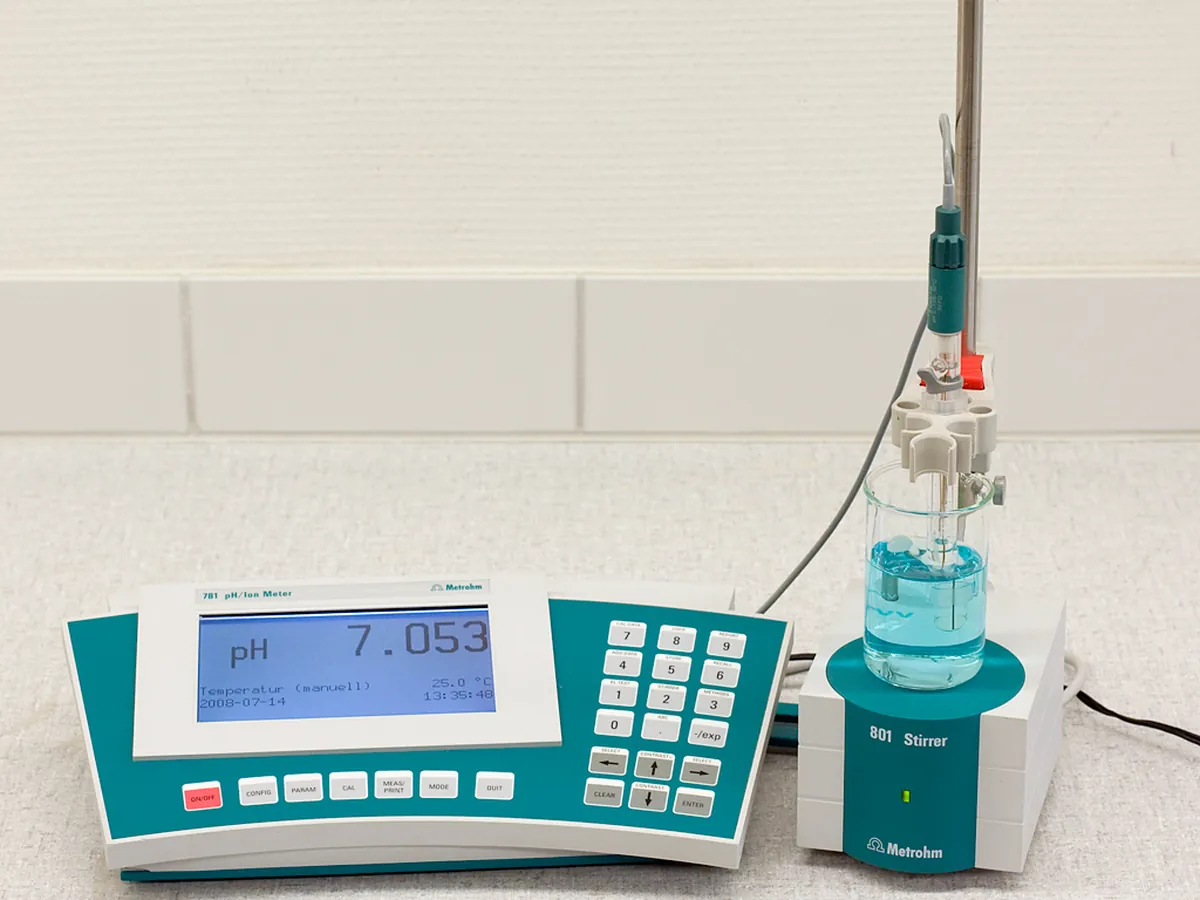
- pH meter
- Analytical balance
Reference: Typical method based on USP <791> and Ph. Eur. 2.2.3. Always follow your approved specification and STP.
Why this method works
A glass electrode develops a potential that depends on the hydrogen-ion activity of the solution. The pH meter measures this potential against a reference electrode and converts it into pH using a calibration line set with two or more standard buffers. Because both the electrode response and the sample's pH change with temperature, buffers and samples are measured at the same controlled temperature, usually 25 ± 2 °C.
Instruments used

Reagents & standards
| Reagent | Grade / specification |
|---|---|
| Standard buffers | Certified, traceable buffers, e.g. pH 4.01, 7.00 and 10.01 at 25 °C, chosen to bracket the sample pH |
| Check buffer | A certified buffer within the calibrated range, e.g. pH 6.86 or 9.18 |
| Purified water | Carbon dioxide-free water where the monograph specifies it (freshly boiled and cooled) |
| Electrode electrolyte | Usually 3 M KCl, as the electrode manufacturer specifies |
Preparing the sample
- 01
Equilibrate
Bring the sample and buffers to 25 ± 2 °C.
- 02
Prepare
Use liquids as they are; dissolve solids as the monograph states.
- 03
Calibrate
Calibrate the meter with buffers bracketing the expected pH.
- 04
Verify
Read a check buffer and confirm it is within limits.
- 05
Measure
Read the sample in duplicate and record pH and temperature.
Procedure
- 1Liquid products (injections, oral solutions, eye drops): mix well and transfer enough sample to a clean, dry beaker to cover the electrode bulb and junction.
- 2Suspensions: shake well and measure directly unless the monograph says otherwise.
- 3Solid products or APIs: weigh the quantity stated in the monograph (for example to make a 1% w/v or 5% w/v solution) and dissolve it in the specified volume of carbon dioxide-free water.
- 4Allow the sample to reach 25 ± 2 °C (or the temperature stated in the method).
Standard preparation
- 1Pour fresh portions of each buffer into clean, labelled beakers just before use.
- 2Do not return used buffer to the bottle; check buffer expiry dates.
Notes for analysts
- Always report the temperature together with the pH.
- For viscous or oily samples, clean the electrode carefully between samples; use a special electrode if needed.
- Low-ionic-strength samples respond slowly; allow extra time or follow the monograph (some add KCl).
- Recalibrate if a sample pH falls outside the range bracketed by the buffers.
Method parameters (typical)
| Measuring temperature | 25 ± 2 °C unless otherwise stated |
|---|---|
| Resolution | 0.01 pH unit |
| Calibration buffers | At least two, bracketing the expected pH (e.g. 4.01 and 7.00 for an acidic product) |
| Stability criterion | Reading stable, e.g. change of less than 0.02 pH in 30 seconds, or as defined in your SOP |
| Stirring | Gentle, constant rate for both buffers and samples (or no stirring, consistently) |
| Replicates | Two readings on separate portions; report the mean |
System suitability & sequence
| Parameter | Limit |
|---|---|
| Electrode slope | Typically 95–105% |
| Offset in pH 7.00 buffer | Typically within ±30 mV |
| Check buffer | Within ±0.05 pH of its certified value at the measured temperature |
Typical sequence
- 1Calibration buffers (e.g. 7.00, then 4.01)
- 2Check buffer × 1
- 3Sample portion 1
- 4Sample portion 2
- 5Check buffer × 1 at the end of a long series (as your SOP requires)
What result passes
- pH within the range in the approved specification, for example 4.5 to 7.0 for a typical injection. Use the limits in your specification.
- The two readings agree within the limit in your SOP (for example 0.05 pH units).
Validation parameters (ICH Q2(R2))
| Parameter | Typical requirement |
|---|---|
| Approach | pharmacopoeial pH tests are usually verified, not fully validated |
| Accuracy | Shown by check buffer reading within ±0.05 pH of certified value |
| Precision | Duplicate sample readings agree within the SOP limit |
| Specificity / matrix | Electrode type suitable for the matrix (e.g. low-ionic-strength, viscous or protein samples) |
Run this method in LimsPulse: specifications and STPs under version control, results calculated and checked against limits, and a signed Certificate of Analysis.