Assay of an Acidic API by Potentiometric Titration (Ibuprofen, illustrative)
Determines the purity of an acidic API, here ibuprofen, by dissolving it in methanol and titrating the carboxylic acid group with standardised 0.1 M sodium hydroxide, locating the equivalence point potentiometrically.
- Acid–base potentiometric titration with 0.1 M sodium hydroxide
- Potentiometric titrator
- Analytical balance
Reference: Illustrative method modelled on the classic pharmacopoeial titration of ibuprofen with 0.1 M NaOH in methanol. Your monograph may specify an indicator endpoint or a different technique; always follow your approved specification and STP.
Why this method works
Ibuprofen (C₁₃H₁₈O₂, molar mass 206.28 g/mol) has one carboxylic acid group that reacts with sodium hydroxide in a 1 : 1 ratio. As NaOH is added the pH rises slowly and then jumps sharply at the equivalence point. The titrator finds that point from the maximum of the first derivative. Each mL of 0.1 M NaOH is equivalent to 20.63 mg of ibuprofen.
Instruments used
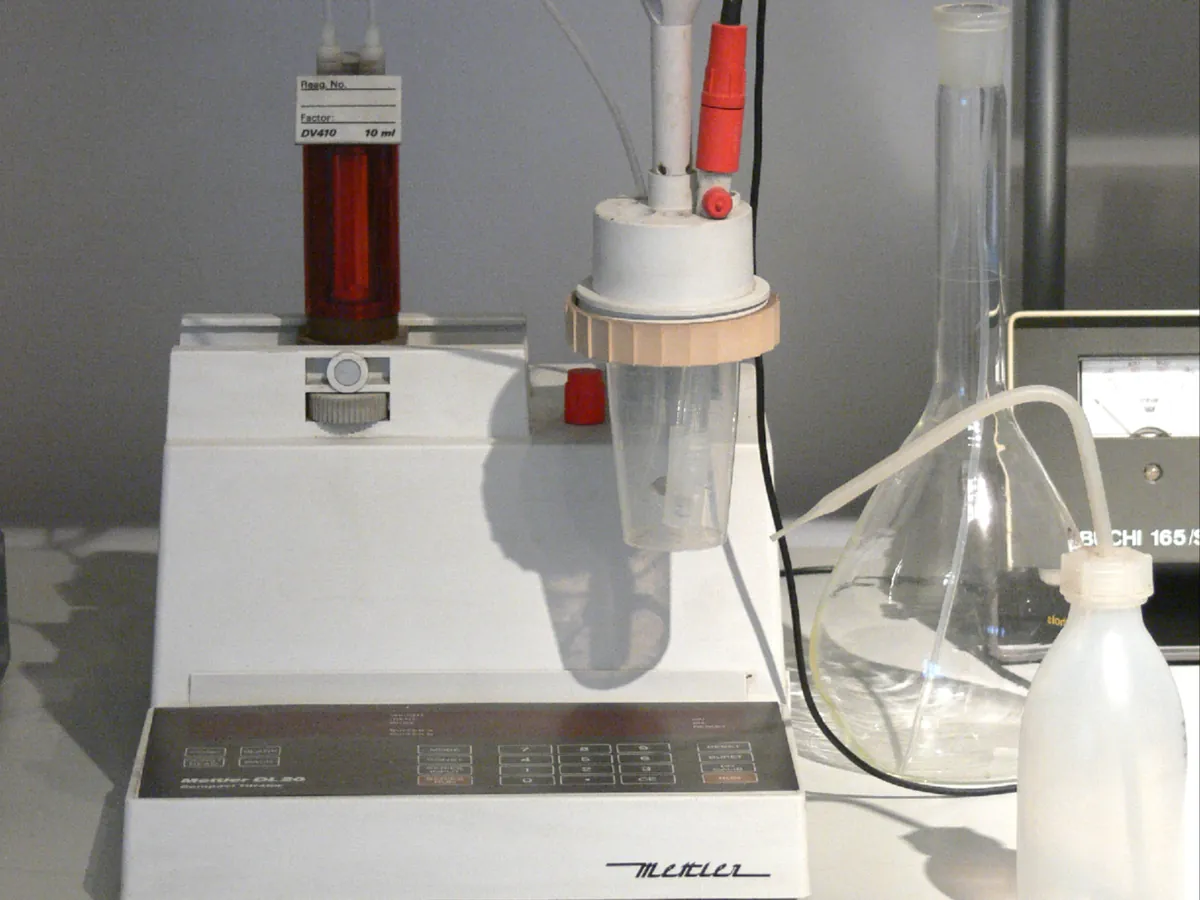
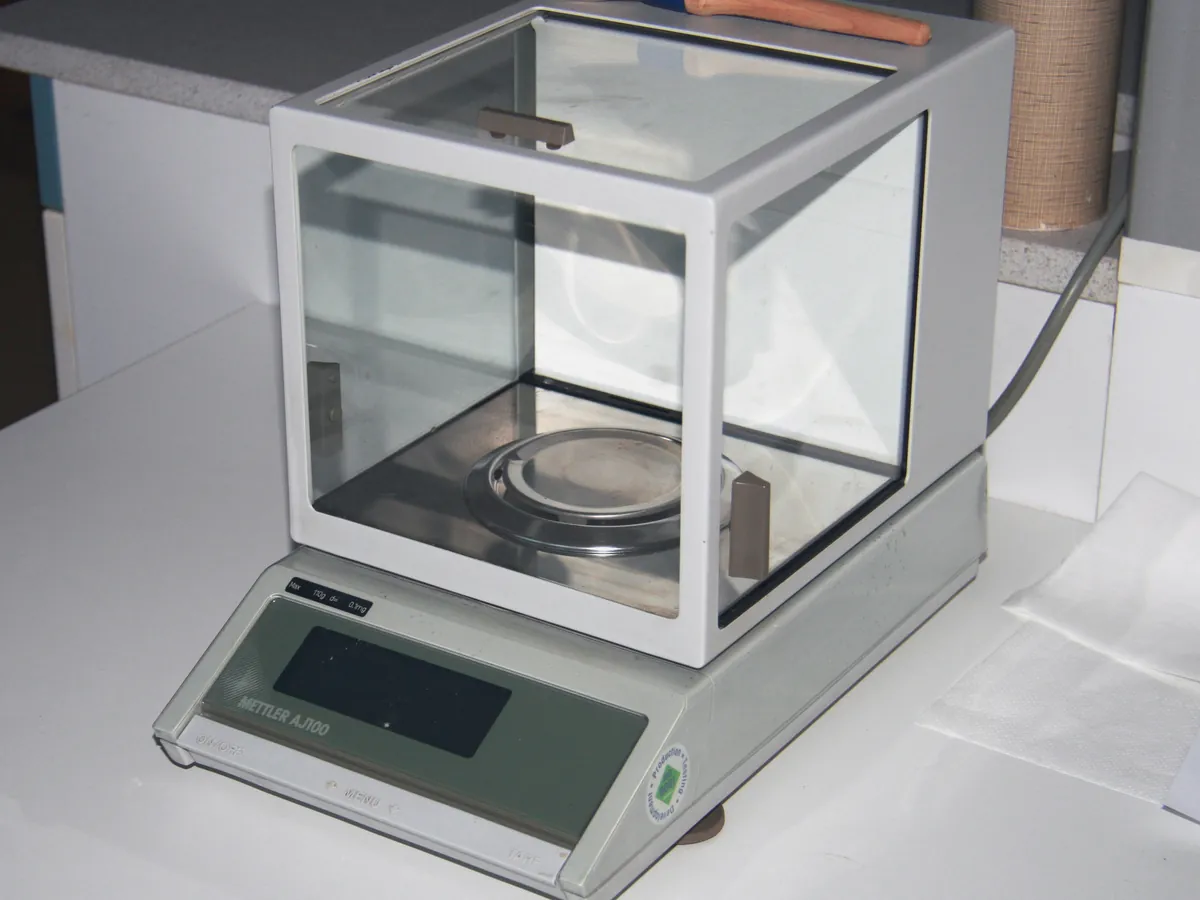
Reagents & standards
| Reagent | Grade / specification |
|---|---|
| 0.1 M sodium hydroxide | Volumetric solution, standardised against potassium hydrogen phthalate |
| Methanol | AR grade, neutralised if required by the method |
| pH buffers | pH 4.01, 7.00, 9.21 for electrode check |
Preparing the sample
- 01
Check system
Electrode check and current NaOH molarity.
- 02
Weigh
Weigh about 0.45 g of sample accurately.
- 03
Dissolve
Dissolve in 50 mL methanol with stirring.
- 04
Titrate
Titrate with 0.1 M NaOH to the equivalence point.
- 05
Blank
Titrate 50 mL methanol alone and subtract.
Procedure
- 1Accurately weigh about 0.450 g of the sample into a clean, dry titration beaker.
- 2Add 50 mL of methanol and stir until completely dissolved.
- 3Immerse the combined pH glass electrode and the burette tip in the solution.
- 4Titrate with standardised 0.1 M sodium hydroxide using dynamic dosing, and record the equivalence volume.
- 5Carry out a blank titration on 50 mL of methanol and record the blank volume.
- 6Analyse in duplicate (or as specified).
Standard preparation
- 1No reference standard is needed: the titrant is standardised against a primary standard (potassium hydrogen phthalate) and its molarity is used in the calculation.
Notes for analysts
- Protect the NaOH from atmospheric carbon dioxide with a soda-lime tube; carbonate makes the equivalence point less sharp.
- Choose the sample mass so the equivalence point falls at roughly 10–90% of the burette volume.
- If the method uses a colour indicator instead, results should agree within the method's precision.
Method parameters (typical)
| Titrant | 0.1 M NaOH (actual molarity from standardisation) |
|---|---|
| Electrode | Combined pH glass electrode suitable for non-aqueous / mixed solvents |
| Burette | 20 mL |
| Dosing | Dynamic, with small increments near the equivalence point |
| Endpoint evaluation | Inflection point (maximum of dE/dV) |
| Solvent | Methanol, 50 mL |
| Sample mass | About 0.450 g |
System suitability & sequence
| Parameter | Limit |
|---|---|
| Electrode slope | Typically 95–105% of theoretical |
| Titrant standardisation | Within validity; %RSD of standardisation not more than 0.2% |
| Titration curve | One clear inflection at the expected volume |
Typical sequence
- 1Electrode check
- 2Blank (methanol) × 1
- 3Sample preparation 1
- 4Sample preparation 2
Calculation with a worked example
Where
- VS
- Volume of NaOH at the sample equivalence point (mL)
- VB
- Volume of NaOH consumed by the blank (mL)
- M
- Actual molarity of the NaOH (M)
- 20.63
- mg of ibuprofen equivalent to 1 mL of exactly 0.1 M NaOH (206.28 × 0.1)
- W
- Weight of sample taken (mg)
- LOD
- Loss on drying of the sample (%)
Given
- W
- 450.6 mg
- VS
- 21.86 mL
- VB
- 0.05 mL
- M
- 0.10043 M
- LOD
- 0.3%
Working
- Net volume = 21.86 − 0.05 = 21.81 mL
- Factor = 0.10043 ÷ 0.1 = 1.0043
- Ibuprofen found = 21.81 × 1.0043 × 20.63 = 451.88 mg
- As-is assay = 451.88 ÷ 450.6 × 100 = 100.28%
- Dried weight = 450.6 × (100 − 0.3) ÷ 100 = 449.25 mg
- Dried-basis assay = 451.88 ÷ 449.25 × 100 = 100.58%
Assay = 100.6% of C₁₃H₁₈O₂, calculated on the dried basis
What result passes
- Typically 98.5% to 101.0% on the dried basis for ibuprofen; use the limit in your approved specification.
Validation parameters (ICH Q2(R2))
| Parameter | Typical requirement |
|---|---|
| Specificity | Titration is not specific to the API; acidic impurities are titrated too, so purity is controlled together with a related-substances test |
| Accuracy | Recovery with a reference standard typically 99.0–101.0% |
| Precision | Repeatability %RSD typically not more than 0.5% (six determinations) |
| Linearity | Equivalence volume against sample mass over about 80–120% of the nominal mass, r ≥ 0.999 |
| Robustness | Solvent volume, stirring speed and dosing parameters |
Run this method in LimsPulse: specifications and STPs under version control, results calculated and checked against limits, and a signed Certificate of Analysis.