Tablet Hardness (Breaking Force) and Friability
Measures the force needed to break individual tablets and the percentage of weight lost when a sample of tablets is tumbled for 100 revolutions.
- Physical testing: breaking force tester and friabilator
- Hardness tester
- Friability tester
- Analytical balance
Reference: Typical procedure based on USP <1217> and <1216> and the equivalent Ph. Eur. chapters. Use the limits in your approved specification.
Why this method works
Breaking force is measured by squeezing each tablet across its diameter until it fractures. Friability is measured by tumbling a weighed sample of tablets in a rotating drum; chipped and abraded material is lost, and the weight loss shows how well the tablets resist handling.
Instruments used
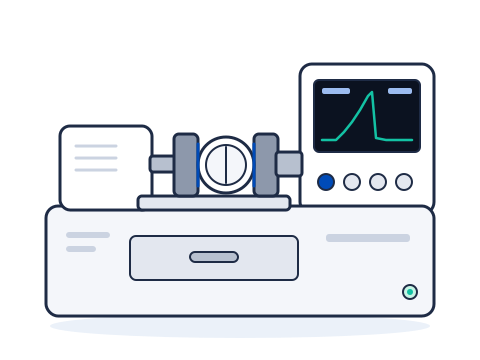


Reagents & standards
| Reagent | Grade / specification |
|---|---|
| Tablets | Sample from the batch as per the sampling plan |
| Soft brush or compressed air | For dedusting before weighing |
Preparing the sample
- 01
Hardness
Test 10 tablets one by one in the same orientation.
- 02
Friability sample
Take whole tablets weighing about 6.5 g (or 10 tablets if each is over 650 mg).
- 03
Dedust & weigh
Dedust and weigh the friability sample (W1).
- 04
Tumble
Rotate 100 times at 25 rpm.
- 05
Dedust & reweigh
Dedust again and weigh (W2).
Procedure
- 1Hardness: place each of 10 tablets between the jaws in the orientation stated in the procedure and record the breaking force in newtons.
- 2Calculate mean, minimum and maximum breaking force.
- 3Friability: for tablets with a unit weight up to 650 mg, take whole tablets as close as possible to 6.5 g; for heavier tablets, take 10 whole tablets.
- 4Dedust the tablets and weigh them accurately (W1).
- 5Place them in the drum and rotate 100 times (25 ± 1 rpm, 4 minutes).
- 6Remove the tablets, dedust them in the same way and weigh again (W2).
- 7Inspect for cracked, cleaved or broken tablets.
Notes for analysts
- Friability applies mainly to uncoated tablets; coated tablets are normally not tested this way.
- If tablets absorb moisture, weigh promptly and control the room humidity, or the result may show a weight gain.
- Hardness depends on orientation: always test scored or shaped tablets the same way.
- Hardness, friability, disintegration and dissolution are linked. A change in one is a reason to look at the others.
Method parameters (typical)
| Hardness sample | Commonly 10 tablets |
|---|---|
| Hardness units | Newtons (N); 1 kP ≈ 9.81 N |
| Friability drum speed | 25 ± 1 rpm |
| Revolutions | 100 |
| Friability sample | ≈ 6.5 g of whole tablets (unit weight ≤ 650 mg) or 10 tablets (unit weight > 650 mg) |
| Balance | Calibrated analytical balance, readability 1 mg or better |
System suitability & sequence
| Parameter | Limit |
|---|---|
| Hardness tester | Force calibration within due date; zero checked before use |
| Friability tester | Speed and count calibration within due date |
| Balance | Daily performance check passed |
Typical sequence
- 1Hardness on 10 tablets
- 2Friability on a separate sample
Calculation with a worked example
Where
- W1
- Weight of dedusted tablets before tumbling (g)
- W2
- Weight of dedusted tablets after tumbling (g)
- n
- Number of tablets tested for hardness
Given
- Tablet weight
- About 600 mg, so 11 tablets taken (≈ 6.6 g)
- W1
- 6.612 g
- W2
- 6.587 g
- Hardness (N)
- 92, 88, 95, 90, 86, 94, 91, 89, 93, 87
Working
- Weight loss = 6.612 − 6.587 = 0.025 g
- Friability = 0.025 ÷ 6.612 × 100 = 0.38%
- Sum of hardness values = 905 N; average = 905 ÷ 10 = 90.5 N
- Range = 86–95 N; 90.5 N ≈ 9.2 kP (90.5 ÷ 9.807)
Friability 0.38% (passes a typical NMT 1.0% limit, no broken tablets); average hardness 90.5 N (range 86–95 N).
Try it with your numbersWhat result passes
- Friability: maximum mean weight loss typically not more than 1.0% (from one test, or the mean of three tests where the chapter requires), and no cracked, cleaved or broken tablets.
- Hardness: within the product-specific range in the specification or batch record (there is no general pharmacopoeial limit).
Validation parameters (ICH Q2(R2))
| Parameter | Typical requirement |
|---|---|
| Applicability | Compendial physical tests; confirm suitability for the tablet shape (e.g. tilted drum for large tablets, orientation for scored tablets) |
| Precision | Consistent results between analysts on the same batch |
Run this method in LimsPulse: specifications and STPs under version control, results calculated and checked against limits, and a signed Certificate of Analysis.