Specific Optical Rotation (Raw Materials)
A solution of the substance is prepared at the concentration stated in the monograph, its optical rotation is measured in a polarimeter at 589 nm and the stated temperature, and the specific optical rotation is calculated on the dried (or anhydrous) basis.
- Polarimetry
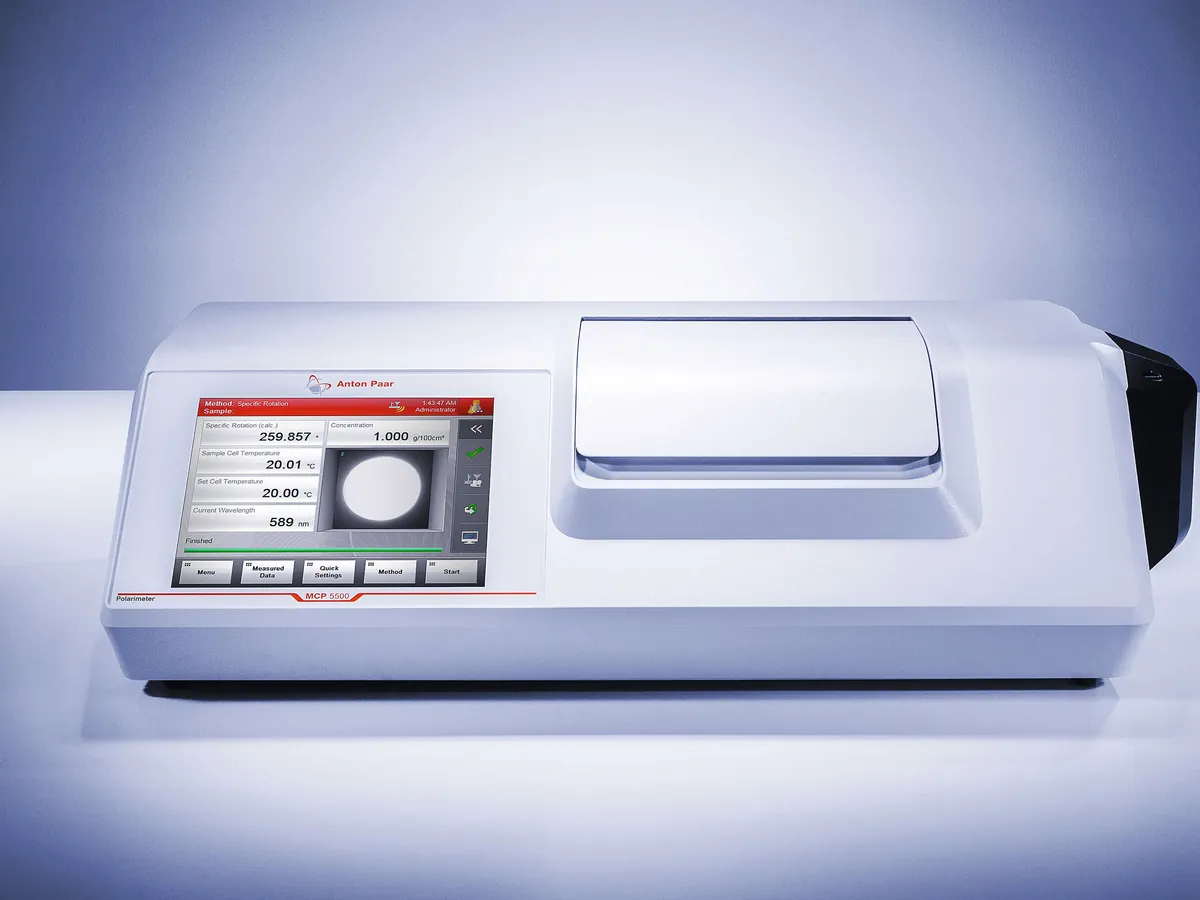
- Polarimeter
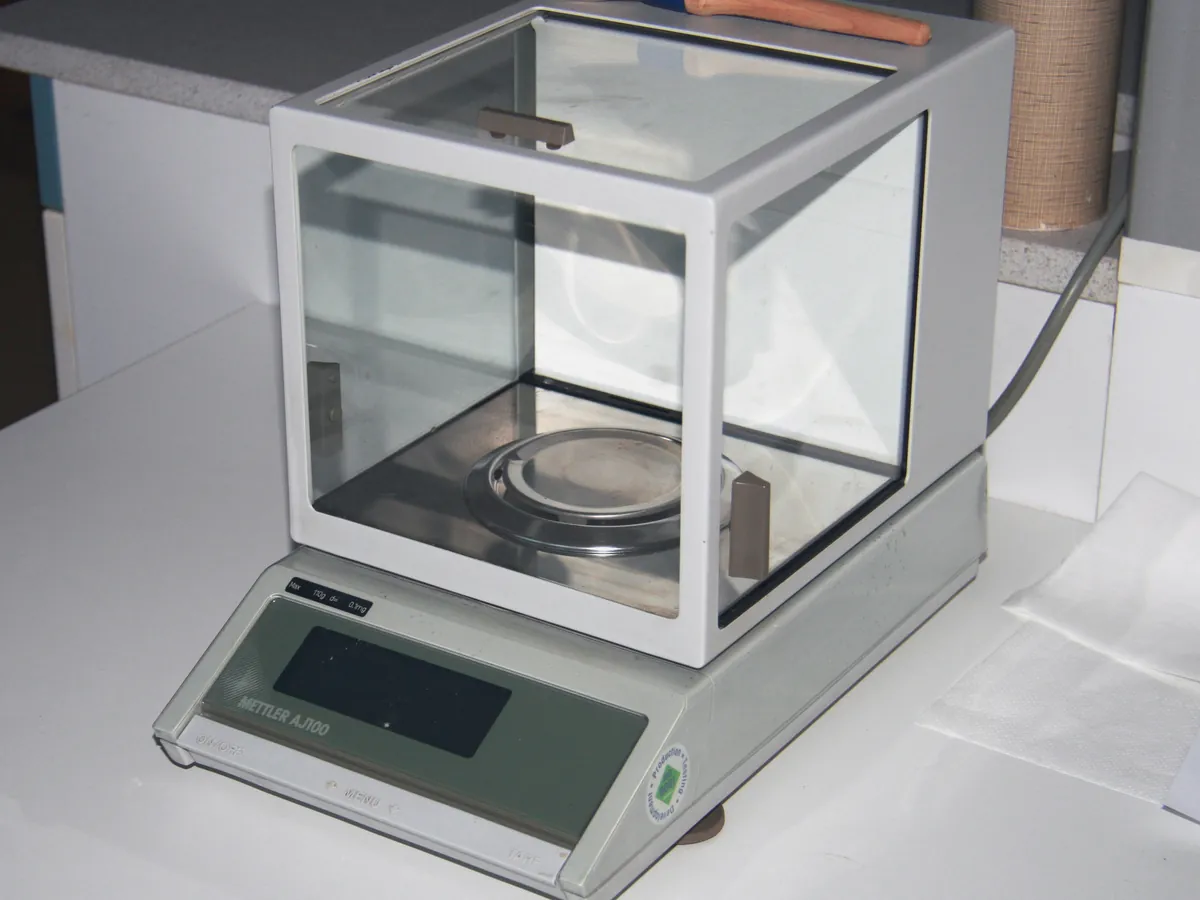
- Analytical balance
Reference: Typical method based on USP <781> and Ph. Eur. 2.2.7. Concentration, solvent, temperature and limits come from the monograph and your approved specification.
Why this method works
Chiral molecules turn the plane of polarised light. The observed angle α depends on the substance, the amount of it in the light path, the wavelength and the temperature. Dividing α by the tube length (in dm) and the concentration (in g per 100 mL) gives the specific optical rotation [α] = 100 × α ÷ (l × c). Because water or solvent in the sample adds weight but no rotation, the concentration is corrected to the dried or anhydrous basis using the loss on drying or water content result.
Instruments used
Reagents & standards
| Reagent | Grade / specification |
|---|---|
| Solvent | As stated in the monograph, e.g. purified water, methanol, ethanol, chloroform or a dilute acid or base |
| Quartz control plate | Certified plate for the system check before measurement (if your SOP requires) |
Preparing the sample
- 01
Weigh
Accurately weigh the sample quantity stated in the monograph.
- 02
Dissolve
Dissolve in the stated solvent in a volumetric flask and make up to volume at room temperature.
- 03
Equilibrate
Bring the solution to the measuring temperature (20 °C or 25 °C).
- 04
Blank
Zero the polarimeter with the solvent in the same tube.
- 05
Measure
Fill the tube with sample solution and record the mean rotation.
- 06
Calculate
Correct the concentration to the dried basis and calculate [α].
Procedure
- 1Weigh accurately about 1.0 g of the substance (or the amount stated in the monograph) into a 50 mL volumetric flask.
- 2Add about 30 mL of the stated solvent and dissolve, using gentle swirling or sonication if allowed. Make sure the solution is clear.
- 3Allow to reach room temperature, make up to volume with the solvent and mix well.
- 4Filter through a suitable membrane if the solution is not clear, discarding the first few millilitres.
- 5Measure within the time stated in the monograph (some substances change rotation on standing).
Standard preparation
- 1No reference standard is normally needed; the polarimeter scale is checked with a certified quartz plate.
- 2The solvent blank is used to zero the instrument or is subtracted from the sample reading.
Notes for analysts
- Always use the dried or anhydrous basis exactly as the monograph says (LOD or water by Karl Fischer).
- Use the same tube orientation for blank and sample.
- Check the tube for bubbles before reading; use the bubble trap.
- Specific rotation confirms identity and the correct enantiomer, but is not sensitive to small amounts of the other enantiomer; use chiral HPLC for enantiomeric purity.
Method parameters (typical)
| Wavelength | 589 nm (sodium D line) unless the monograph states another |
|---|---|
| Temperature | 20 ± 0.5 °C (Ph. Eur.) or 25 °C (USP), as stated in the monograph |
| Tube length | Usually 1 dm (100 mm) or 2 dm (200 mm) |
| Concentration | As stated in the monograph, e.g. 2 g per 100 mL |
| Readings | At least 5 readings per filling (or as your SOP requires); report the mean |
System suitability & sequence
| Parameter | Limit |
|---|---|
| Quartz plate check | Reading within the tolerance in your SOP of the certified value (if required before use) |
| Solvent blank | Close to 0.000°; used to zero or subtracted |
| Temperature | Within the stated range during measurement |
Typical sequence
- 1Quartz plate check (if required)
- 2Solvent blank — zero
- 3Sample solution — 5 readings
- 4Solvent blank — re-check at the end
Calculation with a worked example
Where
- [α]
- Specific optical rotation, in degrees, at the stated temperature and wavelength
- α
- Observed rotation of the sample, corrected for the blank, in degrees
- l
- Tube length in decimetres (dm)
- c
- Concentration in g per 100 mL, on the dried (or anhydrous) basis
- W
- Weight of sample taken, g
- V
- Volume of the solution, mL
- LOD
- Loss on drying (or water content) of the sample, %
Given
- Sample weight (W)
- 1.0012 g
- Volume (V)
- 50 mL
- Loss on drying
- 0.45%
- Mean sample reading
- +1.262°
- Solvent blank
- +0.012°
- Tube length (l)
- 2 dm (200 mm)
Working
- Blank-corrected rotation α = 1.262 − 0.012 = +1.250°
- Concentration as is = 1.0012 × 100 ÷ 50 = 2.0024 g/100 mL
- Dried-basis concentration c = 2.0024 × (1 − 0.0045) = 1.9934 g/100 mL
- [α] = 100 × 1.250 ÷ (2 × 1.9934) = 125.0 ÷ 3.9868 = +31.35°
Specific optical rotation = +31.4° (dried basis). Compare with the range in the monograph or specification.
Try it with your numbersWhat result passes
- [α] within the range stated in the monograph or approved specification (for example a range such as +30.0° to +33.0° — illustrative only).
- The sign (+ or −) must match the monograph.
Validation parameters (ICH Q2(R2))
| Parameter | Typical requirement |
|---|---|
| Approach | Pharmacopoeial method; verify suitability rather than fully validate |
| Instrument accuracy | Shown by quartz plate calibration |
| Precision | Repeat readings and, if required, duplicate preparations agree within your SOP limit |
| Robustness | Temperature and time after preparation controlled as the monograph states |
Run this method in LimsPulse: specifications and STPs under version control, results calculated and checked against limits, and a signed Certificate of Analysis.