Analytical balance · Calibration procedure
Daily performance check
A quick check before first use each day, weighing one or two calibrated weights to confirm the balance still reads correctly.
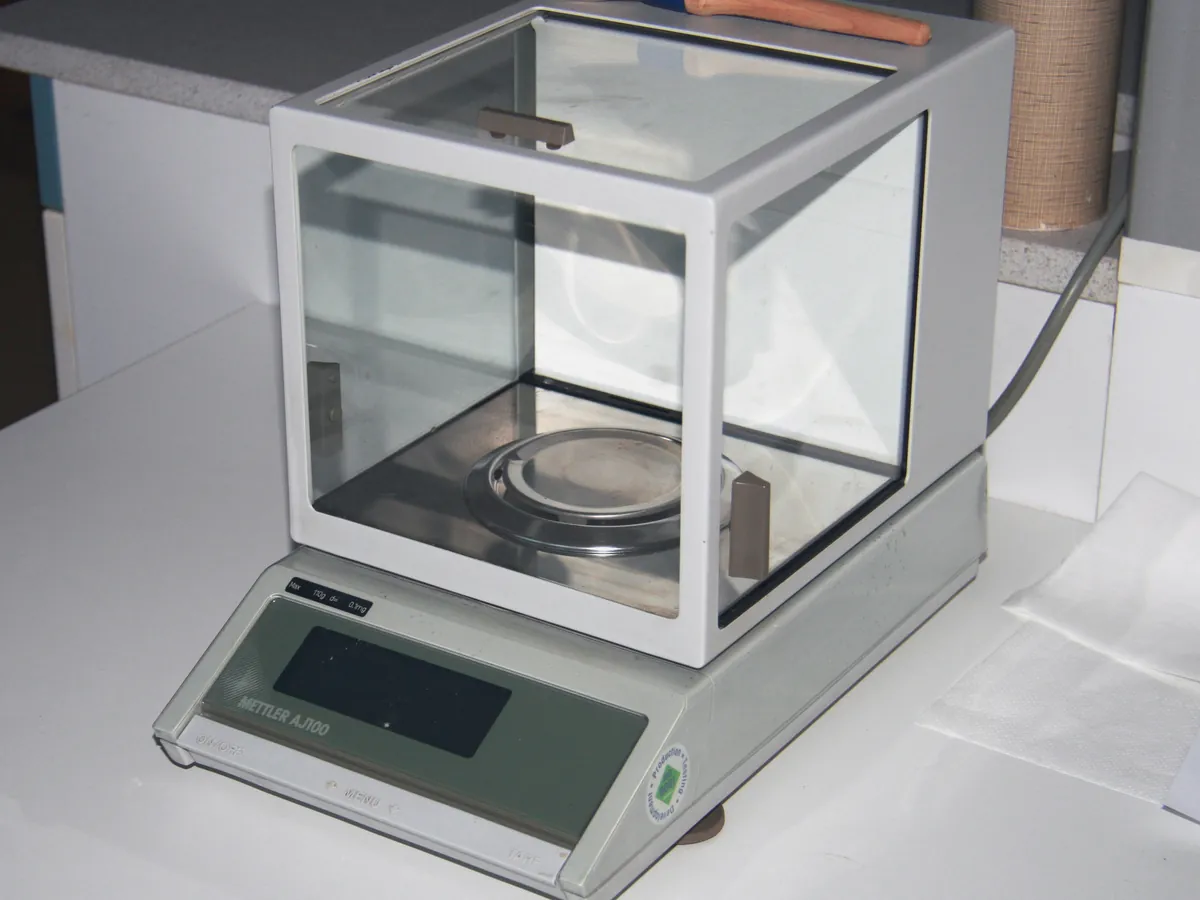
PURPOSE
Why this is checked
A balance can be knocked, moved or affected by a temperature change overnight. The daily check catches a problem before it affects any weighing done that day.
Frequency
Every day before first use (and after the balance has been moved or cleaned).
Learn how the Analytical balance worksYOU WILL NEED
Standards & tools
- Calibrated test weights, e.g. OIML class E2 or F1, with a valid certificate (commonly one small and one large weight, such as 20 g and 200 g)
BEFORE YOU START
Prerequisites
- Balance switched on and warmed up
- Balance level and pan clean
- Internal adjustment performed if the balance has one
- Weights at room temperature
PROCEDURE
Step by step
- 1Close the doors and zero the balance. Record that the display shows 0.0000 g.
- 2Using forceps, place the smaller test weight in the centre of the pan. Close the doors and record the stable reading.
- 3Remove the weight and confirm the reading returns to zero.
- 4Repeat with the larger test weight.
- 5Compare each reading with the certified value and record the result in the daily check log.
RECORD
Example observation table
| Test weight (g) | Observed (g) | Difference (g) | % error | Limit | Result |
|---|---|---|---|---|---|
| 0 (zero) | 0.0000 | 0.0000 | — | 0.0000 ± 0.0001 g | Pass |
| 20 | 20.0001 | +0.0001 | +0.0005% | ±0.05% | Pass |
| 200 | 200.0003 | +0.0003 | +0.00015% | ±0.05% | Pass |
CALCULATION
How to calculate the result
% error = (Observed − Certified value) ÷ Certified value × 100
- 20 g weight reads 20.0001 g
- Difference = 20.0001 − 20.0000 = 0.0001 g
- % error = 0.0001 ÷ 20 × 100 = 0.0005%
ACCEPTANCE CRITERIA
Pass if
- Each reading within the limit set in your SOP. Many labs use a tighter limit than the USP accuracy limit of 0.10% (for example ±0.05%) so that a drift is caught early.
- Zero returns to 0.0000 g after removing the weight.
IF IT FAILS
What to do
- Do not use the balance. Run the internal adjustment and repeat the check once.
- If it fails again, label it 'Out of order' and inform the supervisor and the calibration team.
- Assess weighings done since the last passing check.
MORE
Other Analytical balance calibrations
In LimsPulse · Calibration Management
LimsPulse schedules this calibration, records the result against limits, and blocks the instrument everywhere if it fails or goes overdue.