Particle Size Distribution by Laser Diffraction
Measures the volume-based size distribution of a powder by laser diffraction and reports D10, D50, D90 and span against the specification.
- Laser diffraction (wet or dry dispersion)
- Laser diffraction PSA
- Analytical balance
- Optical microscope
Reference: Typical approach based on USP <429> / Ph. Eur. 2.9.31 and ISO 13320. Always follow your approved specification and validated method.
Why this method works
The dispersed powder scatters laser light. Large particles scatter at small angles and small particles at wide angles. The instrument fits the measured scattering pattern with Mie (or Fraunhofer) theory to give the volume distribution of equivalent spheres. D10, D50 and D90 are read from the cumulative distribution and span describes its width.
Instruments used
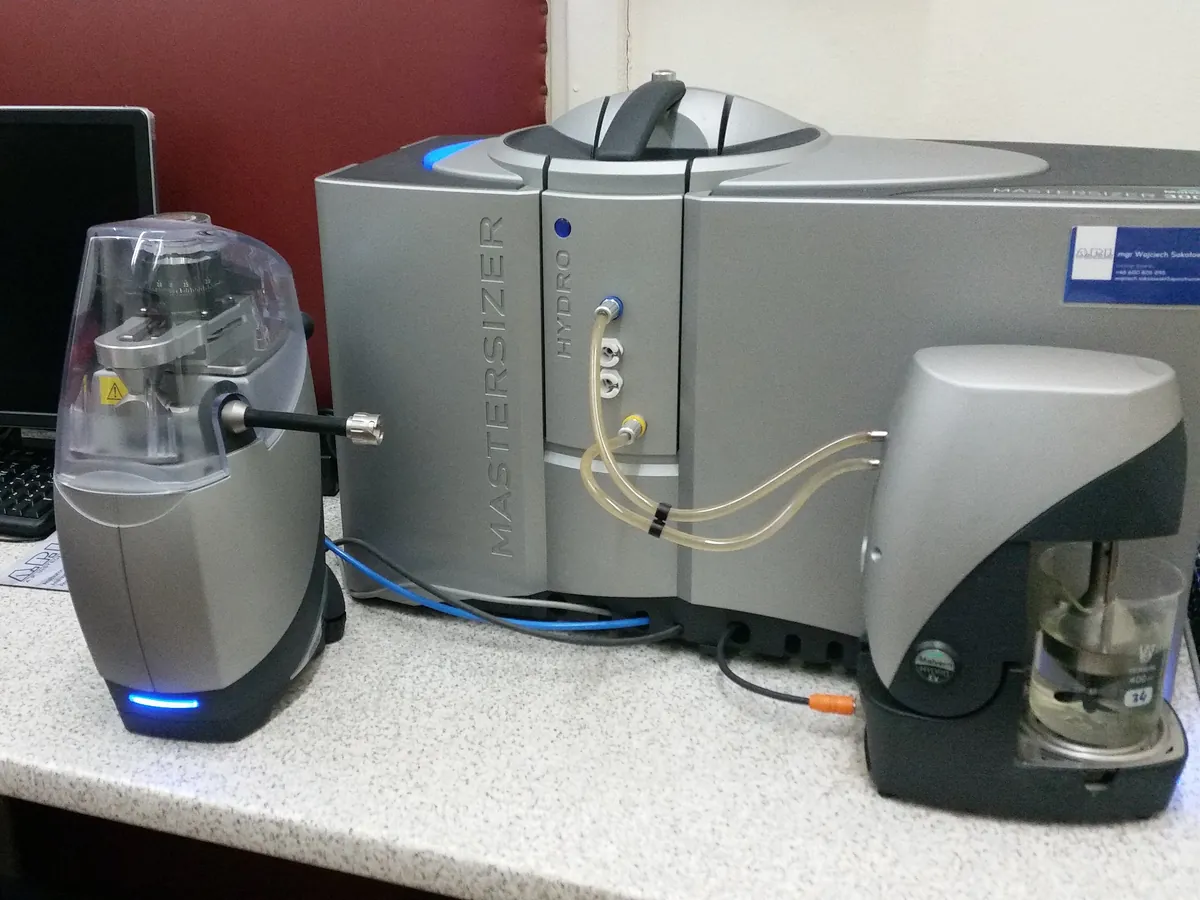
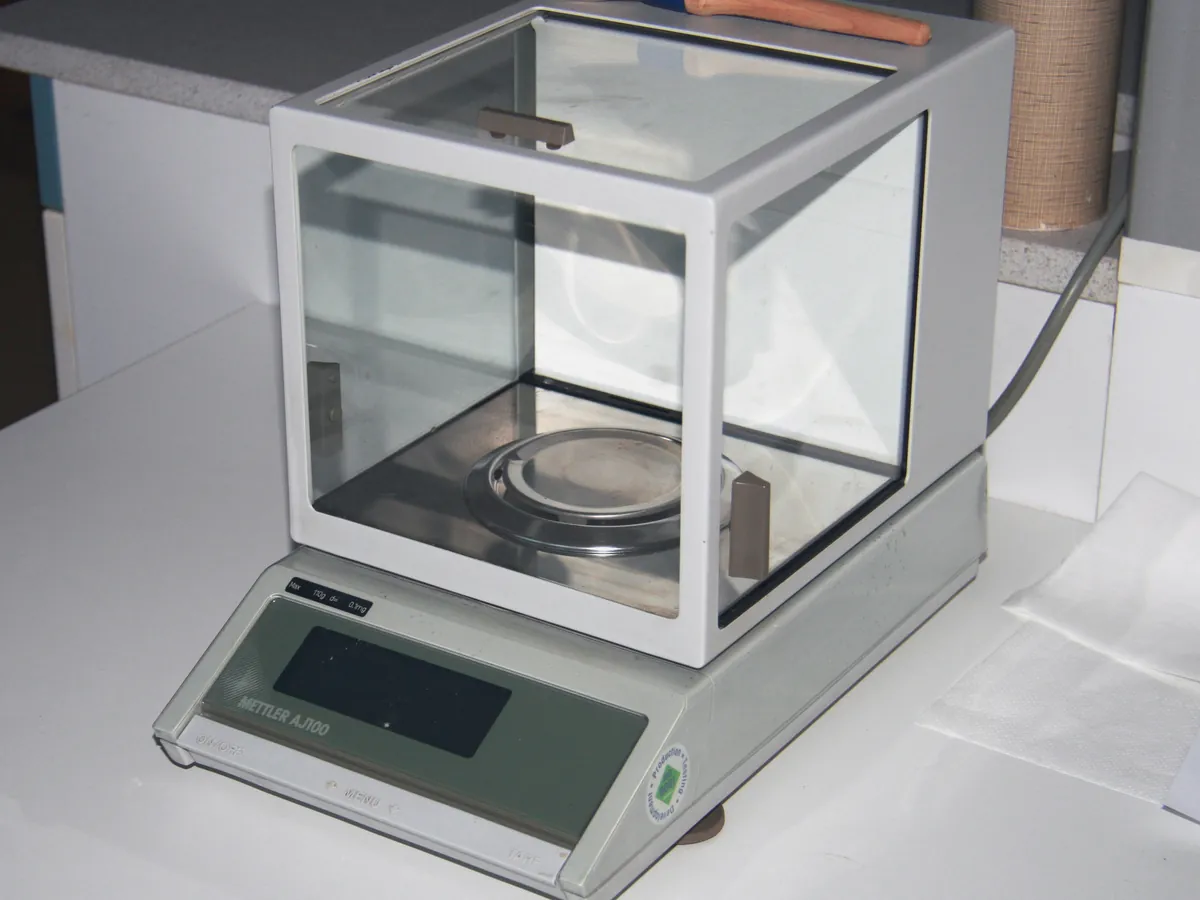
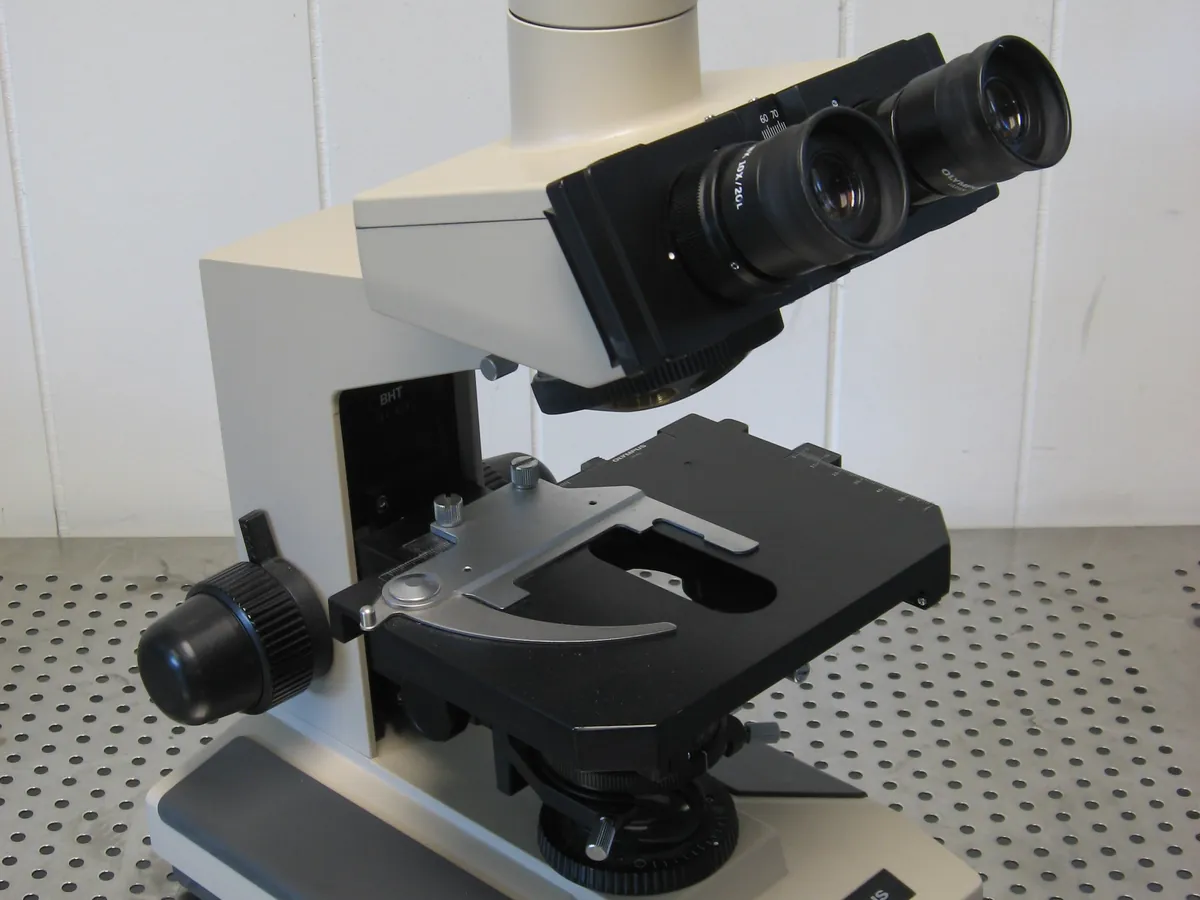
Reagents & standards
| Reagent | Grade / specification |
|---|---|
| Dispersant (wet method) | Liquid in which the sample does not dissolve, e.g. light liquid paraffin or a saturated aqueous solution, as per the validated method |
| Surfactant (if required) | e.g. a small amount of lecithin or polysorbate to help wetting |
| Compressed air (dry method) | Clean, dry and oil-free |
Preparing the sample
- 01
Sample
Take a representative sample with a riffler or by careful mixing.
- 02
Pre-disperse
For wet methods, wet the powder with a little dispersant to form a paste.
- 03
Add to unit
Add until obscuration is in the method range.
- 04
Disperse
Apply the stated sonication / stirring or air pressure for the set time.
- 05
Measure
Measure in replicate and check the trend.
- 06
Check visually
Look at the sample under a microscope if agglomerates are suspected.
Procedure
- 1Mix the container contents gently and sub-sample with a rotary riffler or spinning splitter where possible.
- 2Wet method: weigh about the amount stated (often 50–200 mg), wet it with a few drops of dispersant containing surfactant and mix to a smooth paste.
- 3Measure the background with clean dispersant.
- 4Add the sample until the obscuration is in range (e.g. 10–20% for wet methods; method-specific).
- 5Sonicate or stir for the validated time to break agglomerates without breaking primary particles.
- 6Measure three times and record D10, D50 and D90.
- 7Prepare and measure further sub-samples if the method requires (commonly two or three preparations).
Standard preparation
- 1No calibration standard is used in each run; instrument performance is shown by the periodic certified reference material check.
Notes for analysts
- Laser diffraction reports equivalent sphere sizes; needle-shaped crystals can give misleading results, so confirm shape by microscopy.
- Results from wet and dry methods, or from different instrument models, may differ; do not compare them directly without a bridging study.
- Span is a width measure; a span near 1 is a narrow distribution and above 2 a broad one.
Method parameters (typical)
| Optical model | Mie theory with the validated refractive index for the sample and dispersant (or Fraunhofer if justified) |
|---|---|
| Dispersion | Wet (stirred tank, stated stirrer speed and sonication) or dry (stated air pressure and feed rate) |
| Obscuration range | As validated, e.g. 10–20% (wet) or 0.5–6% (dry) |
| Measurement time | e.g. 10 s background and 10 s sample per measurement |
| Replicates | Three measurements per preparation |
| Results reported | D10, D50, D90 (µm); span |
System suitability & sequence
| Parameter | Limit |
|---|---|
| CRM check | Within its calibration due date |
| Background | Low and stable, within the instrument's limit |
| Repeatability of replicates | Typically %RSD ≤ 3% for D50 and ≤ 5% for D10 and D90 (wider limits may apply below 10 µm) |
Typical sequence
- 1Background measurement
- 2Preparation 1: three measurements
- 3Preparation 2: three measurements (if required)
- 4Clean unit and re-check background
Calculation with a worked example
Where
- D10
- Size below which 10% of the sample volume lies (µm)
- D50
- Volume median diameter: 50% of volume is below this size (µm)
- D90
- Size below which 90% of the sample volume lies (µm)
Given
- D10
- 12.4 µm
- D50
- 45.6 µm
- D90
- 118.2 µm
Working
- D90 − D10 = 118.2 − 12.4 = 105.8 µm
- Span = 105.8 ÷ 45.6 = 2.32
D10 = 12.4 µm, D50 = 45.6 µm, D90 = 118.2 µm, span = 2.32. Compare each with the specification (e.g. D90 not more than a stated limit).
What result passes
- As per the material specification, usually limits on D50 and D90 (and sometimes D10), e.g. 'D90 not more than 150 µm'. Limits are product-specific.
Validation parameters (ICH Q2(R2))
| Parameter | Typical requirement |
|---|---|
| Specificity / dispersion | Dispersant does not dissolve the sample; sonication or pressure titration shows agglomerates are broken without milling primary particles |
| Precision | Repeatability and intermediate precision, typically %RSD ≤ 3% at D50 and ≤ 5% at D10 and D90 |
| Robustness | Small changes to obscuration, stirrer speed, sonication time and refractive index |
| Sampling | Sub-sampling technique shown to give representative results |
Run this method in LimsPulse: specifications and STPs under version control, results calculated and checked against limits, and a signed Certificate of Analysis.