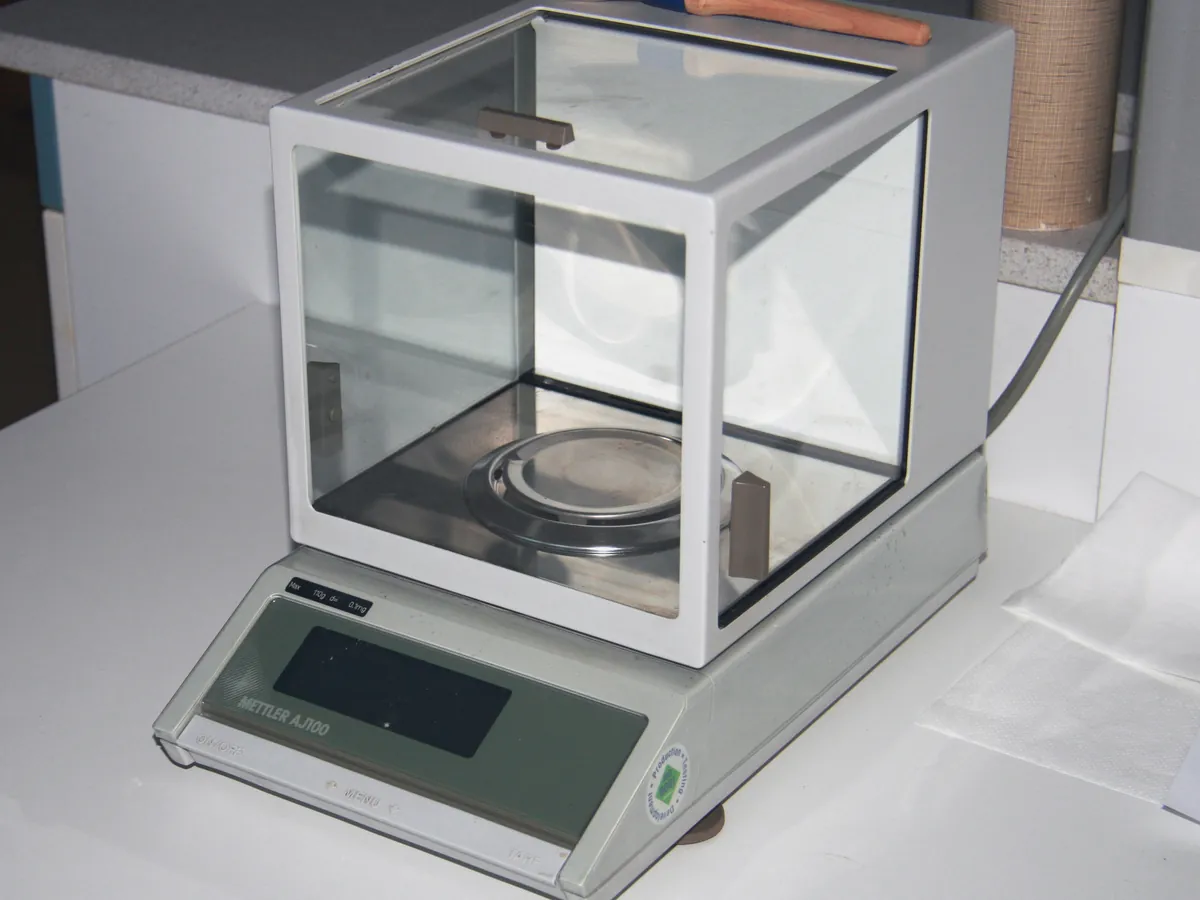
Analytical balance
Measures the mass of a sample very precisely, usually to 0.1 mg or 0.01 mg. Almost every quantitative test in a QC lab starts with a weighing, so the balance is the most used instrument in the lab.
- Pharmaceutical
- Biotech
- Chemicals
- Food & beverage
- Academic research
- Cosmetics
Test your Analytical balance knowledge
Multiple-choice questions
Pick an answer to see whether you are right and why.
Q1. A typical analytical balance has a readability of:
basicQ2. Why should the draught shield doors be closed before reading the weight?
basicQ3. A hot crucible straight from the oven is weighed. The reading will most likely be:
basicQ4. According to USP <41>, repeatability is satisfactory when:
intermediateQ5. In a repeatability test the standard deviation is 0.03 mg on a balance with d = 0.1 mg. Which value of s is used?
intermediateQ6. If s = 0.05 mg, the minimum weight (without safety factor) is:
intermediateQ7. Which test checks whether the reading changes when the load is placed off-centre?
advancedQ8. Why must the minimum weight be determined at the place where the balance is used?
advanced
Viva questions
Think of your answer first, then open it to compare.
1. What is the difference between readability and accuracy?
Readability is the smallest step the display shows (for example 0.1 mg). Accuracy is how close the reading is to the true mass. A balance can show many decimals and still be inaccurate if it is not calibrated or the environment is poor.
2. What is minimum weight and why do we apply a safety factor?
Minimum weight is the smallest net sample mass that can be weighed while keeping the weighing error within 0.10% (2000 × s under USP <41>). A safety factor, often 2 or 3, is applied because repeatability varies with conditions, different operators and containers, so the working minimum is set higher to give a margin.
3. Why should test weights be handled with forceps or gloves?
Fingerprints add oil and moisture, which change the weight's mass and can corrode its surface. Warmth from the hand also causes air currents. Both would make the calibration check wrong.
4. What is weighing by difference and when would you use it?
You weigh a closed container with the sample, transfer some sample out, and weigh the container again; the loss in mass is the amount transferred. It is used for hygroscopic or volatile samples, and when powder may stick to a weighing boat, because only the amount that actually left the container is counted.
Keep every Analytical balance in control: usage logs, calibration and maintenance schedules, and automatic blocking of overdue instruments.