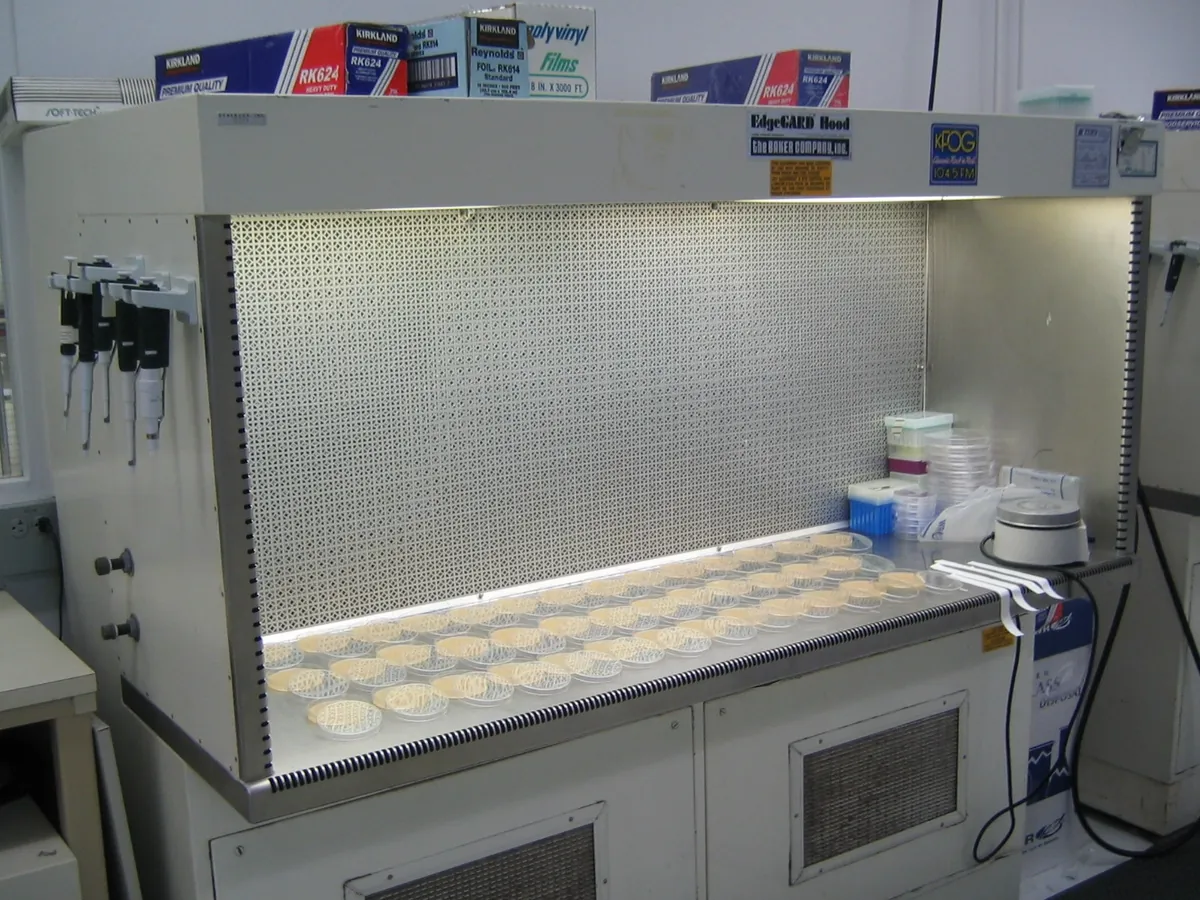
Laminar air flow unit (LAF)
A work station that blows HEPA-filtered air in a uniform, one-directional stream over the work surface to give an ISO 5 / Grade A zone for aseptic handling of media, samples and sterile materials.
- Pharmaceutical
- Biotech
- Hospitals and compounding pharmacies
- Electronics
- Food & beverage
- Research laboratories
What is LAF?
A laminar air flow unit draws room air through a pre-filter, pushes it with a fan into a plenum and then through a HEPA filter. The filtered air leaves the filter face as a uniform stream moving in one direction at a steady speed, usually around 0.45 m/s. This stream sweeps particles and microorganisms away from the work zone instead of letting them settle onto open plates or containers.
Units are either vertical (air flows down from the top onto the work surface) or horizontal (air flows from the back towards the operator). Both protect the product, but neither is designed to protect the operator. Work with pathogens or hazardous material needs a biosafety cabinet instead.
Under the EU GMP Annex 1 grading system, the working zone of a qualified LAF is expected to meet Grade A, which corresponds to ISO 5 for non-viable particles at rest and in operation. In a QC microbiology lab, LAF units are used for media pouring, sample dilution, microbial limit tests and, inside a clean room, sterility testing.
Used for
- Aseptic preparation and pouring of culture media plates
- Sample preparation and serial dilution for microbial limit tests
- Sterility testing, usually inside a Grade B clean room or isolator
- Handling of sterile components and filtration assemblies
- Growth promotion testing and culture handling of non-pathogenic reference strains
How it works
- 01
Pre-filter
Removes coarse dust from room air to protect and extend the life of the HEPA filter.
- 02
Fan / blower
Draws air in and pressurises the plenum behind the HEPA filter.
- 03
Plenum
Distributes air evenly over the whole back face of the filter.
- 04
HEPA filter
Removes particles and microorganisms from the air.
- 05
Work zone
Filtered air flows uniformly across the work surface in one direction, sweeping contamination away.
- 06
Exhaust
Air leaves the front of the unit into the room, carrying particles with it.
Advantages
- Provides a Grade A / ISO 5 work zone at relatively low cost
- Simple to use and to clean
- Continuous flushing of the work zone reduces the risk of contamination
- Performance can be verified by simple measurements (air velocity, particle count, filter integrity)
Limitations
- Does not protect the operator or the environment from the material handled
- Turbulence from fast hand movements, large objects or open doors can break the unidirectional flow
- Grade A conditions are only achieved inside the filtered air stream, not at the edges or outside the unit
- HEPA filters can be damaged by impact or liquid and need periodic integrity testing
- UV lamps, where fitted, only disinfect exposed surfaces and lose output with age
3 calibration procedures
Methods that use LAF
- Microbial Enumeration Test (TAMC / TYMC) by Plate Count
- Environmental Monitoring of Clean Areas (Viable)
- Growth Promotion Test of Culture Media
- Microbial Count of Pharmaceutical Water by Membrane Filtration
- Tests for Specified Microorganisms in Non-Sterile Products
- Sterility Test by Membrane Filtration or Direct Inoculation
- Bacterial Endotoxins Test (LAL) by Kinetic Chromogenic Method
Keep every LAF in control: usage logs, calibration and maintenance schedules, and automatic blocking of overdue instruments.