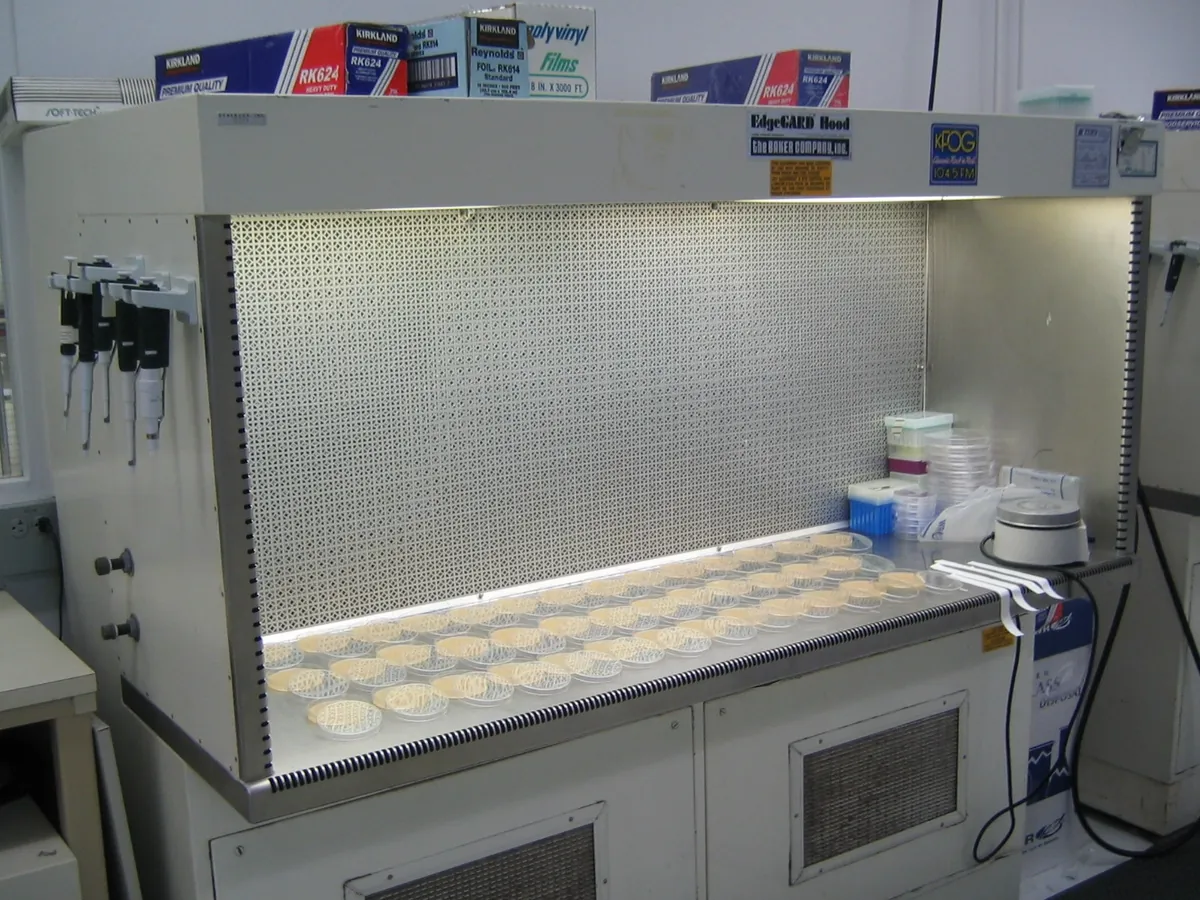
Laminar air flow unit (LAF)
A work station that blows HEPA-filtered air in a uniform, one-directional stream over the work surface to give an ISO 5 / Grade A zone for aseptic handling of media, samples and sterile materials.
- Pharmaceutical
- Biotech
- Hospitals and compounding pharmacies
- Electronics
- Food & beverage
- Research laboratories
Test your LAF knowledge
Multiple-choice questions
Pick an answer to see whether you are right and why.
Q1. What does a laminar air flow unit protect?
basicQ2. What is a typical air velocity at the working position of an LAF?
basicQ3. The work zone of a qualified LAF should meet which grade under EU GMP Annex 1?
basicQ4. What is the ISO 5 limit for particles ≥0.5 µm?
intermediateQ5. Which aerosol is commonly used for HEPA filter integrity (leak) testing?
intermediateQ6. A typical acceptance criterion for HEPA filter scan testing is penetration not more than:
intermediateQ7. The differential pressure across a HEPA filter has slowly risen over several months while velocity has fallen. The most likely cause is:
advancedQ8. What is meant by 'first air'?
advanced
Viva questions
Think of your answer first, then open it to compare.
1. Why should you not work in the LAF with the UV lamp on?
UV-C light damages the eyes and skin. The lamp is only for surface disinfection when the unit is not in use, and it should be switched off (often by interlock) before work starts.
2. Which tests are included in the periodic qualification of an LAF?
Air velocity and uniformity, HEPA filter integrity by aerosol challenge, non-viable particle count for ISO 5 / Grade A, and often an airflow visualisation (smoke) study, light and UV intensity. Viable monitoring is done routinely during use.
3. A Grade A settle plate in the LAF shows one colony. How should this be handled?
Under Annex 1, any growth in Grade A should be investigated. Identify the organism, review the session (technique, cleaning, airflow and HEPA status), check other EM data from the same time, and assess the impact on tests performed. Record it as an excursion and trend it.
Keep every LAF in control: usage logs, calibration and maintenance schedules, and automatic blocking of overdue instruments.