Laminar air flow unit (LAF)
A work station that blows HEPA-filtered air in a uniform, one-directional stream over the work surface to give an ISO 5 / Grade A zone for aseptic handling of media, samples and sterile materials.
- Pharmaceutical
- Biotech
- Hospitals and compounding pharmacies
- Electronics
- Food & beverage
- Research laboratories
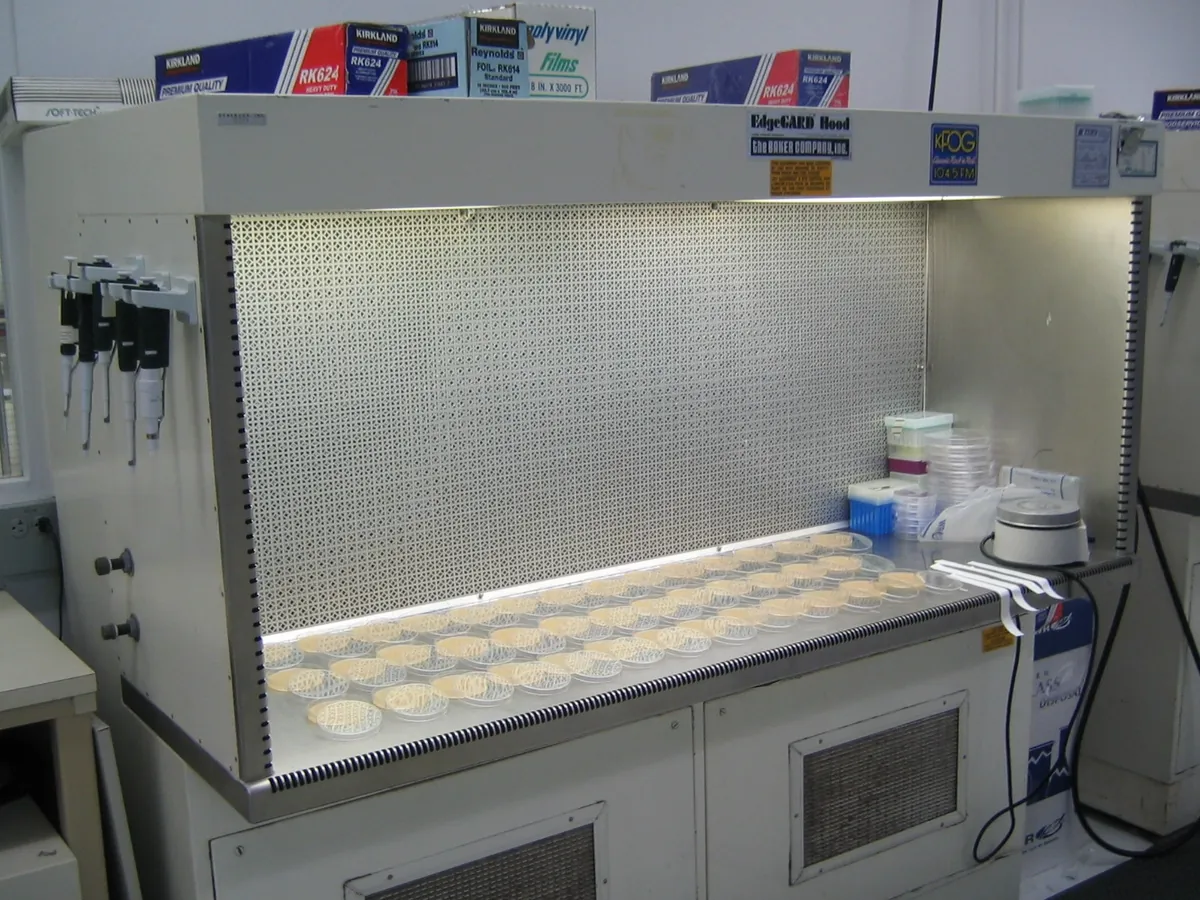
How LAF works
Room air is pre-filtered, pressurised by a fan and forced through a HEPA filter that removes at least 99.97% of particles of 0.3 µm (H14 filters retain at least 99.995% at their most penetrating particle size). The clean air leaves the filter face as a uniform, parallel stream at about 0.45 m/s, which carries away any particle released in the work zone before it can reach the product.
The path of a sample
- 01
Pre-filter
Removes coarse dust from room air to protect and extend the life of the HEPA filter.
- 02
Fan / blower
Draws air in and pressurises the plenum behind the HEPA filter.
- 03
Plenum
Distributes air evenly over the whole back face of the filter.
- 04
HEPA filter
Removes particles and microorganisms from the air.
- 05
Work zone
Filtered air flows uniformly across the work surface in one direction, sweeping contamination away.
- 06
Exhaust
Air leaves the front of the unit into the room, carrying particles with it.
Main parts and what they do
Cabinet body
Stainless-steel or powder-coated frame that houses the filters and fan and defines the work zone.
Pre-filter
Coarse filter (often G4 / ISO Coarse grade) at the air inlet that protects the HEPA filter.
Blower and motor
Centrifugal fan that moves air through the filters at the required velocity; often with speed control.
HEPA filter
Main filter (H13 or H14) that delivers particle-free air to the work zone, sealed in its frame with a gasket or gel seal.
Diffuser / protective grille
Protects the filter face from damage and helps give uniform airflow.
Work surface
Smooth stainless-steel surface that is easy to clean and disinfect.
Side panels and front sash
Glass or acrylic panels that reduce entrainment of room air into the work zone.
Magnehelic / differential pressure gauge
Shows the pressure drop across the HEPA filter; a rising reading indicates filter loading.
UV lamp (optional)
Germicidal lamp (about 254 nm) used to disinfect surfaces when the unit is not in use.
Fluorescent / LED lighting and controls
Lights the work zone and controls the fan, lamp and alarms.
Terms every analyst should know
Unidirectional airflow
Air moving in parallel streams at a uniform speed in a single direction. The older term is laminar flow.
HEPA filter
High-efficiency particulate air filter. Classes such as H13 and H14 (EN 1822) define minimum efficiency at the most penetrating particle size.
Air velocity
Typical guidance is 0.36–0.54 m/s (0.45 m/s ±20%) at the working position. Too low a velocity fails to sweep particles away; too high causes turbulence.
Grade A / ISO 5
The cleanest grade in EU GMP Annex 1. The ≥0.5 µm particle limit is 3,520 per m³, and no viable microorganisms are expected.
First air
Air coming directly from the HEPA filter that has not yet passed over any object or hand. Critical operations should be done in first air.
Vertical vs horizontal flow
Vertical units blow downward and are less affected by the operator's body; horizontal units blow towards the operator and give clear first air but direct it at the user.
Keep every LAF in control: usage logs, calibration and maintenance schedules, and automatic blocking of overdue instruments.