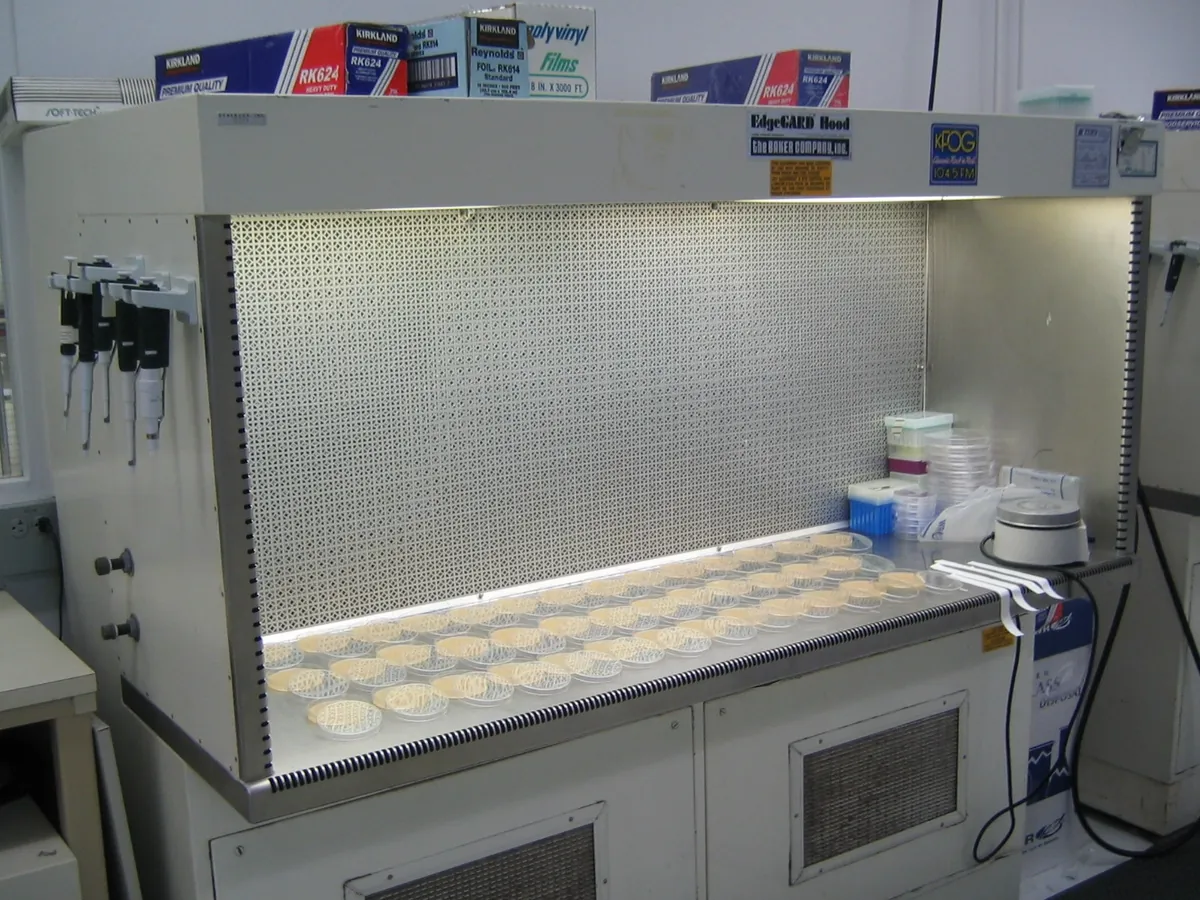
Laminar air flow unit (LAF)
A work station that blows HEPA-filtered air in a uniform, one-directional stream over the work surface to give an ISO 5 / Grade A zone for aseptic handling of media, samples and sterile materials.
- Pharmaceutical
- Biotech
- Hospitals and compounding pharmacies
- Electronics
- Food & beverage
- Research laboratories
LAF calibration procedures
Air velocity
Measures the speed of the filtered air at a grid of points across the filter face or working plane, using a calibrated anemometer, to confirm uniform unidirectional flow.
Open procedureHEPA filter integrity
Challenges the HEPA filter with an oil aerosol (PAO or DOP) upstream and scans the whole downstream face and seal with a photometer probe to detect leaks.
Open procedureNon-viable particle count
Counts airborne particles of ≥0.5 µm and ≥5.0 µm at defined locations in the work zone with a calibrated particle counter, to classify the unit as ISO 5 / Grade A.
Open procedureInstrument qualification (DQ · IQ · OQ · PQ)
- 01
DQ — Design qualification
Defines orientation (vertical or horizontal), work zone size, HEPA class, target air velocity, noise and lighting levels, and the cleanroom class required.
- 02
IQ — Installation qualification
Confirms the unit, filters, gauges and electrical supply are installed as specified, with filter certificates and a calibrated pressure gauge.
- 03
OQ — Operational qualification
Tests air velocity and uniformity, HEPA filter integrity by aerosol challenge, airflow visualisation (smoke study), particle count at rest, light, noise and UV intensity.
- 04
PQ — Performance qualification
Shows the unit maintains Grade A in use: particle counts in operation and viable monitoring (settle plates, contact plates, active air) over a defined period.
Keep every LAF in control: usage logs, calibration and maintenance schedules, and automatic blocking of overdue instruments.