UV-Visible Spectrophotometer
Measures how much ultraviolet or visible light a solution absorbs at each wavelength. Used in pharma QC for identification, assay, dissolution and many quick quantitative tests.
- Pharmaceutical
- Biotech
- Food & beverage
- Environmental
- Chemicals
- Academic research
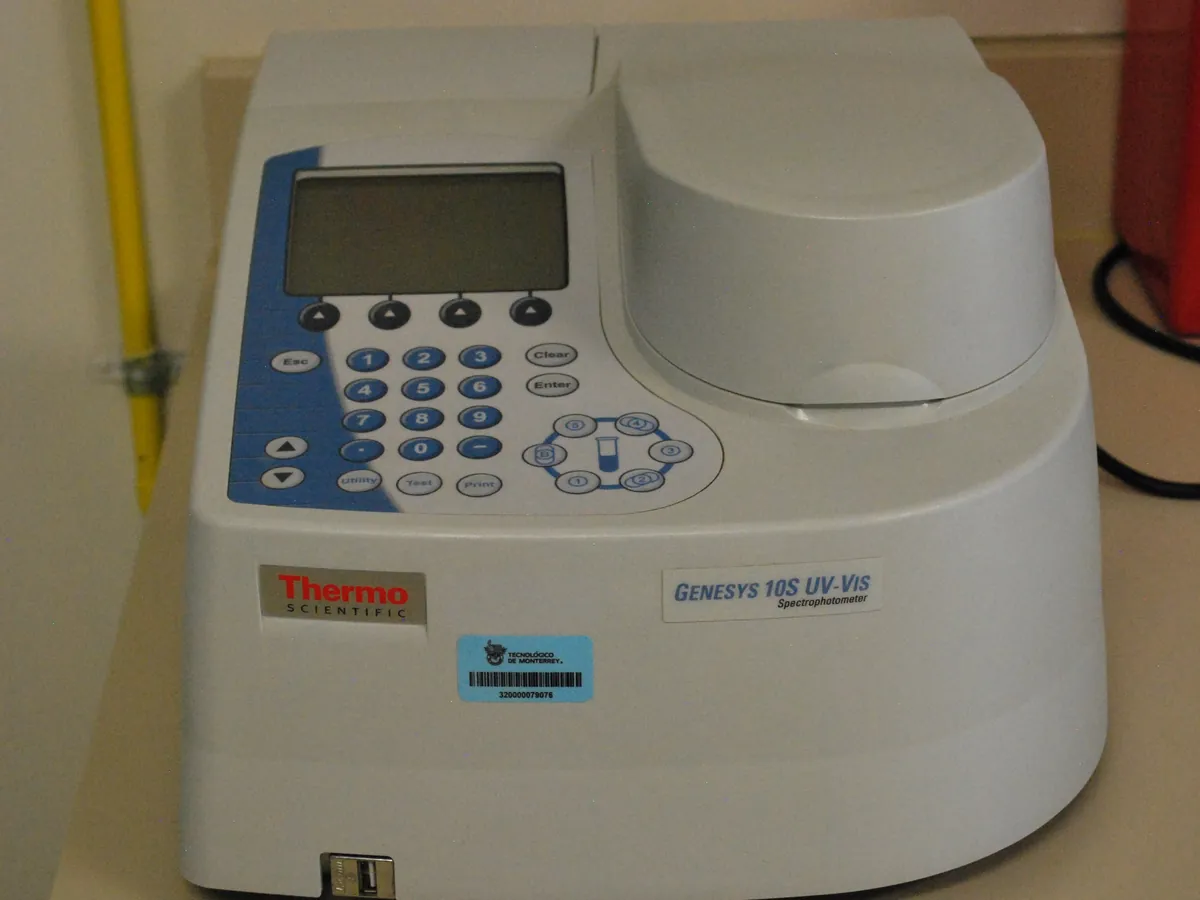
What is UV-Vis?
A UV-Vis spectrophotometer shines a beam of light through a sample held in a small transparent cell (a cuvette) and measures how much of the light gets through. Molecules with suitable groups of atoms (chromophores), such as aromatic rings and conjugated double bonds, absorb light at characteristic wavelengths between about 190 and 800 nm.
The instrument compares the light passing through the sample with the light passing through a blank (the solvent alone) and reports the result as absorbance. Because absorbance is proportional to concentration (the Beer–Lambert law), the same reading can be used to identify a substance from the shape of its spectrum or to measure how much of it is present.
In a pharmaceutical QC lab the UV-Vis is used for identification of raw materials, assay of APIs and simple formulations, dissolution testing, content uniformity, and colour or clarity-related absorbance tests. It is also the detector principle inside most HPLC systems.
Used for
- Identification of APIs and excipients by λmax and spectrum comparison
- Assay using a reference standard or a specific absorbance value
- Dissolution sample analysis
- Content uniformity of tablets and capsules
- Absorbance and colour limits in monographs (e.g. absorbance of a solution at a stated wavelength)
- Kinetic and stability studies
- Cleaning verification for strongly absorbing compounds
How it works
- 01
Light source
A deuterium lamp covers the UV (about 190–350 nm) and a tungsten-halogen lamp covers the visible range; the instrument switches between them automatically.
- 02
Monochromator
A diffraction grating and slits select a narrow band of wavelengths from the source.
- 03
Sample and reference
The selected light passes through the blank and the sample cuvette (alternately in a double-beam instrument).
- 04
Detector
A photomultiplier tube or photodiode measures the intensity of the transmitted light.
- 05
Signal processing
The software compares sample and blank intensities and calculates transmittance and absorbance.
- 06
Result
A single reading, a full spectrum (absorbance against wavelength) or a calibration-curve result is reported.
Advantages
- Fast, simple and inexpensive per test
- Good precision for quantitative work (typically better than 1% RSD)
- Non-destructive: the solution can often be reused
- Small sample volumes and easy method transfer
- Widely described in pharmacopoeial monographs
Limitations
- The analyte must absorb UV or visible light
- Low selectivity: anything else in the solution that absorbs at the same wavelength interferes
- Accurate only within the linear range (commonly about 0.2–1.0 absorbance for best precision)
- Solvent and cuvette choice limit the usable wavelength range (glass and plastic cells absorb below about 320 nm)
- Gives limited structural information compared with IR or NMR
5 calibration procedures
Methods that use UV-Vis
Keep every UV-Vis in control: usage logs, calibration and maintenance schedules, and automatic blocking of overdue instruments.