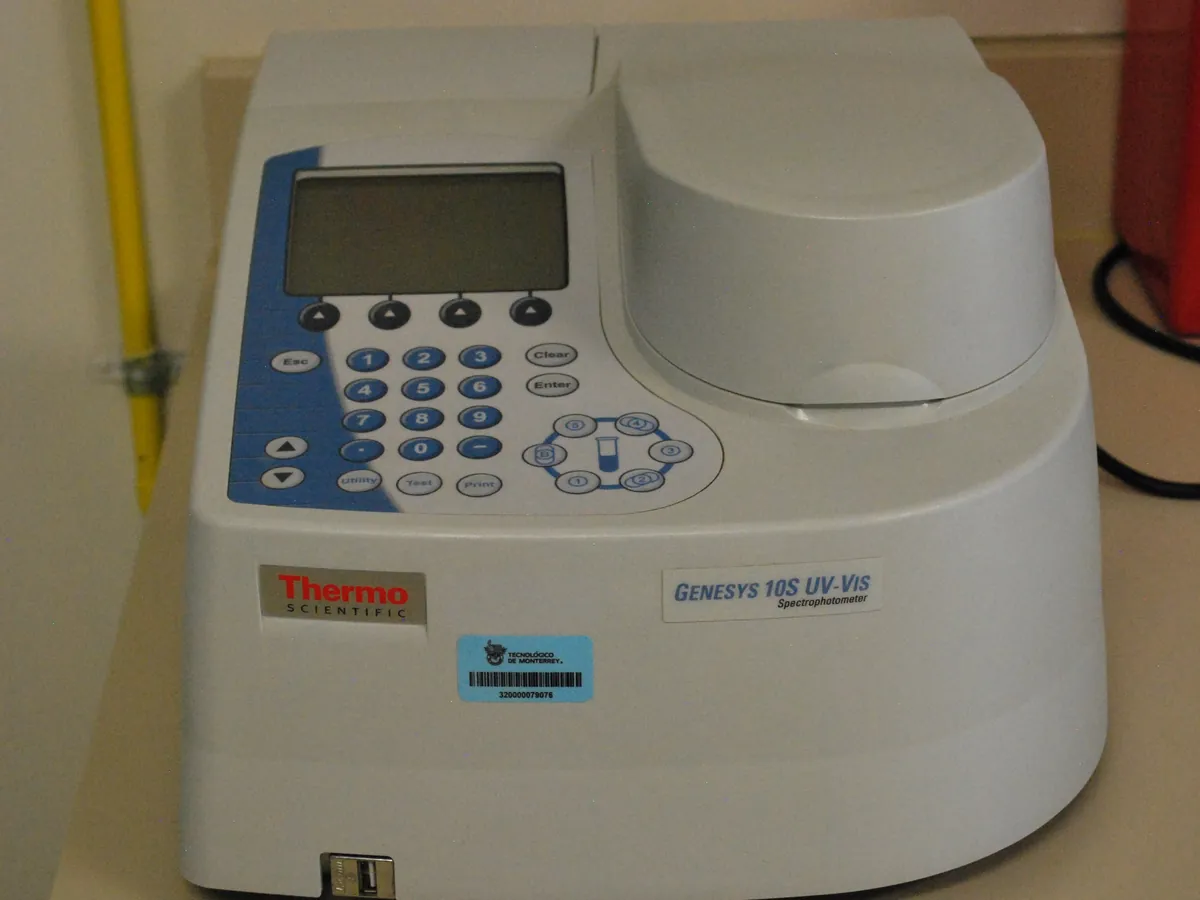
UV-Visible Spectrophotometer
Measures how much ultraviolet or visible light a solution absorbs at each wavelength. Used in pharma QC for identification, assay, dissolution and many quick quantitative tests.
- Pharmaceutical
- Biotech
- Food & beverage
- Environmental
- Chemicals
- Academic research
UV-Vis calibration procedures
Wavelength accuracy
Checks that the wavelength the instrument displays is the wavelength actually reaching the sample, using holmium oxide absorption bands and the instrument's own deuterium emission lines.
Open procedureAbsorbance accuracy
Checks that the absorbance reading is correct, by measuring a potassium dichromate solution of known concentration in dilute acid and comparing the specific absorbance with reference values.
Open procedureStray light
Measures how much unwanted light (light outside the selected band) reaches the detector, using a solution that blocks essentially all light at the test wavelength, such as potassium chloride at 198 nm.
Open procedureResolution
Checks the instrument's ability to separate closely spaced spectral features, using the ratio of the toluene absorbance maximum near 269 nm to the minimum near 266 nm.
Open procedurePhotometric linearity
Checks that absorbance rises in a straight line with concentration across the working range, using a series of potassium dichromate solutions.
Open procedureInstrument qualification (DQ · IQ · OQ · PQ)
- 01
DQ — Design qualification
Defines the user requirements (wavelength range, spectral bandwidth, single or double beam, compliant software) and confirms the chosen model meets them.
- 02
IQ — Installation qualification
Confirms the instrument, accessories, software version and documentation are received and installed correctly in a suitable location.
- 03
OQ — Operational qualification
Tests the instrument against specifications: wavelength accuracy and repeatability, absorbance accuracy, stray light, resolution, photometric linearity, noise and baseline flatness.
- 04
PQ — Performance qualification
Shows the instrument performs consistently for its intended use, for example by periodic checks with certified reference materials and system checks within the methods.
Keep every UV-Vis in control: usage logs, calibration and maintenance schedules, and automatic blocking of overdue instruments.