Spectroscopy
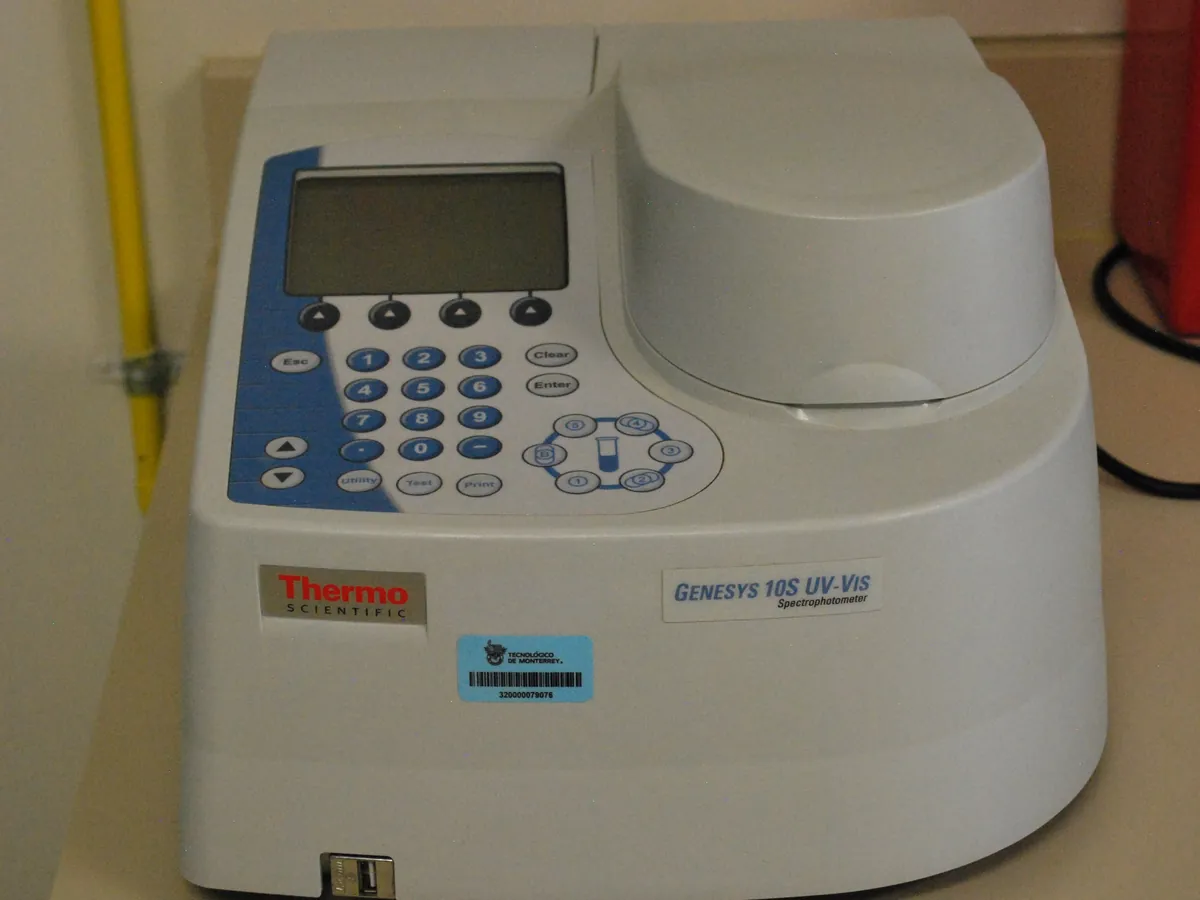
UV-Visible Spectrophotometer
Measures how much ultraviolet or visible light a solution absorbs at each wavelength. Used in pharma QC for identification, assay, dissolution and many quick quantitative tests.
- Pharmaceutical
- Biotech
- Food & beverage
- Environmental
- Chemicals
- Academic research
TROUBLESHOOTING
Common problems, causes and fixes
Noisy or drifting baseline
Likely causes
- • Lamps not fully warmed up
- • Deuterium lamp near end of life
- • Dirty optics or cuvette windows
- • Temperature changes in the room
What to do
- • Allow a longer warm-up
- • Check lamp energy and replace the lamp if low
- • Clean the cuvettes; get optics cleaned by service
- • Keep the instrument away from draughts and direct sunlight
Negative absorbance readings
Likely causes
- • Blank absorbs more than the sample
- • Baseline taken with a dirty or different cuvette
- • Cuvettes not matched
What to do
- • Prepare the blank from the same solvent lot
- • Repeat the baseline with clean cuvettes
- • Use a matched pair or always use the same cell
Results not reproducible
Likely causes
- • Cuvette placed in different orientations
- • Air bubbles or particles in the solution
- • Fingerprints on the optical faces
What to do
- • Mark the cuvette and always insert it the same way
- • Tap out bubbles; filter or centrifuge turbid solutions
- • Wipe the cuvette with lint-free tissue
Absorbance lower than expected at high concentration
Likely causes
- • Stray light at high absorbance
- • Solution outside the linear range
- • Chemical effects such as association at high concentration
What to do
- • Dilute so the reading falls in the linear range
- • Check stray-light performance
- • Use the dilution specified in the method
λmax shifted from the expected value
Likely causes
- • Wavelength calibration error
- • Wrong solvent or pH (many drugs shift with pH)
- • Contaminated sample
What to do
- • Run a wavelength accuracy check (holmium oxide or deuterium lines)
- • Check the solvent and pH specified in the monograph
- • Prepare a fresh solution
Very high or 'over-range' absorbance in the low UV
Likely causes
- • Solvent cut-off (solvent absorbs strongly)
- • Glass or plastic cuvette used in the UV
- • Lamp failure
What to do
- • Use a solvent with a suitable UV cut-off
- • Use quartz cuvettes below about 320 nm
- • Check lamp status and energy
In LimsPulse · Calibration Management
Keep every UV-Vis in control: usage logs, calibration and maintenance schedules, and automatic blocking of overdue instruments.