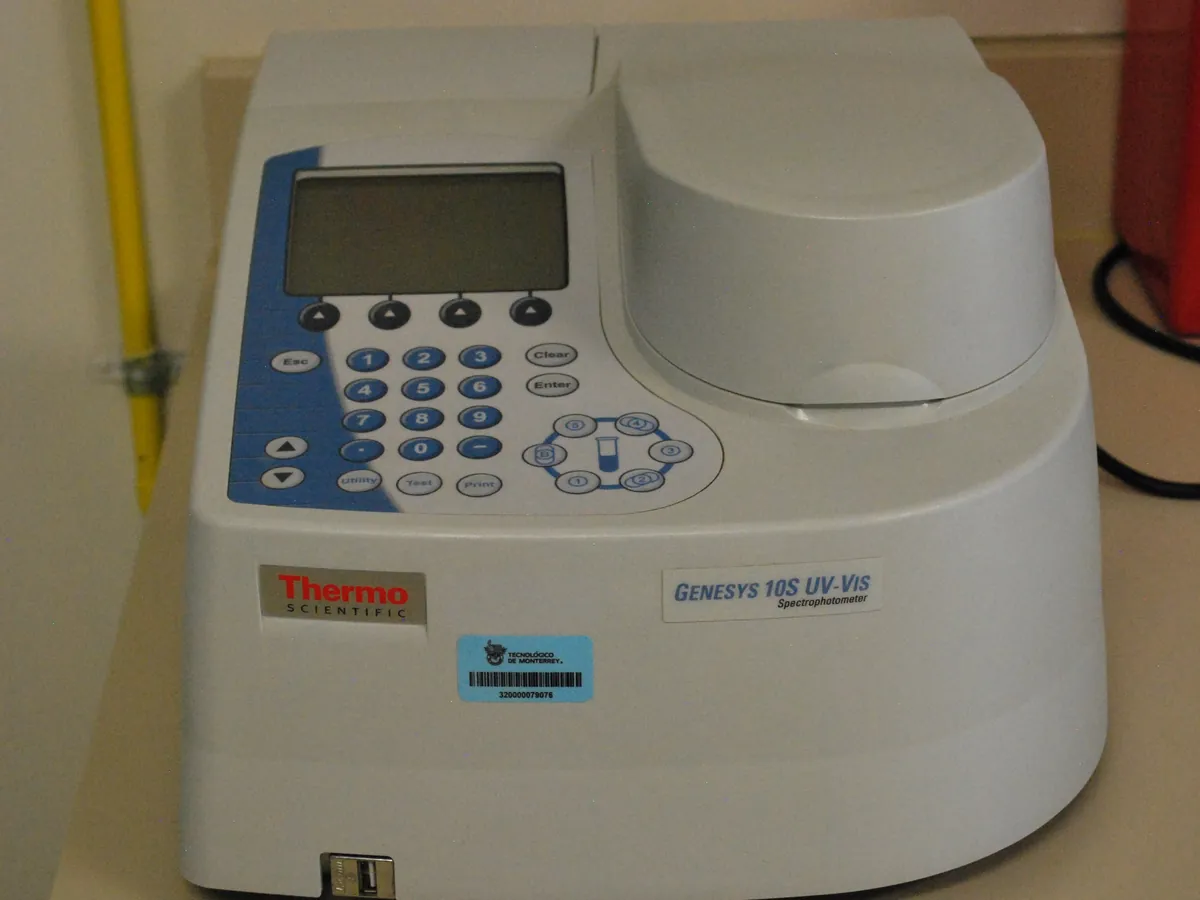
UV-Visible Spectrophotometer
Measures how much ultraviolet or visible light a solution absorbs at each wavelength. Used in pharma QC for identification, assay, dissolution and many quick quantitative tests.
- Pharmaceutical
- Biotech
- Food & beverage
- Environmental
- Chemicals
- Academic research
How UV-Vis works
When light passes through a solution, molecules absorb energy at wavelengths that match electronic transitions in their chromophores. The fraction of light absorbed depends on the substance, its concentration and the path length of the cell. The instrument measures the intensity of light with and without the sample and converts the ratio into absorbance.
The path of a sample
- 01
Light source
A deuterium lamp covers the UV (about 190–350 nm) and a tungsten-halogen lamp covers the visible range; the instrument switches between them automatically.
- 02
Monochromator
A diffraction grating and slits select a narrow band of wavelengths from the source.
- 03
Sample and reference
The selected light passes through the blank and the sample cuvette (alternately in a double-beam instrument).
- 04
Detector
A photomultiplier tube or photodiode measures the intensity of the transmitted light.
- 05
Signal processing
The software compares sample and blank intensities and calculates transmittance and absorbance.
- 06
Result
A single reading, a full spectrum (absorbance against wavelength) or a calibration-curve result is reported.
Main parts and what they do
Deuterium lamp
Continuous UV source, typically used from about 190 to 350 nm.
Tungsten-halogen lamp
Visible and near-IR source, typically used above about 340–350 nm.
Monochromator (grating and slits)
Disperses the light and selects a narrow band of wavelengths; the slit width sets the spectral bandwidth.
Beam splitter or chopper (double-beam)
Sends the light alternately through the reference and sample paths.
Cuvettes (cells)
Hold the solution in a fixed path length, usually 10 mm. Quartz or fused silica for UV work; glass or plastic only for the visible range.
Cell holder / sample compartment
Positions the cuvettes reproducibly in the beam; may be temperature-controlled.
Detector
Photomultiplier tube, silicon photodiode or diode array that converts light into an electrical signal.
Software
Controls scans and measurements, applies calculations and stores results with an audit trail.
Terms every analyst should know
Transmittance (T)
The fraction of incident light that passes through the sample: T = I / I₀. Often expressed as %T.
Absorbance (A)
A = −log₁₀ T = log₁₀ (I₀ / I). An absorbance of 1 means only 10% of the light gets through; 2 means only 1%.
Beer–Lambert law
A = ε × b × c, where ε is the molar absorptivity, b the path length (usually 1 cm) and c the concentration. Absorbance rises in a straight line with concentration within the linear range.
Specific absorbance A(1%, 1 cm)
The absorbance of a 1% w/v solution (1 g in 100 mL) in a 1 cm cell. Pharmacopoeias use it to identify or assay a substance without a reference standard: A(1%, 1 cm) = A ÷ (c × b), with c in g/100 mL.
λmax
The wavelength of maximum absorbance. Measuring at λmax gives the best sensitivity and least error from small wavelength shifts.
Single vs double beam
A single-beam instrument measures the blank and sample one after the other; a double-beam instrument splits the light and measures both continuously, which compensates for lamp drift.
Spectral bandwidth
The width of the band of wavelengths reaching the sample, set by the slit. A narrower bandwidth gives better resolution of fine spectral features.
Keep every UV-Vis in control: usage logs, calibration and maintenance schedules, and automatic blocking of overdue instruments.