UV-Vis · Calibration procedure
Photometric linearity
Checks that absorbance rises in a straight line with concentration across the working range, using a series of potassium dichromate solutions.
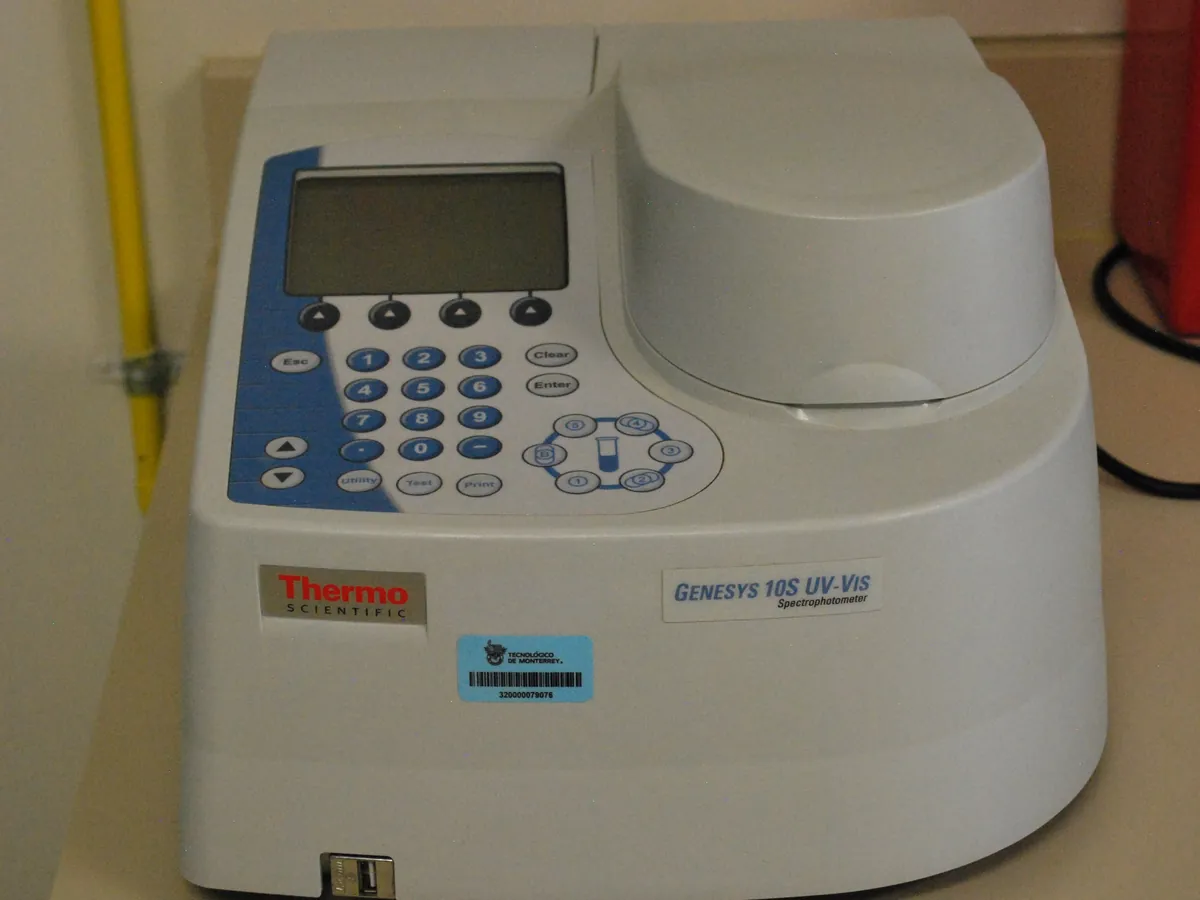
PURPOSE
Why this is checked
Most UV assays compare a sample with a single standard or use a specific absorbance value. Both assume the Beer–Lambert law holds over the range measured.
Frequency
Typically every 6 months (some labs quarterly), and after lamp replacement, major repair or relocation, as defined in your calibration SOP.
Learn how the UV-Vis worksYOU WILL NEED
Standards & tools
- Potassium dichromate solutions in 0.005 M sulfuric acid, at least five concentrations (e.g. 20, 40, 60, 80 and 100 mg/L)
- Or a set of certified neutral-density filters covering about 0.2 to 2 A
BEFORE YOU START
Prerequisites
- Wavelength and absorbance accuracy already passed
- Solutions prepared by accurate dilution of one stock with Class A glassware
PROCEDURE
Step by step
- 1Zero the instrument with the acid blank at 350 nm (or the wavelength in your SOP).
- 2Measure each solution from the lowest to the highest concentration, rinsing the cuvette with the next solution each time.
- 3Plot absorbance against concentration and calculate the regression line and the correlation coefficient.
- 4Optionally check that the specific absorbance is constant at each level.
RECORD
Example observation table
| Concentration (mg/L) | Absorbance at 350 nm | A(1%, 1 cm) |
|---|---|---|
| 20 | 0.214 | 107.0 |
| 40 | 0.427 | 106.8 |
| 60 | 0.640 | 106.7 |
| 80 | 0.851 | 106.4 |
| 100 | 1.067 | 106.7 |
CALCULATION
How to calculate the result
Linear regression A = m × c + intercept; report the correlation coefficient r
- Using the five points above: slope m = 0.01065 A per mg/L, intercept = 0.0008
- r = 0.99999
- Specific absorbance stays between 106.4 and 107.0 at every level, confirming a straight-line response
ACCEPTANCE CRITERIA
Pass if
- Correlation coefficient r typically not less than 0.999 over the tested range.
- Where filters with certified values are used, each reading within its certified tolerance (as per your SOP).
IF IT FAILS
What to do
- Check solution preparation and cuvette cleanliness; repeat once if an error is documented.
- Check stray light, since high stray light causes curvature at the top of the range.
- Limit the working range in use or arrange service if it still fails.
MORE
Other UV-Vis calibrations
In LimsPulse · Calibration Management
LimsPulse schedules this calibration, records the result against limits, and blocks the instrument everywhere if it fails or goes overdue.