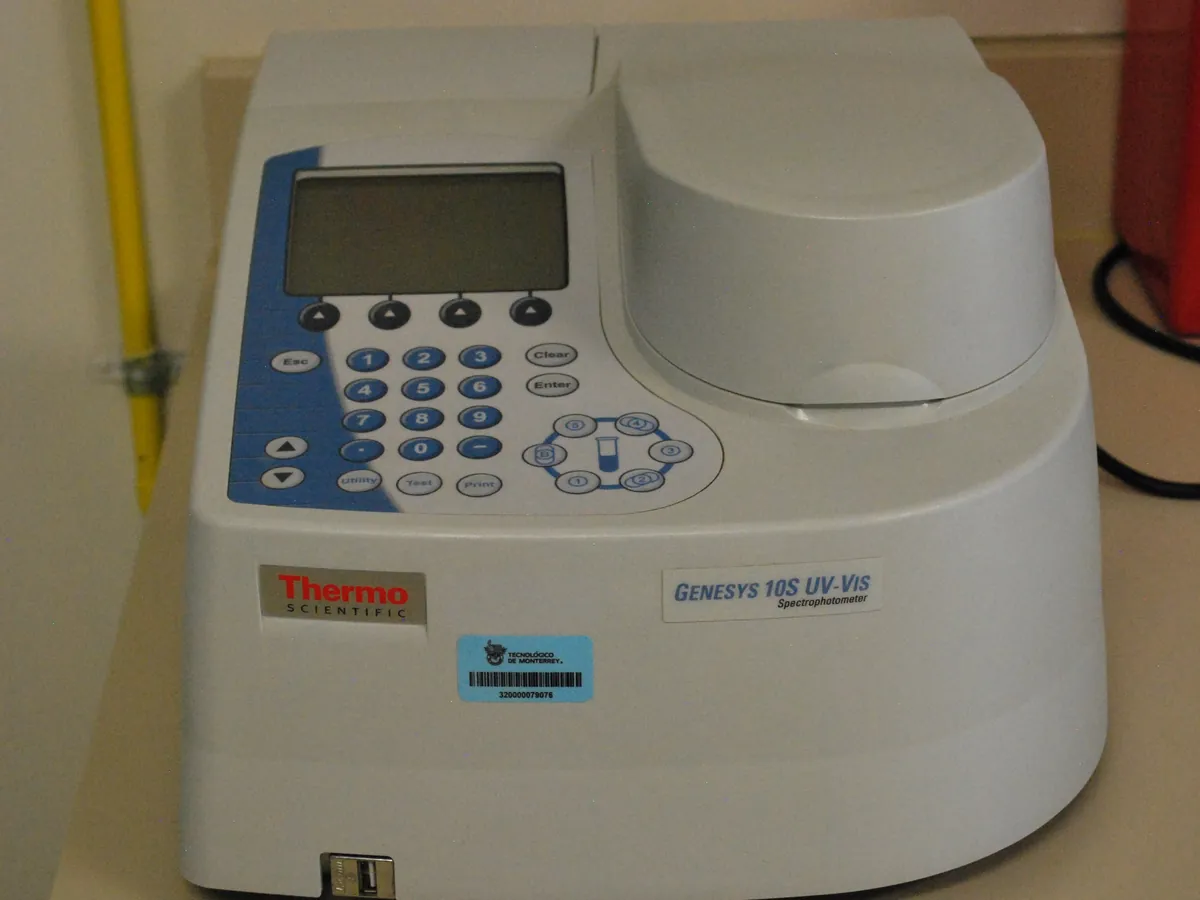
UV-Visible Spectrophotometer
Measures how much ultraviolet or visible light a solution absorbs at each wavelength. Used in pharma QC for identification, assay, dissolution and many quick quantitative tests.
- Pharmaceutical
- Biotech
- Food & beverage
- Environmental
- Chemicals
- Academic research
Test your UV-Vis knowledge
Multiple-choice questions
Pick an answer to see whether you are right and why.
Q1. Which lamp is normally used as the UV source in a UV-Vis spectrophotometer?
basicQ2. A solution transmits 10% of the incident light. What is its absorbance?
basicQ3. Which cuvette material should be used for measurements at 250 nm?
basicQ4. According to the Beer–Lambert law, if the concentration of a solution is doubled (same cell), its absorbance will:
intermediateQ5. Which standard is commonly used to check wavelength accuracy of a UV-Vis spectrophotometer?
intermediateQ6. The stray-light test with 12 g/L potassium chloride is carried out at about:
intermediateQ7. In the toluene-in-hexane resolution test, what is measured?
advancedQ8. A solution of 0.001 g/100 mL in a 1 cm cell has an absorbance of 0.715. What is its specific absorbance A(1%, 1 cm)?
advanced
Viva questions
Think of your answer first, then open it to compare.
1. State the Beer–Lambert law and explain each term.
A = ε × b × c. A is absorbance (no units), ε is the molar absorptivity (a constant for the substance at that wavelength, in L mol⁻¹ cm⁻¹), b is the path length of the cell (usually 1 cm) and c is the concentration (mol/L). It means absorbance is proportional to concentration, which is the basis of UV assays. It holds best for dilute solutions and monochromatic light.
2. Why do we measure at λmax?
At the absorbance maximum the sensitivity is highest and the absorbance changes very little if the wavelength setting is slightly off, because the curve is flat at the top. Measuring on the slope of a band makes results sensitive to small wavelength errors.
3. Name the calibration parameters of a UV-Vis spectrophotometer and the standard used for each.
Wavelength accuracy: holmium oxide solution or filter, and deuterium lines. Absorbance accuracy: potassium dichromate in dilute acid (or certified filters). Stray light: potassium chloride 12 g/L at 198 nm (and other cut-off solutions such as sodium iodide). Resolution: toluene 0.02% v/v in hexane. Photometric linearity: a series of potassium dichromate solutions or certified filters.
4. Why is stray light a problem at high absorbance values?
At high absorbance very little true light reaches the detector. Stray light (light of other wavelengths reaching the detector) then makes up a large share of the signal, so the instrument reports more light than really passed and the absorbance reads too low. This causes calibration curves to bend at the top and is worst in the low UV, where lamp energy is weakest.
Keep every UV-Vis in control: usage logs, calibration and maintenance schedules, and automatic blocking of overdue instruments.