UV-Vis · Calibration procedure
Wavelength accuracy
Checks that the wavelength the instrument displays is the wavelength actually reaching the sample, using holmium oxide absorption bands and the instrument's own deuterium emission lines.
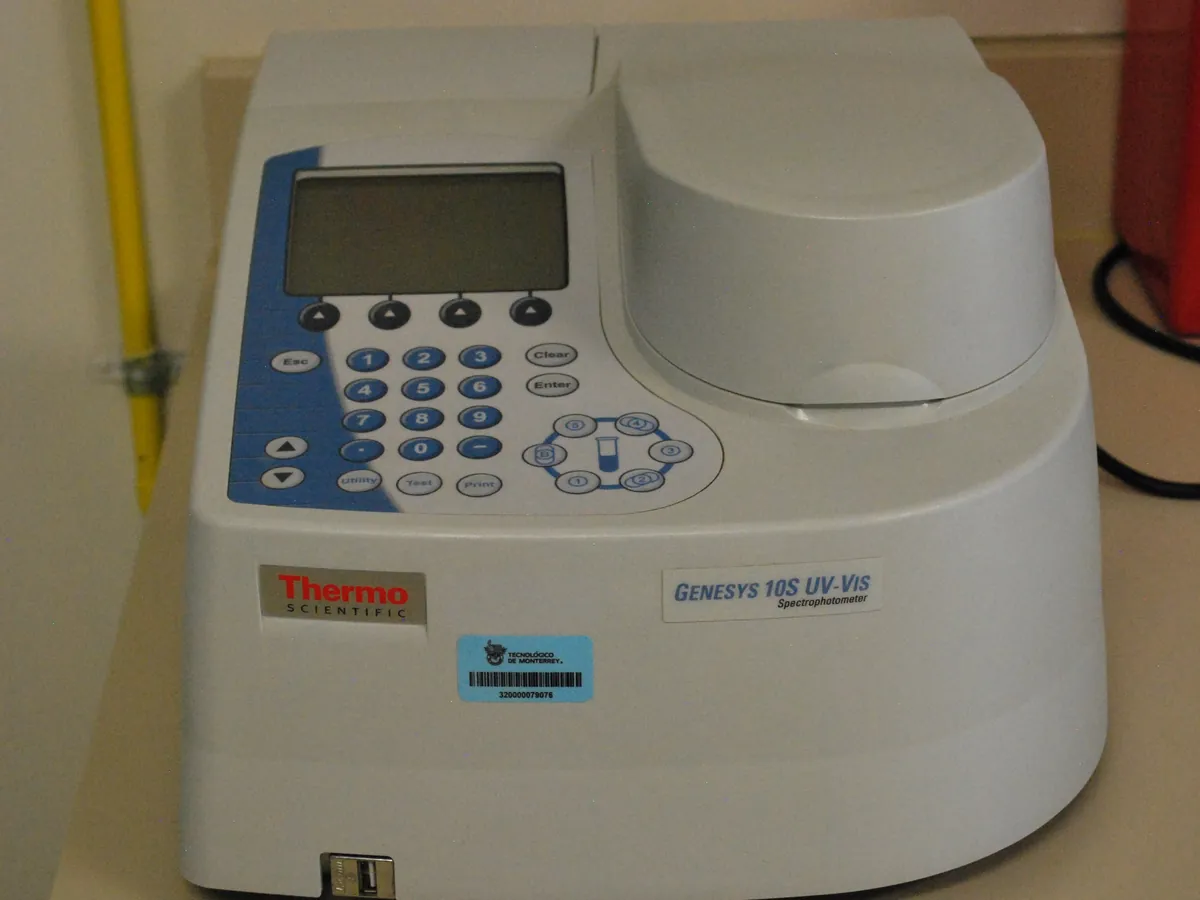
PURPOSE
Why this is checked
Identification tests compare λmax values and assays are measured at a fixed wavelength. If the wavelength scale is off, maxima appear in the wrong place and absorbance readings change, especially on the slope of a band.
Frequency
Typically every 6 months (some labs quarterly), and after lamp replacement, major repair or relocation, as defined in your calibration SOP.
Learn how the UV-Vis worksYOU WILL NEED
Standards & tools
- Holmium oxide (perchloric acid) solution in a sealed quartz cell, or a holmium oxide glass filter, with a certificate of traceable band positions
- Deuterium lamp emission lines (near 486.0 and 656.1 nm), used by the built-in check of most instruments
- Optionally a didymium filter or mercury lamp lines, as permitted by your SOP
BEFORE YOU START
Prerequisites
- Lamps warmed up as per the manufacturer (commonly at least 30 minutes)
- Sample compartment clean; reference CRM within its certificate validity
- Spectral bandwidth set as stated on the CRM certificate (e.g. 1 nm or less)
PROCEDURE
Step by step
- 1Record a baseline with air (or the blank supplied with the CRM) in the beam.
- 2Scan the holmium oxide solution or filter over about 230–650 nm at a slow scan speed and narrow bandwidth.
- 3Use the software's peak-pick function to find each absorption maximum.
- 4Run the deuterium-line check in energy (single-beam) mode and record the observed emission peaks.
- 5Compare each observed value with the certified value and calculate the difference.
- 6Repeat the scan (commonly three times) if your SOP also requires wavelength repeatability.
RECORD
Example observation table
| Standard | Certified value (nm) | Observed (nm) | Difference (nm) |
|---|---|---|---|
| Holmium oxide solution | 241.15 | 241.3 | +0.15 |
| Holmium oxide solution | 287.15 | 287.0 | −0.15 |
| Holmium oxide solution | 361.5 | 361.7 | +0.2 |
| Deuterium line | 486.0 | 486.2 | +0.2 |
| Holmium oxide solution | 536.3 | 536.0 | −0.3 |
| Deuterium line | 656.1 | 656.3 | +0.2 |
CALCULATION
How to calculate the result
Difference = Observed wavelength − Certified wavelength
- Holmium band certified at 361.5 nm, observed at 361.7 nm
- Difference = 361.7 − 361.5 = +0.2 nm
- Limit in the UV range is typically ±1 nm, so this band passes
ACCEPTANCE CRITERIA
Pass if
- Typically within ±1 nm in the ultraviolet range (about 200–400 nm).
- Typically within ±2 nm (USP) to ±3 nm (Ph. Eur.) in the visible range; apply the limit in the current chapter and your SOP.
- Repeatability (if tested): typically a range or standard deviation of not more than about 0.5 nm.
IF IT FAILS
What to do
- Label the instrument 'Out of calibration' and stop using it.
- Check that the bandwidth, scan speed and CRM match the certificate conditions; repeat once if a set-up error is found and documented.
- Get the wavelength scale recalibrated or the monochromator serviced by a trained engineer.
- Assess the impact on identification and assay results since the last passing calibration.
MORE
Other UV-Vis calibrations
In LimsPulse · Calibration Management
LimsPulse schedules this calibration, records the result against limits, and blocks the instrument everywhere if it fails or goes overdue.