Microplate reader
Measures absorbance, fluorescence or luminescence in the wells of 96- or 384-well plates. It is the read-out instrument for ELISA, protein assays, cell-based assays and enzyme kinetics.
- Biotechnology
- Biopharmaceutical
- Clinical research
- Academic research
- Food (allergen ELISA)
- Environmental (toxicity assays)
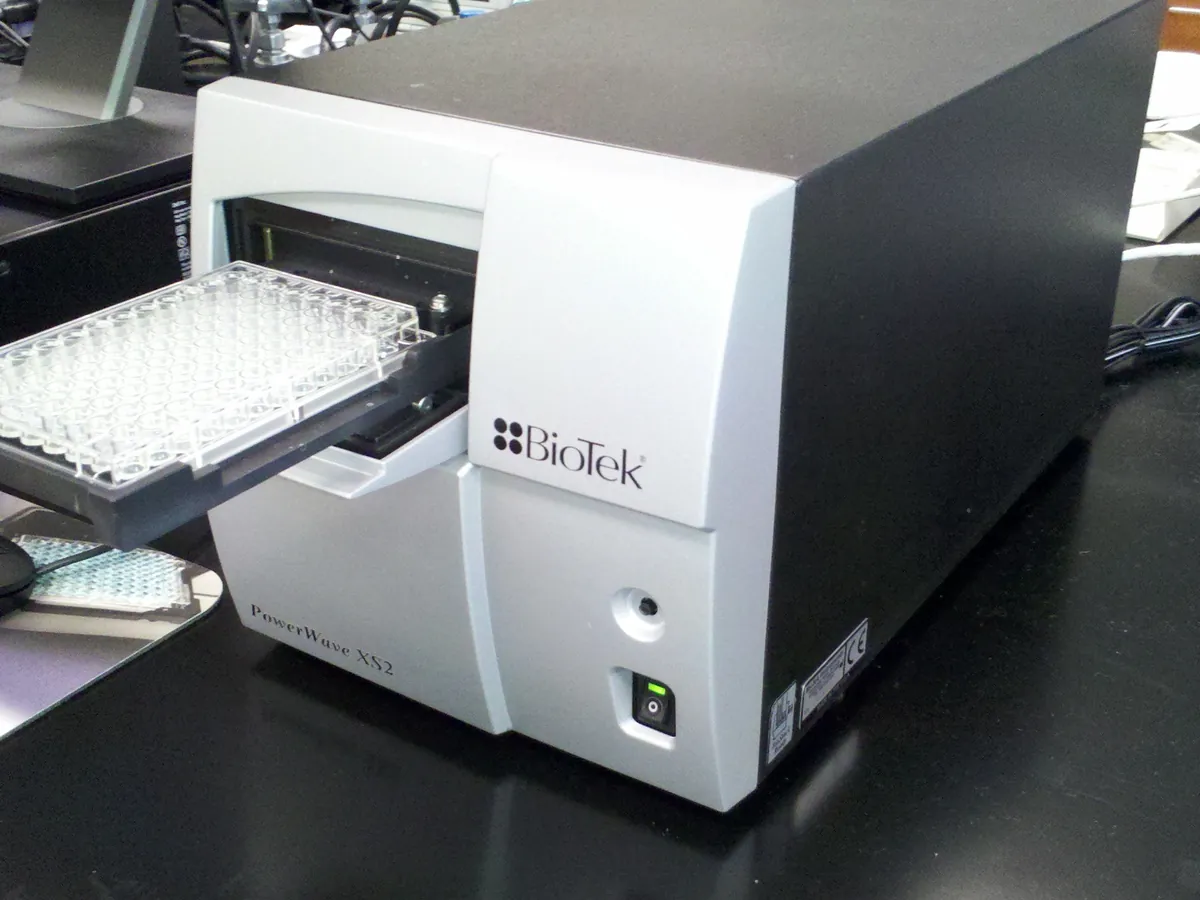
What is Plate reader?
A microplate reader is a spectrophotometer built to read many small samples at once. It moves a 96- or 384-well plate under a vertical light beam and measures each well in a few seconds. Absorbance readers are used for colorimetric assays such as ELISA and BCA or Bradford protein assays. Multimode readers add fluorescence, luminescence and sometimes time-resolved fluorescence.
Unlike a cuvette spectrophotometer, the light passes vertically through the liquid. The path length therefore depends on the volume in the well and the shape of the meniscus, not a fixed 1 cm cell. This is why plate assays are almost always calibrated with standards on the same plate, and why some readers offer a path-length correction.
Wavelength is selected with filters or with a monochromator. Because the reader is used for potency, impurity and content assays in biologics QC, its absorbance accuracy, linearity and wavelength accuracy are verified regularly, usually with a certified calibration plate containing glass filters.
Used for
- ELISA, including host cell protein and potency assays
- Total protein by BCA, Bradford or Lowry assays
- Cell viability and proliferation assays (MTT, resazurin, ATP luminescence)
- Enzyme kinetics and activity assays
- Nucleic acid quantification with fluorescent dyes
- Endotoxin (kinetic chromogenic or turbidimetric LAL) when the reader has incubation and suitable software
How it works
- 01
Select mode and wavelength
Choose absorbance, fluorescence or luminescence and the filter or monochromator wavelengths.
- 02
Load plate
The plate carrier moves the plate into the reading chamber, often with optional shaking and temperature control.
- 03
Reference reading
The reader measures an air or blank reference to set 100% transmission (or a dark reading for fluorescence).
- 04
Read wells
Each well is moved under the beam and read, often with several flashes averaged.
- 05
Correct
Blank subtraction, reference wavelength subtraction and path-length correction are applied if selected.
- 06
Calculate
Software fits the standard curve and calculates sample results.
Advantages
- High throughput: a whole 96-well plate in under a minute
- Small sample and reagent volumes (typically 50–300 µL per well)
- Standards, controls and samples read under the same conditions
- Multimode instruments cover absorbance, fluorescence and luminescence
- Software fits standard curves (linear, 4PL, 5PL) and calculates results
Limitations
- Path length is not fixed, so absolute absorbance depends on volume and meniscus
- Edge effects from evaporation or temperature gradients
- Lower photometric range than a cuvette instrument at high absorbance
- Bubbles, scratches and dust on plates cause outliers
- Crosstalk between wells in fluorescence and luminescence modes
2 calibration procedures
Methods that use Plate reader
Keep every Plate reader in control: usage logs, calibration and maintenance schedules, and automatic blocking of overdue instruments.