Microplate reader
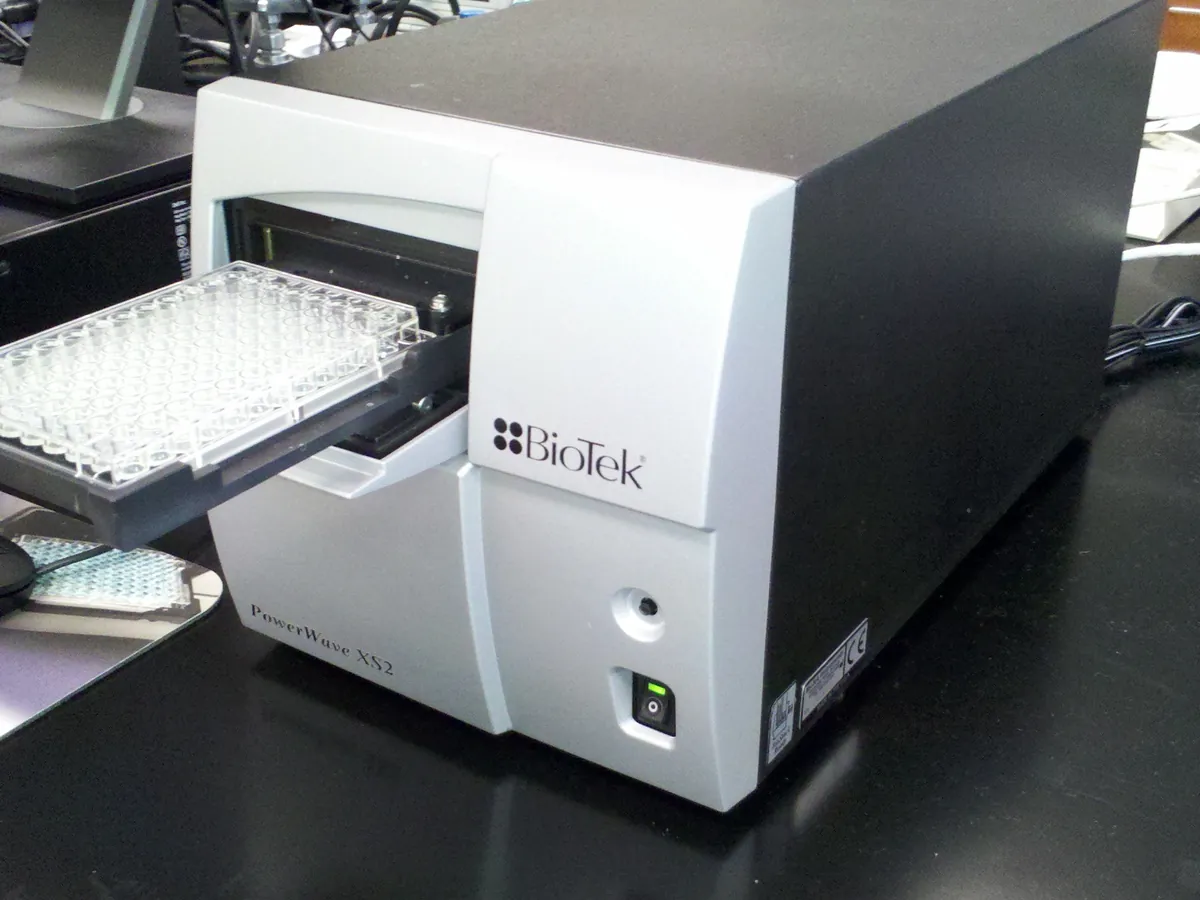
Measures absorbance, fluorescence or luminescence in the wells of 96- or 384-well plates. It is the read-out instrument for ELISA, protein assays, cell-based assays and enzyme kinetics.
- Biotechnology
- Biopharmaceutical
- Clinical research
- Academic research
- Food (allergen ELISA)
- Environmental (toxicity assays)
Test your Plate reader knowledge
Multiple-choice questions
Pick an answer to see whether you are right and why.
Q1. Why does absorbance in a microplate depend on the volume in the well?
basicQ2. In an ELISA read at 450 nm, why is 630 nm often read as a reference wavelength?
intermediateQ3. Which plate colour is preferred for fluorescence intensity assays?
basicQ4. What is used to verify the absorbance accuracy of a plate reader?
intermediateQ5. Which filter in a calibration plate is used to check wavelength accuracy?
intermediateQ6. A certified filter has A = 1.998 and the reader measures 1.985. With a tolerance of ±(1% + 0.010), does it pass?
advancedQ7. Outer wells of a plate read higher than inner wells after a long incubation. What is this called?
basic
Viva questions
Think of your answer first, then open it to compare.
1. Why do plate assays almost always include a standard curve on the same plate?
Path length, temperature, timing and reagent lots vary from plate to plate. Running standards on the same plate under the same conditions cancels these effects, so results depend on the relative response, not absolute absorbance.
2. Which checks would you include in the OQ of a microplate reader?
Absorbance accuracy and linearity with certified filters, wavelength accuracy with a holmium or didymium filter, photometric precision (repeat reads), and fluorescence/luminescence sensitivity if those modes are used, plus temperature and shaking if used by assays.
3. When would you use a four-parameter logistic (4PL) fit instead of linear regression?
For sigmoidal responses such as ELISA, where the curve flattens at low and high concentration. A 4PL fit describes the whole curve; linear regression is only suitable over a range where response is proportional to concentration.
Keep every Plate reader in control: usage logs, calibration and maintenance schedules, and automatic blocking of overdue instruments.