Microplate reader
Measures absorbance, fluorescence or luminescence in the wells of 96- or 384-well plates. It is the read-out instrument for ELISA, protein assays, cell-based assays and enzyme kinetics.
- Biotechnology
- Biopharmaceutical
- Clinical research
- Academic research
- Food (allergen ELISA)
- Environmental (toxicity assays)
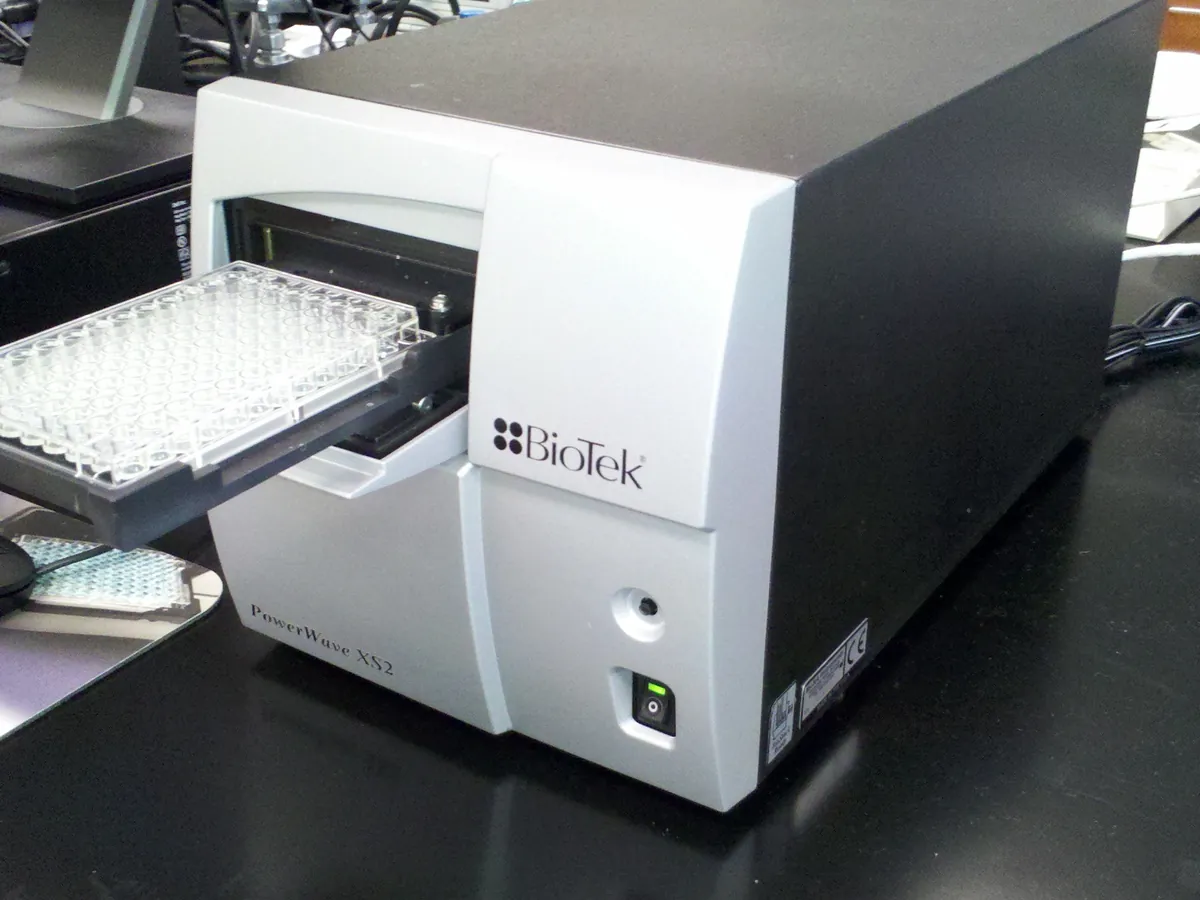
How Plate reader works
In absorbance mode, light of a chosen wavelength passes up through each well and the detector measures how much is transmitted. Absorbance A = log10(I0/I) follows the Beer–Lambert law, A = ε × c × l, so it is proportional to concentration over the linear range. In fluorescence mode the reader excites the sample at one wavelength and measures emitted light at a longer wavelength; in luminescence mode it counts light produced by a chemical reaction without excitation.
The path of a sample
- 01
Select mode and wavelength
Choose absorbance, fluorescence or luminescence and the filter or monochromator wavelengths.
- 02
Load plate
The plate carrier moves the plate into the reading chamber, often with optional shaking and temperature control.
- 03
Reference reading
The reader measures an air or blank reference to set 100% transmission (or a dark reading for fluorescence).
- 04
Read wells
Each well is moved under the beam and read, often with several flashes averaged.
- 05
Correct
Blank subtraction, reference wavelength subtraction and path-length correction are applied if selected.
- 06
Calculate
Software fits the standard curve and calculates sample results.
Main parts and what they do
Light source
Xenon flash lamp (most multimode readers) or tungsten-halogen lamp.
Wavelength selection
Interference filters or a grating monochromator (often with a bandwidth of a few nm).
Fibre optics / read head
Direct light through each well (top or bottom reading for fluorescence).
Detector
Photodiodes for absorbance; photomultiplier tube for fluorescence and luminescence.
Plate carrier
Moves the plate precisely under the beam; may shake and control temperature.
Software
Sets protocols, applies blank and path corrections, fits curves and keeps audit trails.
Terms every analyst should know
Optical density (OD)
Plate readers often show absorbance as OD. For a clear solution they are the same: log10 of incident ÷ transmitted light.
Reference wavelength
A second wavelength where the product does not absorb (for example 630 nm in a 450 nm ELISA). Subtracting it corrects for scratches and plate imperfections.
Path-length correction
Uses the water absorbance peak near 977 nm (against 900 nm) to estimate path length in each well and normalise readings to a 1 cm path.
Standard curve fitting
Linear regression for linear assays; four- or five-parameter logistic fits for sigmoidal ELISA curves.
Calibration plate
A plate with certified neutral-density glass filters and a holmium or didymium filter for checking absorbance and wavelength accuracy.
Edge effect
Outer wells may evaporate or warm differently, giving biased results. Plate seals, humidified incubation or avoiding outer wells reduce it.
Keep every Plate reader in control: usage logs, calibration and maintenance schedules, and automatic blocking of overdue instruments.