Wavelength accuracy
Scans a holmium or didymium glass filter in the calibration plate and checks that the measured absorption peak positions match the certified wavelengths.
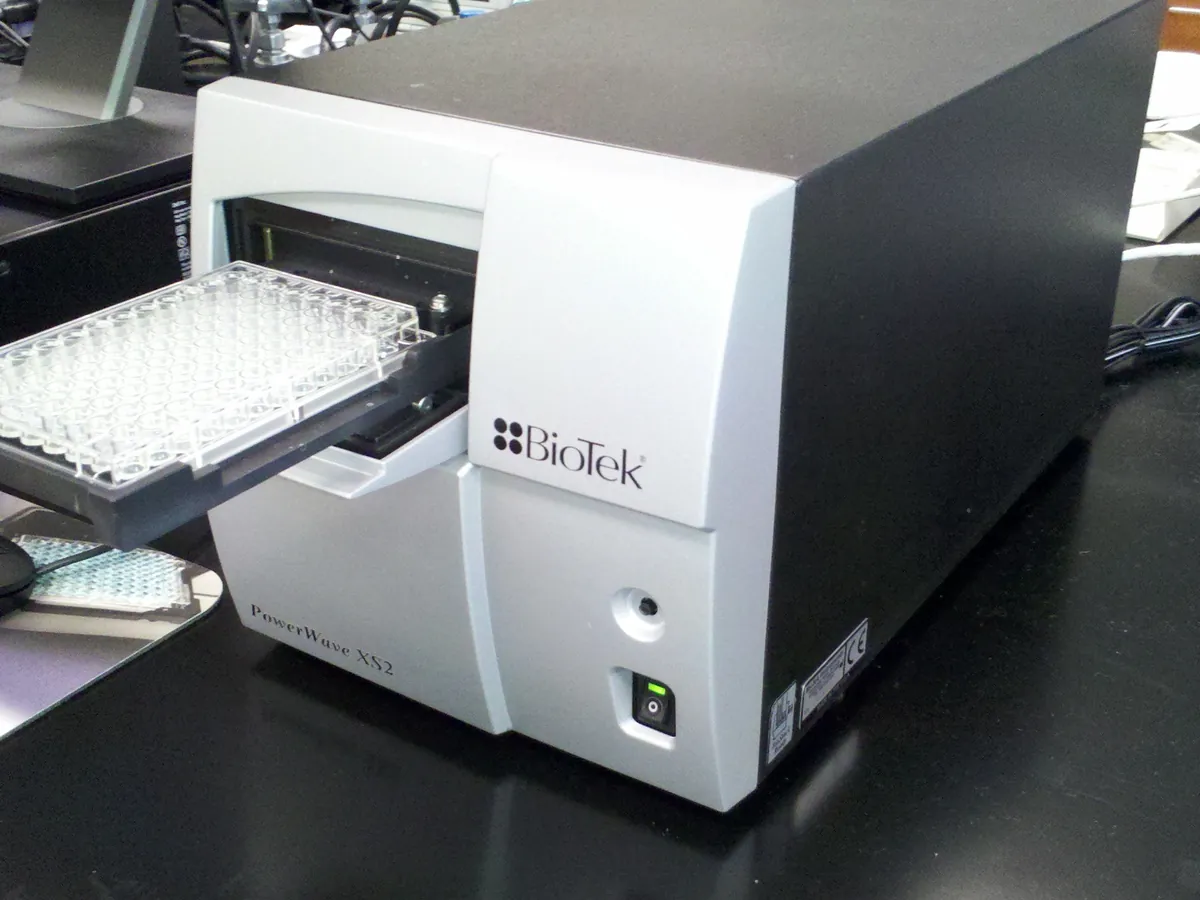
Why this is checked
If a monochromator is mis-set, the reader measures on the slope of an absorbance band instead of its maximum. Results then lose sensitivity and drift between instruments. Filter-based readers are checked to confirm the correct filters are installed and give the expected response.
Typically every 6–12 months and after service, as defined in your SOP.
Learn how the Plate reader worksStandards & tools
- Calibration plate with a certified holmium oxide glass (or didymium) filter
- Certificate stating peak wavelengths (holmium glass peaks are typically near 361, 418, 453 and 536 nm; use the certificate values)
Prerequisites
- Reader warmed up
- Absorbance accuracy check passed or performed in the same session
- Scan protocol with a step of 1 nm or smaller around each peak
Step by step
- 1Load the calibration plate and run a spectral scan of the holmium filter across the certified peaks (for monochromator readers).
- 2Use an empty (air) well or the blank position as reference.
- 3Find the wavelength of maximum absorbance for each certified peak.
- 4Calculate the difference from the certified value.
- 5For filter-based readers, confirm installed filter wavelengths from the supplier's check and that each filter gives the expected response on the test plate.
Example observation table
| Certified peak (nm) | Measured peak (nm) | Difference (nm) | Result |
|---|---|---|---|
| 360.9 | 361.5 | +0.6 | Pass |
| 418.5 | 417.8 | −0.7 | Pass |
| 453.2 | 453.9 | +0.7 | Pass |
| 536.2 | 537.1 | +0.9 | Pass |
How to calculate the result
- 1
536.2 nm peak: 537.1 − 536.2 = +0.9 nm
- 2
418.5 nm peak: 417.8 − 418.5 = −0.7 nm
- 3
Largest difference +0.9 nm, within a typical ±2 nm specification
Pass if
- Each peak typically within ±2 nm of the certified value for monochromator readers (or the manufacturer's specification)
- Filter readers: filter centre wavelength and bandwidth as specified by the supplier
What to do
- Repeat with a clean plate.
- If confirmed, label the reader out of use and request service (monochromator calibration).
- Assess the impact on assays read near steep absorbance bands.
Other Plate reader calibrations
LimsPulse schedules this calibration, records the result against limits, and blocks the instrument everywhere if it fails or goes overdue.