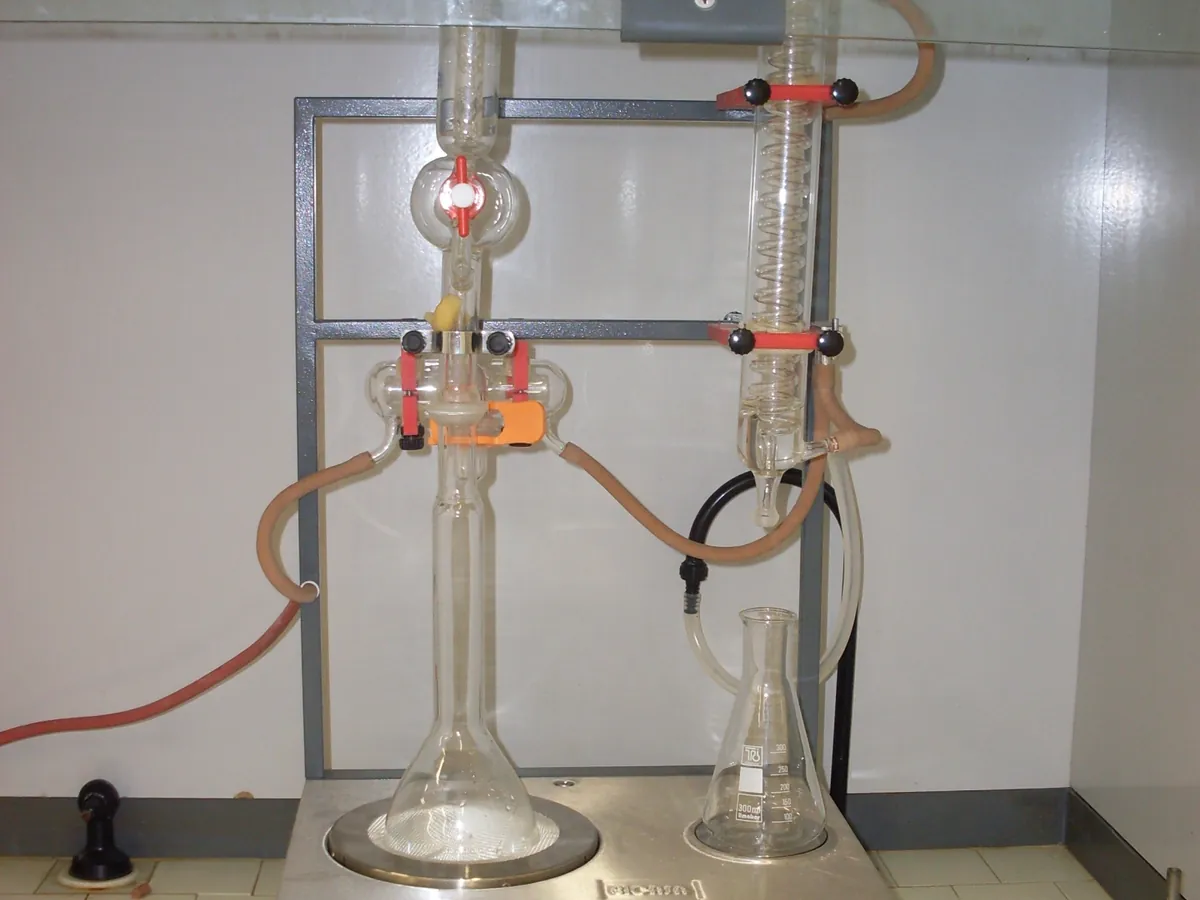
Kjeldahl digestion & distillation unit
Digests a food sample in hot sulphuric acid to turn its organic nitrogen into ammonium, then distils the ammonia and titrates it. The nitrogen found, multiplied by a conversion factor, gives crude protein.
- Food & beverage
- Dairy
- Animal feed
- Agriculture
- Environmental
- Fertiliser
What is Kjeldahl?
The Kjeldahl method has been the reference method for protein in food and feed for well over a century. It does not measure protein directly. It measures total nitrogen, and protein is then calculated with a nitrogen-to-protein factor, usually 6.25 for general foods and 6.38 for milk and dairy products.
A modern Kjeldahl set-up has three parts. A digestion block heats sample tubes with concentrated sulphuric acid, potassium sulphate and a catalyst at around 400–420 °C. A fume scrubber removes the acid fumes. A steam distillation unit then makes the digest alkaline, drives off the ammonia into a boric acid receiver, and in many units titrates it automatically.
Food labs use Kjeldahl for nutrition labelling, raw material checks (cereals, pulses, oilseed meals, meat, milk powder), feed analysis and for checking protein-based payments, for example in milk procurement. Dumas combustion analysers are a faster alternative, but Kjeldahl remains widely accepted in AOAC, ISO and FSSAI methods.
Used for
- Crude protein in cereals, flour, pulses and bakery products
- Protein in milk, milk powder, cheese and other dairy products (factor 6.38)
- Protein in meat, fish and meat products
- Crude protein in animal feed and oilseed meals
- Total nitrogen and ammonia nitrogen in water and wastewater (TKN)
- Non-protein nitrogen and casein fractions in milk, with suitable pre-treatment
How it works
- 01
Weigh
A weighed sample (often 0.5–2 g) is placed in a digestion tube with catalyst tablets and sulphuric acid.
- 02
Digest
The block heats the tubes to about 400–420 °C until the digest is clear (usually pale blue-green with copper).
- 03
Cool & dilute
The tubes are cooled and water is added carefully so the digest does not set solid.
- 04
Alkalise & distil
Excess sodium hydroxide is pumped in and steam carries the released ammonia into a boric acid receiver.
- 05
Titrate
The trapped ammonia is titrated with standard hydrochloric or sulphuric acid to the indicator end point.
- 06
Calculate
Nitrogen % is calculated from the titre, blank and sample mass, then multiplied by the protein factor.
Advantages
- Internationally accepted reference method for protein
- Works for almost any food matrix, solid or liquid
- Good precision and accuracy when digestion is complete
- Relatively low instrument cost; many tubes digested at once
- Automated distillation and titration reduce operator error
Limitations
- Measures total nitrogen, so non-protein nitrogen (urea, melamine, free amino acids) is counted as protein
- Uses hot concentrated sulphuric acid and strong alkali, so it is hazardous
- Slow: digestion alone takes about 1–2 hours
- Nitrate and nitrite nitrogen are not fully recovered without a modified procedure
- Result depends on choosing the correct nitrogen-to-protein factor
2 calibration procedures
Methods that use Kjeldahl
Keep every Kjeldahl in control: usage logs, calibration and maintenance schedules, and automatic blocking of overdue instruments.