Nitrogen recovery check
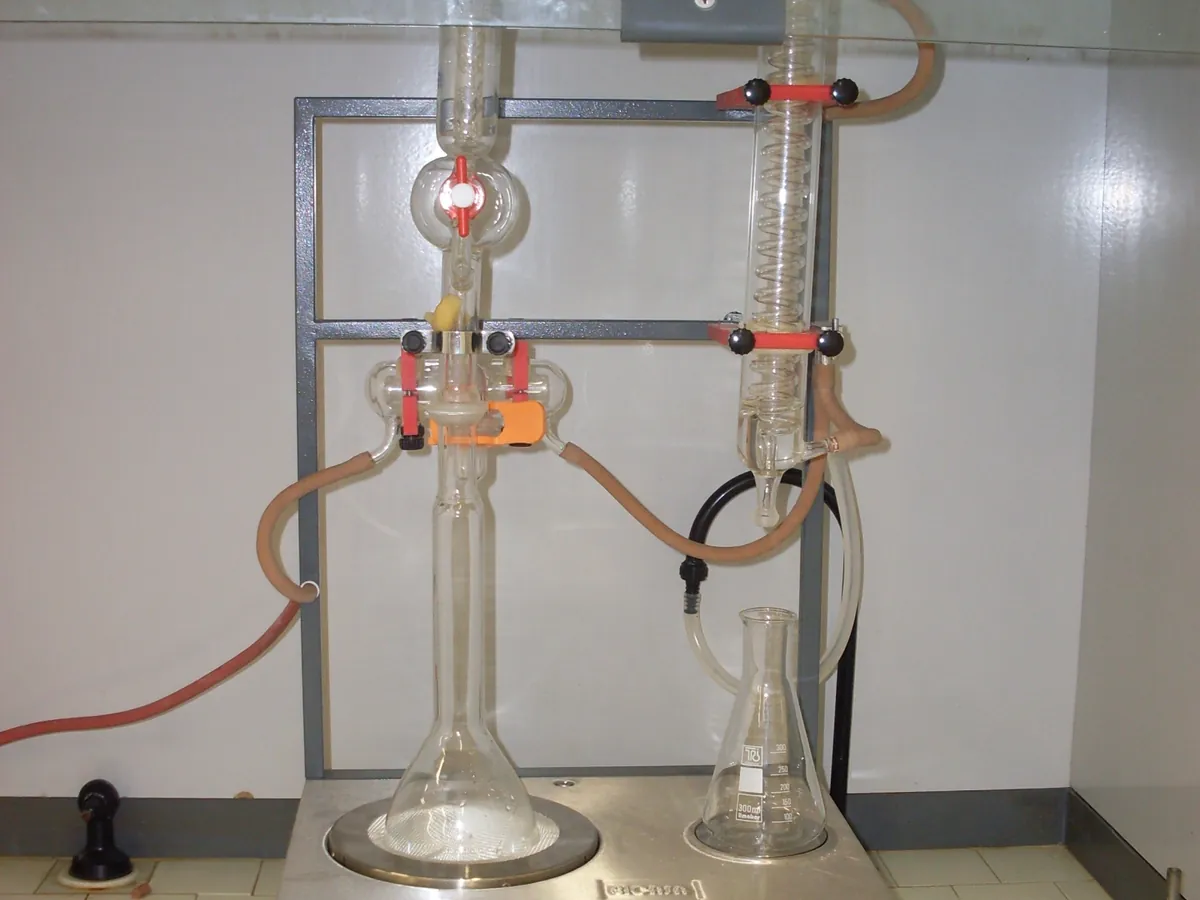
Confirms that the distillation unit recovers all the ammonia (ammonium sulphate) and that digestion plus distillation recovers all the organic nitrogen (tryptophan or acetanilide).
Why this is checked
Kjeldahl results are only right if no nitrogen is lost. Ammonium sulphate checks the distillation and titration steps alone. An organic standard that is harder to digest, such as tryptophan or lysine hydrochloride, checks the whole process including digestion.
Typically with each batch or daily for ammonium sulphate, and at least monthly (and after maintenance) for the organic standard, as defined in your SOP.
Learn how the Kjeldahl worksStandards & tools
- Ammonium sulphate, analytical grade, dried (theoretical nitrogen 21.20%)
- Tryptophan (theoretical nitrogen 13.72%) or acetanilide (10.36%) or lysine hydrochloride as an organic standard
- Standardised 0.1 M hydrochloric acid with a known factor
- Reagent blank (catalyst and acid, no sample)
Prerequisites
- Analytical balance calibrated and verified
- Titrant standardised within its validity period
- Distillation unit warmed up with a steam-only blank
- Block temperature verified
Step by step
- 1Dry ammonium sulphate at about 102 °C for 2 h and cool in a desiccator.
- 2Weigh about 0.15 g of ammonium sulphate accurately into a clean tube. Do not digest it.
- 3Add water and distil with excess alkali into boric acid exactly as for a sample; titrate with 0.1 M HCl.
- 4Run a reagent blank the same way and subtract its titre.
- 5Weigh about 0.18 g of tryptophan (or the organic standard in your SOP) into a tube, add catalyst and acid, and digest, distil and titrate it like a sample.
- 6Calculate nitrogen found and per cent recovery for each standard.
Example observation table
| Standard | Mass (mg) | Theoretical N (mg) | Titre − blank (mL) | N found (mg) | Recovery (%) |
|---|---|---|---|---|---|
| Ammonium sulphate | 150.3 | 31.86 | 22.73 | 31.84 | 99.9 |
| Tryptophan | 180.6 | 24.78 | 17.50 | 24.51 | 98.9 |
How to calculate the result
- 1
Ammonium sulphate: theoretical N = 150.3 mg × 0.2120 = 31.86 mg
- 2
Titre 22.85 mL, blank 0.12 mL, M = 0.1000: N found = 22.73 × 0.1000 × 14.007 = 31.84 mg
- 3Recovery = 31.84 ÷ 31.86 × 100 = 99.9%
- 4
Tryptophan: theoretical N = 180.6 mg × 0.1372 = 24.78 mg; titre 17.62 mL, blank 0.12 mL → N found = 17.50 × 0.1000 × 14.007 = 24.51 mg; recovery = 98.9%
Pass if
- Ammonium sulphate (distillation): typically 99–101% recovery, or as stated by your method
- Organic standard (digestion + distillation): typically not less than about 98% recovery
- Reagent blank titre low and consistent with previous blanks
What to do
- Mark the unit out of use for reportable analysis.
- If ammonium sulphate recovery is low, check alkali dosing, steam generation, seals and the condenser outlet dipping into boric acid.
- If only the organic standard is low, check block temperature, digestion time and acid-to-salt ratio.
- Assess results reported since the last good check and repeat them if needed.
Other Kjeldahl calibrations
LimsPulse schedules this calibration, records the result against limits, and blocks the instrument everywhere if it fails or goes overdue.