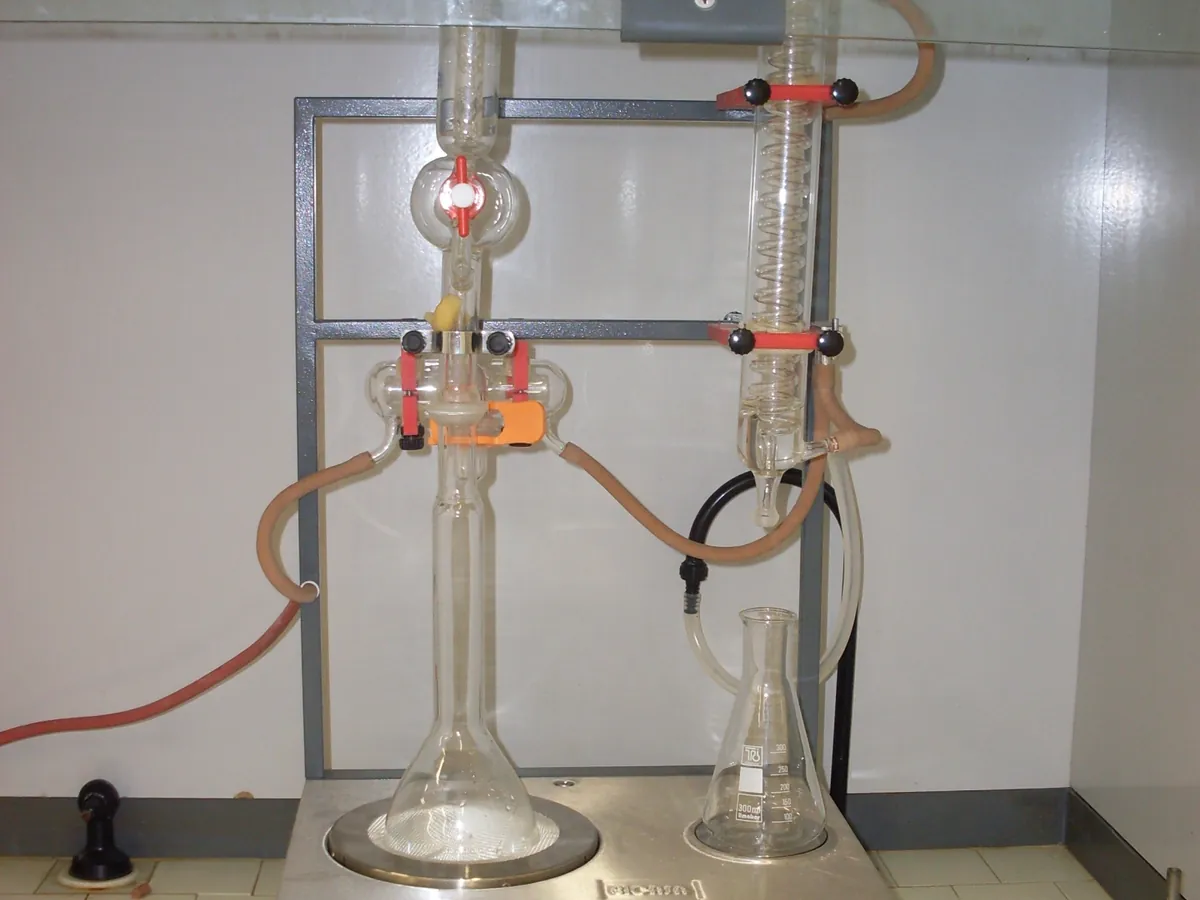
Kjeldahl digestion & distillation unit
Digests a food sample in hot sulphuric acid to turn its organic nitrogen into ammonium, then distils the ammonia and titrates it. The nitrogen found, multiplied by a conversion factor, gives crude protein.
- Food & beverage
- Dairy
- Animal feed
- Agriculture
- Environmental
- Fertiliser
Test your Kjeldahl knowledge
Multiple-choice questions
Pick an answer to see whether you are right and why.
Q1. What does the Kjeldahl method actually measure?
basicQ2. Which nitrogen-to-protein factor is normally used for milk and dairy products?
basicQ3. Why is potassium sulphate added to the digestion mixture?
basicQ4. In the distillation step, what releases ammonia from the digest?
intermediateQ5. Why does the exact volume of boric acid in the receiver not need to be accurate?
intermediateQ6. A sample uses 12.70 mL (blank-corrected) of 0.1012 M HCl and weighs 1.0042 g. What is the nitrogen content?
intermediateQ7. Ammonium sulphate gives 99.8% recovery but tryptophan gives only 93%. Which step is most likely at fault?
advanced
Viva questions
Think of your answer first, then open it to compare.
1. Why did the Kjeldahl test fail to detect melamine adulteration of milk products?
Melamine is rich in nitrogen and Kjeldahl measures total nitrogen, not protein. The added melamine nitrogen was counted as protein, so diluted products appeared to meet protein specifications. Specific methods such as LC-MS/MS are needed to detect it.
2. What is the purpose of the reagent blank in Kjeldahl analysis?
The blank contains all reagents (and nitrogen-free paper, if used) but no sample. Any nitrogen from reagents, water or the lab air shows up as a blank titre, which is subtracted from each sample titre.
3. List the main safety precautions when running a Kjeldahl digestion and distillation.
Digest only with a working scrubber or fume hood; wear face shield, acid-resistant gloves and lab coat; let digests cool before adding water; make sure tubes are seated before alkali is dispensed; avoid mercury and selenium catalysts; and neutralise acid and alkali waste properly.
Keep every Kjeldahl in control: usage logs, calibration and maintenance schedules, and automatic blocking of overdue instruments.