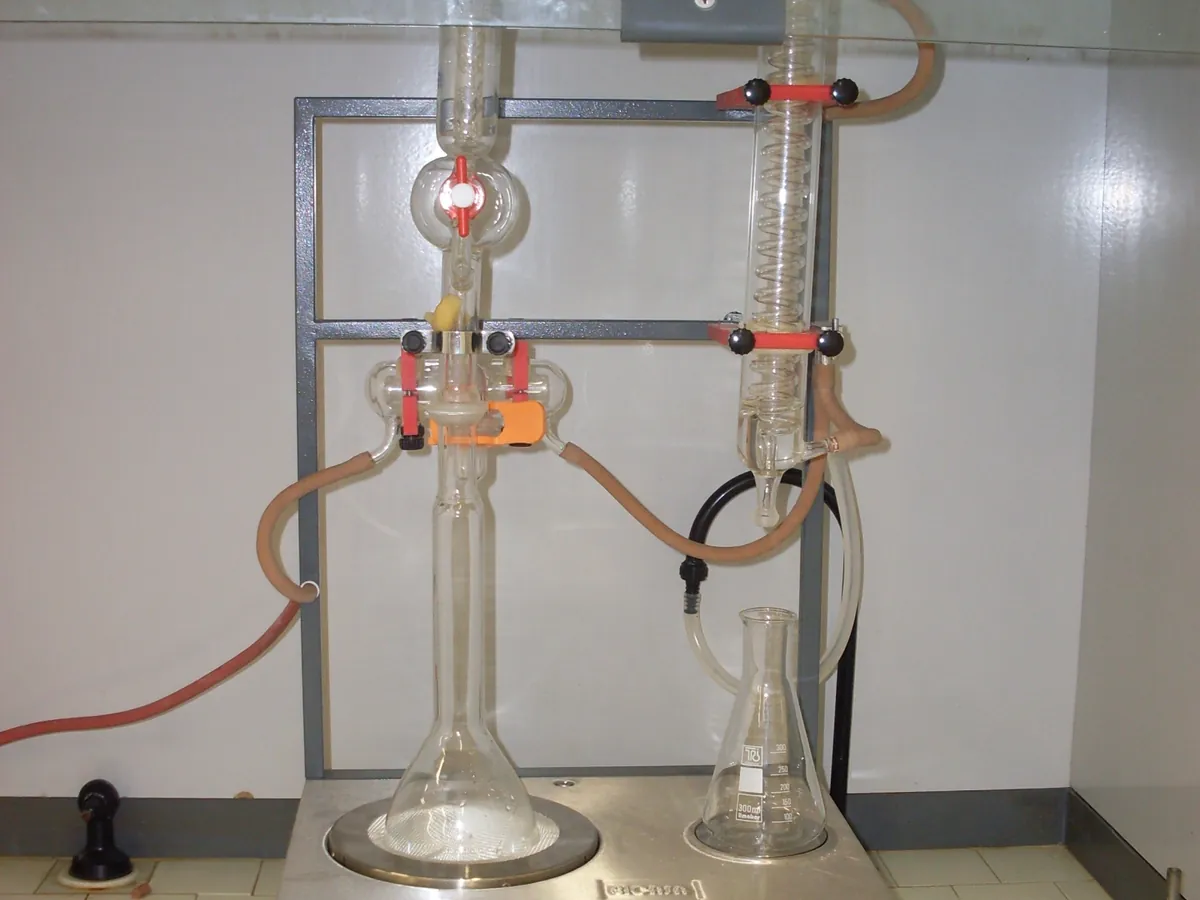
Kjeldahl digestion & distillation unit
Digests a food sample in hot sulphuric acid to turn its organic nitrogen into ammonium, then distils the ammonia and titrates it. The nitrogen found, multiplied by a conversion factor, gives crude protein.
- Food & beverage
- Dairy
- Animal feed
- Agriculture
- Environmental
- Fertiliser
How Kjeldahl works
Organic nitrogen is converted to ammonium sulphate by boiling the sample with concentrated sulphuric acid. Potassium sulphate raises the boiling point and a copper catalyst speeds the reaction. Adding excess sodium hydroxide releases ammonia, which is steam-distilled into boric acid and titrated with standard acid. Each mole of acid used corresponds to one mole of nitrogen (14.007 g).
The path of a sample
- 01
Weigh
A weighed sample (often 0.5–2 g) is placed in a digestion tube with catalyst tablets and sulphuric acid.
- 02
Digest
The block heats the tubes to about 400–420 °C until the digest is clear (usually pale blue-green with copper).
- 03
Cool & dilute
The tubes are cooled and water is added carefully so the digest does not set solid.
- 04
Alkalise & distil
Excess sodium hydroxide is pumped in and steam carries the released ammonia into a boric acid receiver.
- 05
Titrate
The trapped ammonia is titrated with standard hydrochloric or sulphuric acid to the indicator end point.
- 06
Calculate
Nitrogen % is calculated from the titre, blank and sample mass, then multiplied by the protein factor.
Main parts and what they do
Digestion block
Aluminium or graphite heating block that holds 8–40 tubes and controls temperature and ramp programmes.
Digestion tubes
Heat-resistant borosilicate tubes (often 250 mL) in which the sample is digested and later distilled.
Exhaust manifold
Glass head that sits on the tubes and draws off acid fumes during digestion.
Fume scrubber
Water aspirator or pump with alkaline scrubber that neutralises SO₂ and acid fumes before release.
Steam generator
Produces steam that carries ammonia from the alkaline digest to the condenser.
Alkali and water pumps
Dose sodium hydroxide and dilution water into the tube automatically.
Condenser and receiver
Cool the distillate and collect it in a flask of boric acid with indicator.
Titrator (manual burette or automatic)
Titrates the trapped ammonia with standard acid, by colour or a pH electrode end point.
Terms every analyst should know
Digestion
Oxidation of organic matter by hot sulphuric acid. Carbon leaves as CO₂, and organic nitrogen stays behind as ammonium sulphate.
Potassium sulphate
Raises the boiling point of the acid so digestion runs hotter and faster. Too much salt can cause nitrogen loss, so keep to the method ratio.
Catalyst
Copper sulphate (sometimes with titanium dioxide) speeds digestion. Mercury and selenium catalysts are now avoided because of toxicity.
Boric acid trapping
Ammonia forms ammonium borate in boric acid. Boric acid is too weak to interfere, so only the ammonia is titrated and the boric acid volume need not be exact.
Nitrogen-to-protein factor
Converts nitrogen to protein. 6.25 assumes protein is 16% nitrogen; specific factors such as 6.38 for dairy and about 5.7 for wheat are used where the method says so.
Blank
A tube with reagents but no sample is digested and distilled. Its titre corrects for nitrogen in the reagents.
Keep every Kjeldahl in control: usage logs, calibration and maintenance schedules, and automatic blocking of overdue instruments.