Ultrasonic bath (sonicator)
A stainless-steel tank of water vibrated by ultrasound. It is used to dissolve and extract samples, degas mobile phases and clean small glassware.
- Pharmaceutical
- Chemicals
- Food testing
- Electronics
- Jewellery and precision cleaning
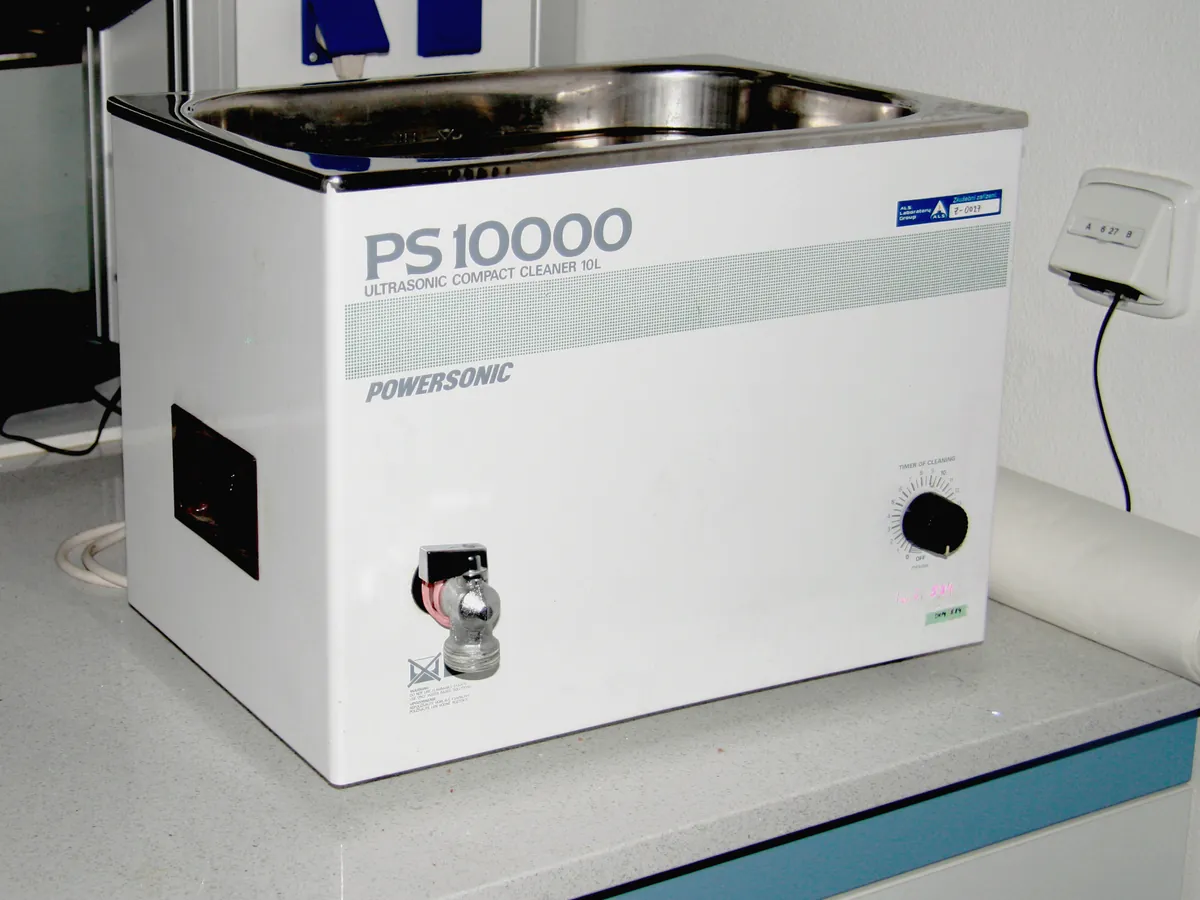
What is Sonicator?
An ultrasonic bath is a tank of water with piezoelectric transducers bonded to its base. The transducers vibrate at a high frequency, typically about 35–40 kHz, and send sound waves through the water and into flasks standing in it.
In the QC lab it is used most often in sample preparation: tablet powder is sonicated in diluent to dissolve and extract the drug before HPLC or UV analysis. It is also used to degas solvents and to clean small parts and glassware.
Sonication time and bath temperature are part of many analytical methods, so they must be followed exactly. The bath warms up during use, and heat can degrade sensitive analytes, so many methods specify cooling to room temperature before making up to volume.
Used for
- Dissolving and extracting the drug from tablet and capsule powders
- Degassing mobile phases and dissolution media
- Dispersing powders and breaking up agglomerates
- Cleaning small glassware, pipette tips, sieves and instrument parts
How it works
- 01
Generator
An electronic generator produces a high-frequency electrical signal (typically 35–40 kHz).
- 02
Transducers
Piezoelectric transducers on the tank base convert the signal into mechanical vibration.
- 03
Sound waves
Pressure waves travel through the water and the flask wall into the sample liquid.
- 04
Cavitation
Microscopic bubbles form and collapse, releasing intense local energy.
- 05
Effect
Particles are broken up, dissolution is speeded up and dissolved gases are driven out.
Advantages
- Fast, effective dissolution and extraction
- Simple to use and inexpensive
- Several flasks can be treated at once
- No direct contact with the sample, so no contamination from a probe
Limitations
- Energy is uneven across the bath (hot and dead spots)
- The water warms during use and can degrade heat-sensitive analytes
- Performance falls as water level, temperature and transducer condition change
- Noise can be uncomfortable; a lid helps
Methods that use Sonicator
Keep every Sonicator in control: usage logs, calibration and maintenance schedules, and automatic blocking of overdue instruments.