Ultrasonic bath (sonicator)
A stainless-steel tank of water vibrated by ultrasound. It is used to dissolve and extract samples, degas mobile phases and clean small glassware.
- Pharmaceutical
- Chemicals
- Food testing
- Electronics
- Jewellery and precision cleaning
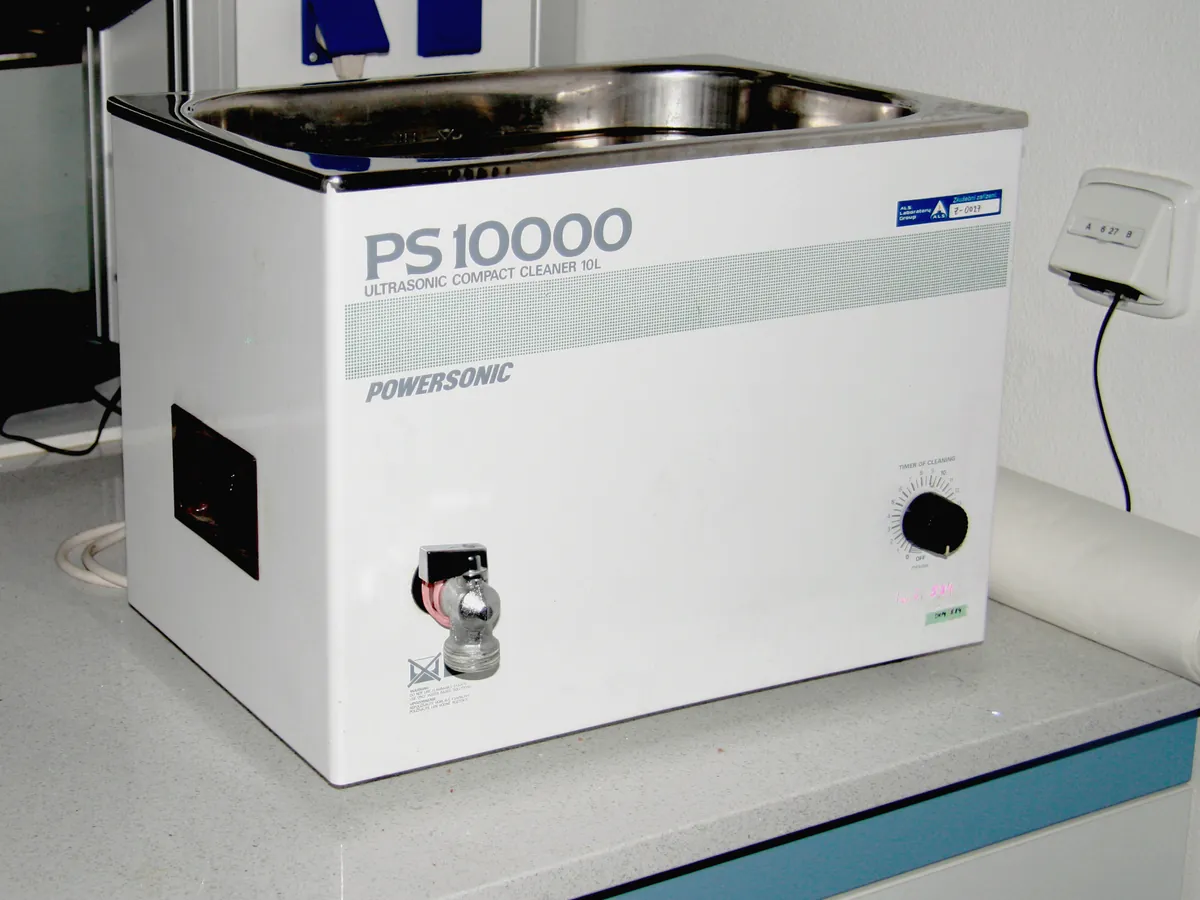
How Sonicator works
Ultrasound creates alternating high- and low-pressure waves in the liquid. In the low-pressure phase tiny vapour bubbles form; in the high-pressure phase they collapse violently. This is called cavitation. The collapse produces local shock waves and micro-jets that break up particles, speed dissolution and scrub surfaces clean.
The path of a sample
- 01
Generator
An electronic generator produces a high-frequency electrical signal (typically 35–40 kHz).
- 02
Transducers
Piezoelectric transducers on the tank base convert the signal into mechanical vibration.
- 03
Sound waves
Pressure waves travel through the water and the flask wall into the sample liquid.
- 04
Cavitation
Microscopic bubbles form and collapse, releasing intense local energy.
- 05
Effect
Particles are broken up, dissolution is speeded up and dissolved gases are driven out.
Main parts and what they do
Stainless-steel tank
Holds the water (coupling liquid) and the flasks.
Piezoelectric transducers
Bonded under the tank; convert electrical energy into ultrasonic vibration.
Ultrasonic generator
Supplies the high-frequency signal to the transducers.
Heater and thermostat (optional)
Warms the bath to a set temperature.
Timer and controls
Set sonication time, temperature and mode (normal, sweep, degas).
Basket or flask rack and lid
Hold flasks off the tank floor and reduce noise and evaporation.
Drain valve
Empties the tank for cleaning.
Terms every analyst should know
Cavitation
The formation and violent collapse of tiny bubbles in a liquid exposed to ultrasound. It does the work in a sonicator.
Frequency
Lower frequencies (around 25–40 kHz) give larger, more energetic bubbles; higher frequencies give gentler cleaning.
Degas mode
Pulsed operation that helps dissolved gas bubbles join and rise out of the liquid.
Sweep mode
The frequency varies slightly around the centre value to even out hot and dead spots.
Bath temperature
Cavitation and friction heat the water. Warmer water dissolves faster but can degrade sensitive analytes.
Keep every Sonicator in control: usage logs, calibration and maintenance schedules, and automatic blocking of overdue instruments.