Potentiometric Titrator (Autotitrator)
Adds a titrant from a motorised burette while an electrode measures the potential of the solution, and finds the equivalence point from the change in potential. Used for assays, standardisation and many limit tests.
- Pharmaceutical
- Chemicals
- Food & beverage
- Environmental
- Metal finishing
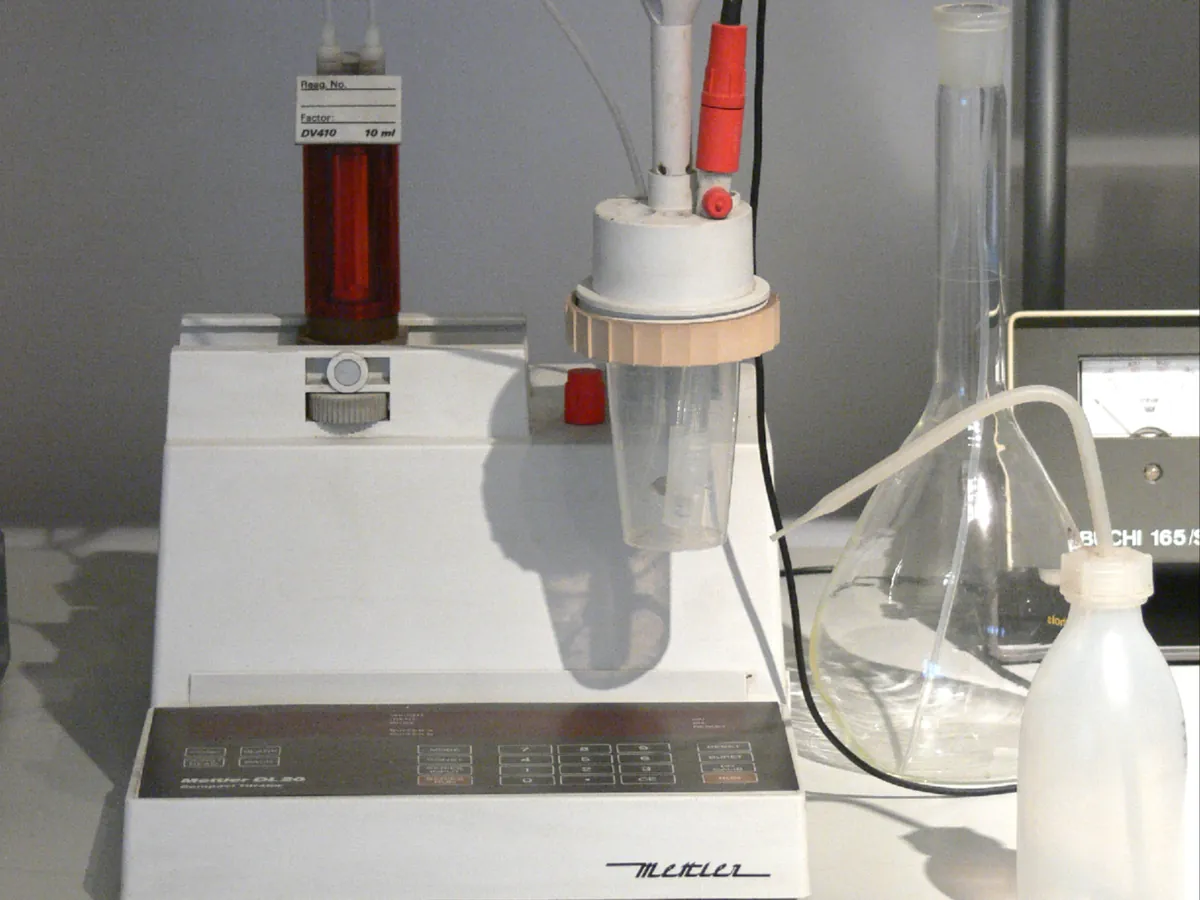
What is Potentiometric titrator?
A potentiometric titrator automates classical titration. Instead of judging a colour change by eye, it measures the potential (in mV) between an indicator electrode and a reference electrode as titrant is added. Near the equivalence point the potential changes sharply, and the titrator locates that point mathematically.
The same instrument can run acid–base, non-aqueous, redox, precipitation (argentometric) and complexometric titrations simply by changing the electrode and titrant.
In pharmaceutical QC it is used for the assay of many APIs, standardisation of volumetric solutions, acid or base value tests, chloride content and similar tests where a pharmacopoeia specifies a titrimetric procedure.
Used for
- Assay of acidic or basic APIs (aqueous or non-aqueous)
- Standardisation of volumetric solutions such as 0.1 M NaOH, 0.1 M HCl and 0.1 M perchloric acid
- Argentometric determination of chloride with silver nitrate
- Redox titrations, for example with ceric sulphate or iodine
- Complexometric titrations with EDTA
- Acid value, saponification value and similar tests on excipients
How it works
- 01
Sample in beaker
The weighed sample is dissolved in a suitable solvent and stirred.
- 02
Electrode
The indicator and reference electrodes (often combined in one body) are dipped in the solution.
- 03
Dosing
The burette adds titrant in steps, smaller near the expected equivalence point.
- 04
Measurement
The potential is read after each addition once it is stable.
- 05
Curve evaluation
The software finds the inflection point and reports the equivalence volume.
- 06
Result
The equivalence volume, titre and sample mass give the assay.
Advantages
- Objective endpoint: no reliance on colour perception
- Works in coloured or turbid solutions where indicators fail
- Very precise burettes and automatic calculation
- Full electronic record with titration curve and audit trail
- One instrument covers many titration types
Limitations
- Electrodes need care, regular checks and correct storage
- Titrants must be standardised and their titre tracked
- Method parameters (dosing, endpoint criteria) need development and validation
- Less suitable than chromatography where specificity against impurities is needed
3 calibration procedures
Methods that use Potentiometric titrator
Keep every Potentiometric titrator in control: usage logs, calibration and maintenance schedules, and automatic blocking of overdue instruments.