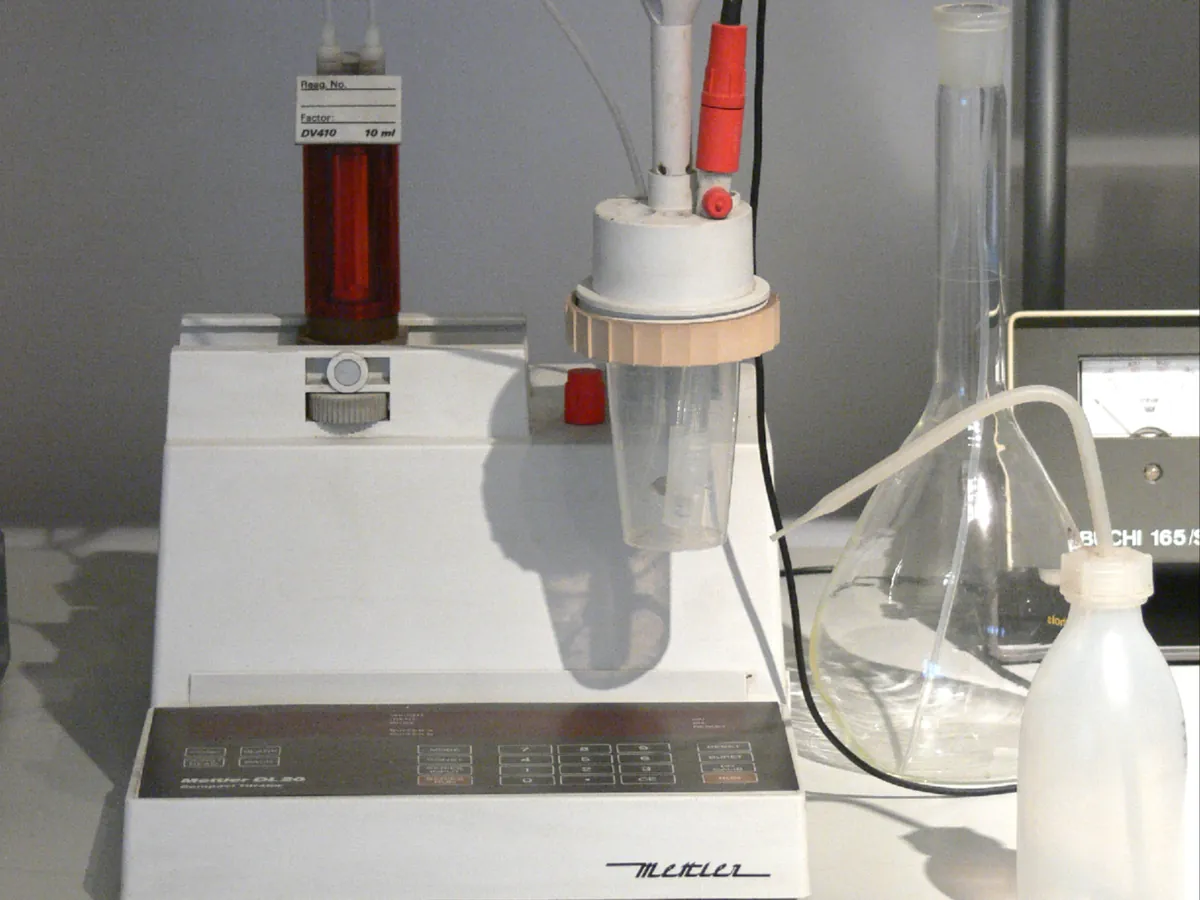
Potentiometric Titrator (Autotitrator)
Adds a titrant from a motorised burette while an electrode measures the potential of the solution, and finds the equivalence point from the change in potential. Used for assays, standardisation and many limit tests.
- Pharmaceutical
- Chemicals
- Food & beverage
- Environmental
- Metal finishing
Test your Potentiometric titrator knowledge
Multiple-choice questions
Pick an answer to see whether you are right and why.
Q1. What does a potentiometric titrator measure to find the equivalence point?
basicQ2. Which primary standard is commonly used to standardise 0.1 M sodium hydroxide?
basicQ3. Which indicator electrode is used for an argentometric (silver nitrate) titration of chloride?
basicQ4. On the titration curve, the equivalence point corresponds to:
intermediateQ5. A pH electrode gives a slope of 56.2 mV/pH at 25 °C. What is its slope as a percentage of theoretical?
intermediateQ6. Why is a blank titration carried out?
intermediateQ7. 0.4086 g of KHP (204.22 g/mol) needs 19.92 mL of NaOH to reach equivalence. What is the molarity of the NaOH?
advancedQ8. Weak bases such as many amine APIs are often assayed with which titrant?
advanced
Viva questions
Think of your answer first, then open it to compare.
1. What is the difference between the equivalence point and the endpoint?
The equivalence point is where the amount of titrant added is chemically equal to the amount of analyte. The endpoint is the point actually detected by the indicator or electrode. A good method makes the endpoint fall as close as possible to the equivalence point.
2. Why should sodium hydroxide titrant be protected from air?
NaOH absorbs carbon dioxide from the air and forms sodium carbonate. This lowers the effective molarity and blurs the equivalence point, so the bottle is fitted with a soda-lime guard tube and the solution is restandardised regularly.
3. What advantages does a potentiometric endpoint have over a colour indicator?
It is objective, works in coloured or turbid solutions, gives a recorded titration curve as evidence, can detect more than one equivalence point, and is easy to automate with a full audit trail.
4. How would you choose the sample mass for a titrimetric assay?
Choose a mass that gives an equivalence volume in roughly the middle of the burette range, often about 10–90% and ideally around half to three-quarters of the burette volume. Too little titrant increases the relative error of the volume reading; too much risks refilling the burette mid-titration.
Keep every Potentiometric titrator in control: usage logs, calibration and maintenance schedules, and automatic blocking of overdue instruments.