Potentiometric Titrator (Autotitrator)
Adds a titrant from a motorised burette while an electrode measures the potential of the solution, and finds the equivalence point from the change in potential. Used for assays, standardisation and many limit tests.
- Pharmaceutical
- Chemicals
- Food & beverage
- Environmental
- Metal finishing
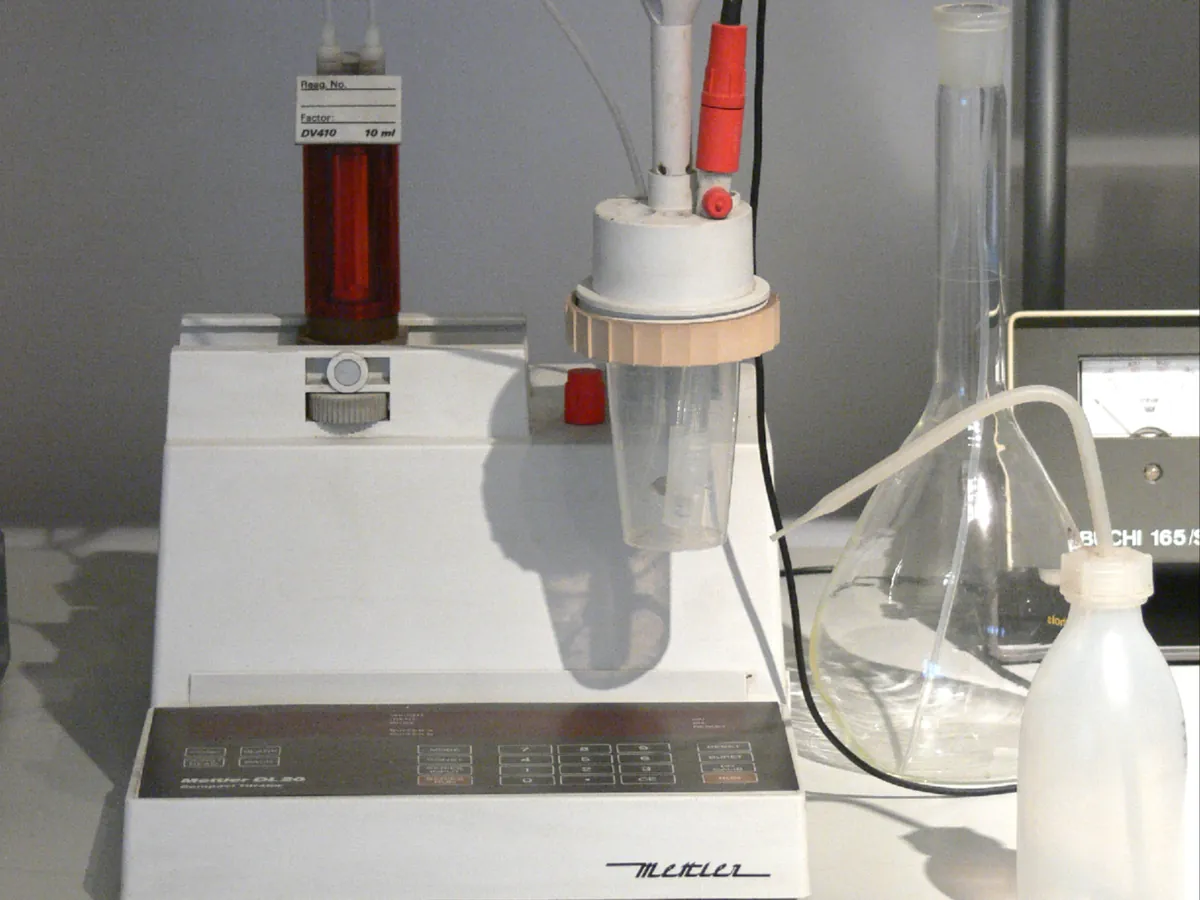
How Potentiometric titrator works
The potential of the indicator electrode depends on the activity of the ion being titrated, following the Nernst equation. As titrant reacts with the analyte the potential changes slowly at first and then steeply around the equivalence point. The titrator records potential against volume and takes the equivalence point at the steepest part of the curve.
The path of a sample
- 01
Sample in beaker
The weighed sample is dissolved in a suitable solvent and stirred.
- 02
Electrode
The indicator and reference electrodes (often combined in one body) are dipped in the solution.
- 03
Dosing
The burette adds titrant in steps, smaller near the expected equivalence point.
- 04
Measurement
The potential is read after each addition once it is stable.
- 05
Curve evaluation
The software finds the inflection point and reports the equivalence volume.
- 06
Result
The equivalence volume, titre and sample mass give the assay.
Main parts and what they do
Motorised piston burette (exchange or dosing unit)
Delivers titrant with high precision; typical sizes 10 or 20 mL.
Indicator electrode
Glass pH electrode, platinum ring, silver ring or ion-selective electrode, chosen for the titration type.
Reference electrode
Provides a constant potential, usually Ag/AgCl in KCl electrolyte; often combined with the indicator electrode.
Temperature sensor
Records solution temperature and allows temperature compensation for pH measurements.
Stirrer
Keeps the solution homogeneous so the potential settles quickly after each addition.
Titration vessel and stand
Holds the beaker, electrode, burette tip and stirrer in a fixed position.
Sample changer (optional)
Runs a series of samples automatically, including rinsing of electrodes between samples.
Control unit and software
Stores methods, controls dosing, evaluates the curve, calculates results and keeps an audit trail.
Terms every analyst should know
Equivalence point vs endpoint
The equivalence point is where the titrant added exactly matches the analyte chemically. The endpoint is the point the method actually detects. A good method makes the two coincide.
Nernst equation
The electrode potential changes by about 59.16 mV per decade of ion activity (per pH unit) at 25 °C for a singly charged ion. A real electrode's slope is expressed as a percentage of this value.
First derivative (dE/dV)
The change in potential per unit volume. It peaks at the inflection point of the titration curve, which is taken as the equivalence point. The second derivative crosses zero at the same point.
Dynamic vs monotonic dosing
Dynamic dosing adds large increments where the curve is flat and small ones near the equivalence point. Monotonic dosing adds equal increments throughout.
Indicator and reference electrodes
The indicator electrode responds to the analyte (glass for pH, platinum for redox, silver for halides). The reference electrode, usually silver/silver chloride, provides a stable comparison potential.
Blank titration
A titration of the solvent alone. The blank volume is subtracted from the sample volume to correct for any titrant consumed by the solvent.
Keep every Potentiometric titrator in control: usage logs, calibration and maintenance schedules, and automatic blocking of overdue instruments.