Inductively Coupled Plasma Mass Spectrometer (ICP-MS)
Ionises the sample in an argon plasma and counts the ions of each element by their mass. The most sensitive routine technique for elemental impurities, reaching ng/L levels.
- Pharmaceutical
- Biotech
- Environmental
- Food & beverage
- Semiconductor
- Clinical
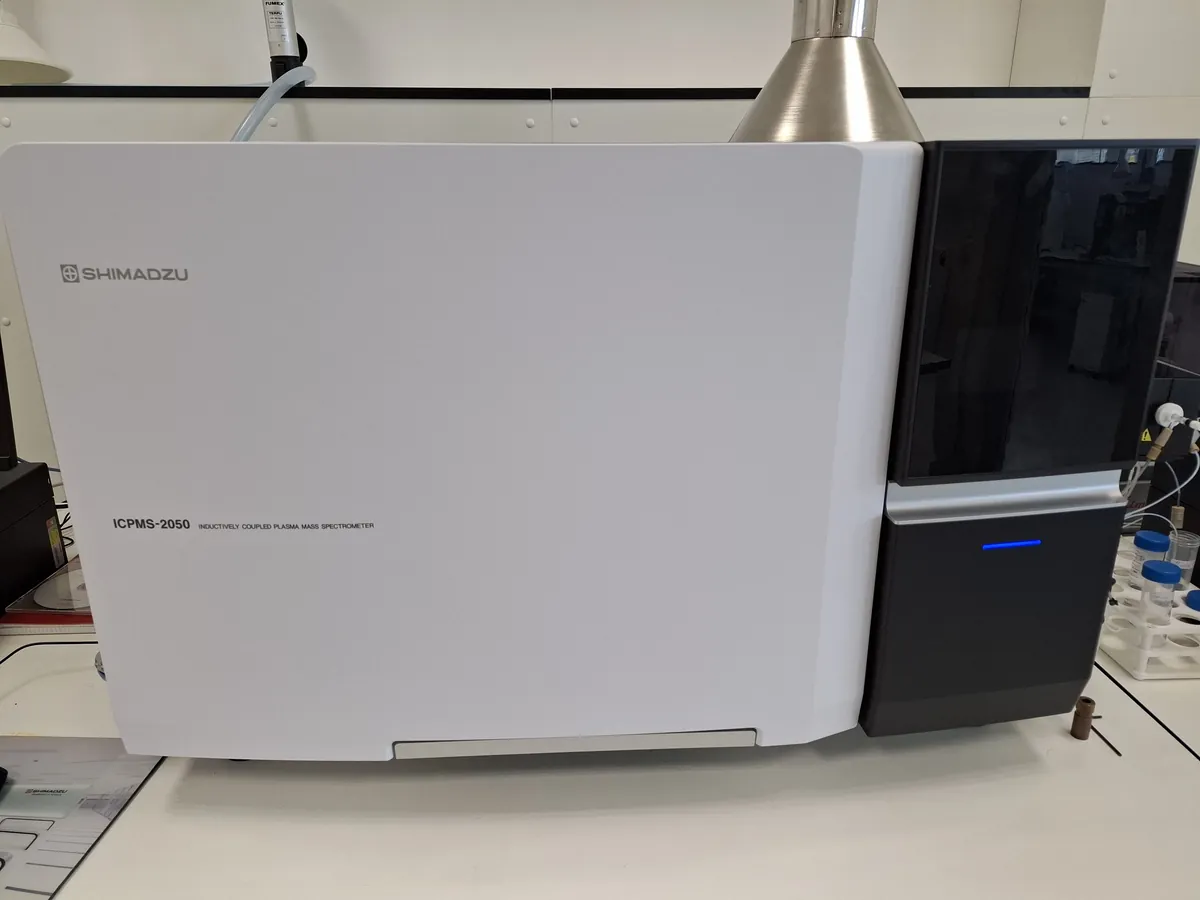
What is ICP-MS?
ICP-MS uses the same kind of argon plasma as ICP-OES, but instead of measuring light it extracts the positive ions the plasma produces into a vacuum. A mass analyser, usually a quadrupole, separates the ions by their mass-to-charge ratio (m/z), and a detector counts them one by one.
Because it counts individual ions against a very low background, ICP-MS is roughly 100 to 1000 times more sensitive than ICP-OES. Detection limits for many elements are in the ng/L (parts per trillion) range in solution. It can also measure isotopes separately.
In pharma QC, ICP-MS is the main technique for elemental impurities under ICH Q3D and USP <232>/<233>, especially for the toxic Class 1 elements (As, Cd, Hg, Pb) at low limits, for parenteral and inhalation products with low PDEs, and for high-dose products where permitted concentrations are small.
Used for
- Elemental impurities in APIs, excipients and drug products (ICH Q3D)
- Class 1 elements (As, Cd, Hg, Pb) at trace levels
- Catalyst residues (Pd, Pt, Ru, Rh, Ir, Os) in APIs
- Metals in water for injection, packaging extractables and leachables
- Isotope ratio measurements and speciation when coupled to HPLC
How it works
- 01
Sample introduction
Peristaltic pump, nebuliser and cooled spray chamber deliver a fine aerosol to the plasma.
- 02
Plasma ionisation
The argon plasma dries, atomises and ionises the sample; most elements form M⁺ ions efficiently.
- 03
Interface cones
Sampler and skimmer cones extract a beam of ions from the atmospheric-pressure plasma into the vacuum.
- 04
Ion lenses
Focus the positive ions and remove photons and neutral species.
- 05
Collision/reaction cell
Helium collisions (kinetic energy discrimination) or reactive gases remove polyatomic interferences.
- 06
Quadrupole and detector
The quadrupole passes one m/z at a time; an electron multiplier counts the ions in counts per second (cps).
Advantages
- Extremely low detection limits (ng/L in solution)
- Fast multi-element analysis of most of the periodic table
- Very wide linear range (often up to nine orders of magnitude with dual-mode detectors)
- Isotope information for identification and isotope dilution
- Collision/reaction cells remove most polyatomic interferences
Limitations
- High purchase and running cost; needs a clean lab environment
- Tolerates only low total dissolved solids (typically about 0.2% or less)
- Polyatomic and isobaric interferences (e.g. ⁴⁰Ar³⁵Cl⁺ on ⁷⁵As⁺) must be controlled
- Very sensitive to contamination from reagents, vessels and the lab
- Matrix suppression needs internal standards
2 calibration procedures
Methods that use ICP-MS
Keep every ICP-MS in control: usage logs, calibration and maintenance schedules, and automatic blocking of overdue instruments.