Spectroscopy
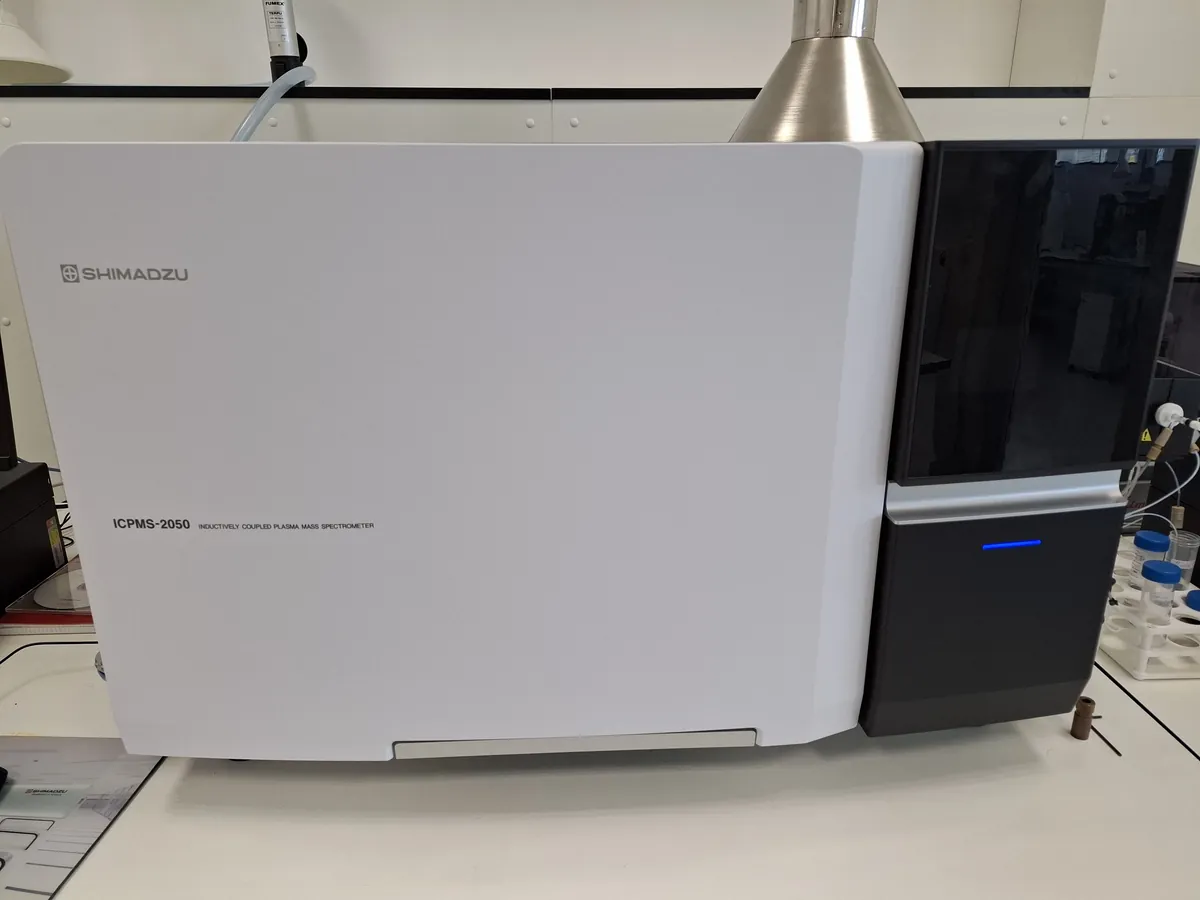
Inductively Coupled Plasma Mass Spectrometer (ICP-MS)
Ionises the sample in an argon plasma and counts the ions of each element by their mass. The most sensitive routine technique for elemental impurities, reaching ng/L levels.
- Pharmaceutical
- Biotech
- Environmental
- Food & beverage
- Semiconductor
- Clinical
Follow your site SOP
This is a typical operating sequence for learning. Your instrument model and approved SOP take precedence.
STAGE 1
Before you start
- 1Check calibration status, argon supply, chiller and exhaust.
- 2Confirm vacuum is within the normal range (the instrument stays under vacuum between uses).
- 3Inspect cones, pump tubing and the sample path; clean or replace as needed.
- 4Use acid-cleaned or certified-clean plastic ware and ultrapure (Type 1) water for all solutions.
- Contamination is the biggest risk at ng/L levels: wear powder-free gloves and avoid glassware for trace work.
STAGE 2
Start-up and tuning
- 1Ignite the plasma and aspirate dilute acid; allow it to warm up (often 20–30 minutes).
- 2Run the tuning / performance check solution (e.g. Li, Co, Y, Ce, Tl at about 1 µg/L).
- 3Confirm sensitivity, oxide ratio, doubly charged ratio, mass calibration and peak width meet the SOP limits.
- 4Run the cell-mode check (e.g. helium mode interference removal) if required.
- Do not run samples if the tune fails; re-optimise or clean the cones first.
STAGE 3
Measurement
- 1Calibrate with a blank and standards bracketing the target (J) value, matrix-matched in acid.
- 2Add internal standards to all solutions, usually on-line.
- 3Run system suitability: standardisation drift check and recovery of spiked samples as per the <233> procedure.
- 4Run samples with blanks and check standards at set intervals; check internal standard recoveries stay within limits.
- Keep total dissolved solids low (often below about 0.2%) to avoid cone blockage and signal drift.
STAGE 4
Shutdown
- 1Rinse with dilute nitric acid (with a little HCl if mercury was measured), then water.
- 2Extinguish the plasma; the vacuum stays on.
- 3Release pump tubing tension and complete the log book.
In LimsPulse · Calibration Management
Keep every ICP-MS in control: usage logs, calibration and maintenance schedules, and automatic blocking of overdue instruments.