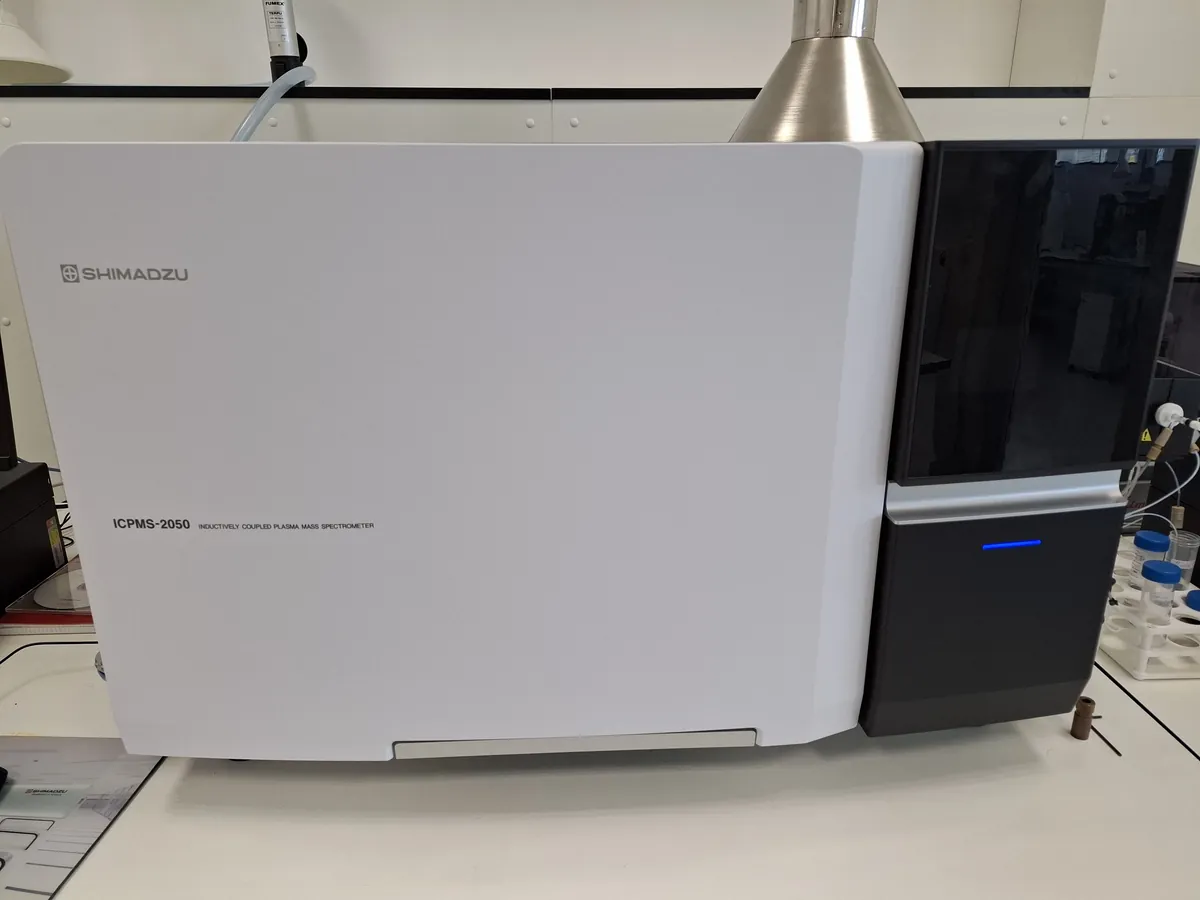
Inductively Coupled Plasma Mass Spectrometer (ICP-MS)
Ionises the sample in an argon plasma and counts the ions of each element by their mass. The most sensitive routine technique for elemental impurities, reaching ng/L levels.
- Pharmaceutical
- Biotech
- Environmental
- Food & beverage
- Semiconductor
- Clinical
How ICP-MS works
The plasma converts each element into singly charged positive ions. The ions pass through cones into a vacuum, are filtered by mass in a quadrupole, and are counted. The count rate at an element's mass is proportional to its concentration, and is quantified against calibration standards with internal standard correction.
The path of a sample
- 01
Sample introduction
Peristaltic pump, nebuliser and cooled spray chamber deliver a fine aerosol to the plasma.
- 02
Plasma ionisation
The argon plasma dries, atomises and ionises the sample; most elements form M⁺ ions efficiently.
- 03
Interface cones
Sampler and skimmer cones extract a beam of ions from the atmospheric-pressure plasma into the vacuum.
- 04
Ion lenses
Focus the positive ions and remove photons and neutral species.
- 05
Collision/reaction cell
Helium collisions (kinetic energy discrimination) or reactive gases remove polyatomic interferences.
- 06
Quadrupole and detector
The quadrupole passes one m/z at a time; an electron multiplier counts the ions in counts per second (cps).
Main parts and what they do
Autosampler and peristaltic pump
Deliver samples and internal standard at a constant rate.
Nebuliser and cooled spray chamber
Produce a fine aerosol and reduce water and oxide load on the plasma.
Torch and RF generator
Sustain the argon plasma that ionises the sample.
Sampler and skimmer cones
Nickel or platinum cones that extract ions into the vacuum; they need regular cleaning.
Ion optics
Focus ions and block photons and neutral particles.
Collision/reaction cell
Removes polyatomic interferences using helium, hydrogen, oxygen or ammonia.
Quadrupole mass analyser
Filters ions by m/z.
Detector and vacuum system
Electron multiplier counts ions; turbo-molecular and rotary pumps maintain high vacuum.
Terms every analyst should know
Mass-to-charge ratio (m/z)
Ions are separated by mass ÷ charge. Most plasma ions are singly charged, so m/z equals isotope mass.
Polyatomic interference
Ions made from argon, acids and matrix that share a nominal mass with the analyte, e.g. ⁴⁰Ar³⁵Cl⁺ at m/z 75 (arsenic).
Isobaric interference
Isotopes of different elements with the same mass, e.g. ²⁰⁴Hg and ²⁰⁴Pb. Avoided by choosing another isotope or mathematical correction.
Oxide and doubly charged ions
CeO⁺/Ce⁺ and Ce²⁺/Ce⁺ ratios show how much interference the plasma conditions create; they are checked during tuning.
Internal standardisation
Elements not present in samples (e.g. Sc, Ge, Rh, In, Tb, Bi) are added to correct for drift and matrix suppression.
Memory effect
Some elements, notably mercury, stick to the sample path and give carry-over. Hydrochloric acid or gold in the rinse helps wash it out.
Keep every ICP-MS in control: usage logs, calibration and maintenance schedules, and automatic blocking of overdue instruments.