Spectroscopy
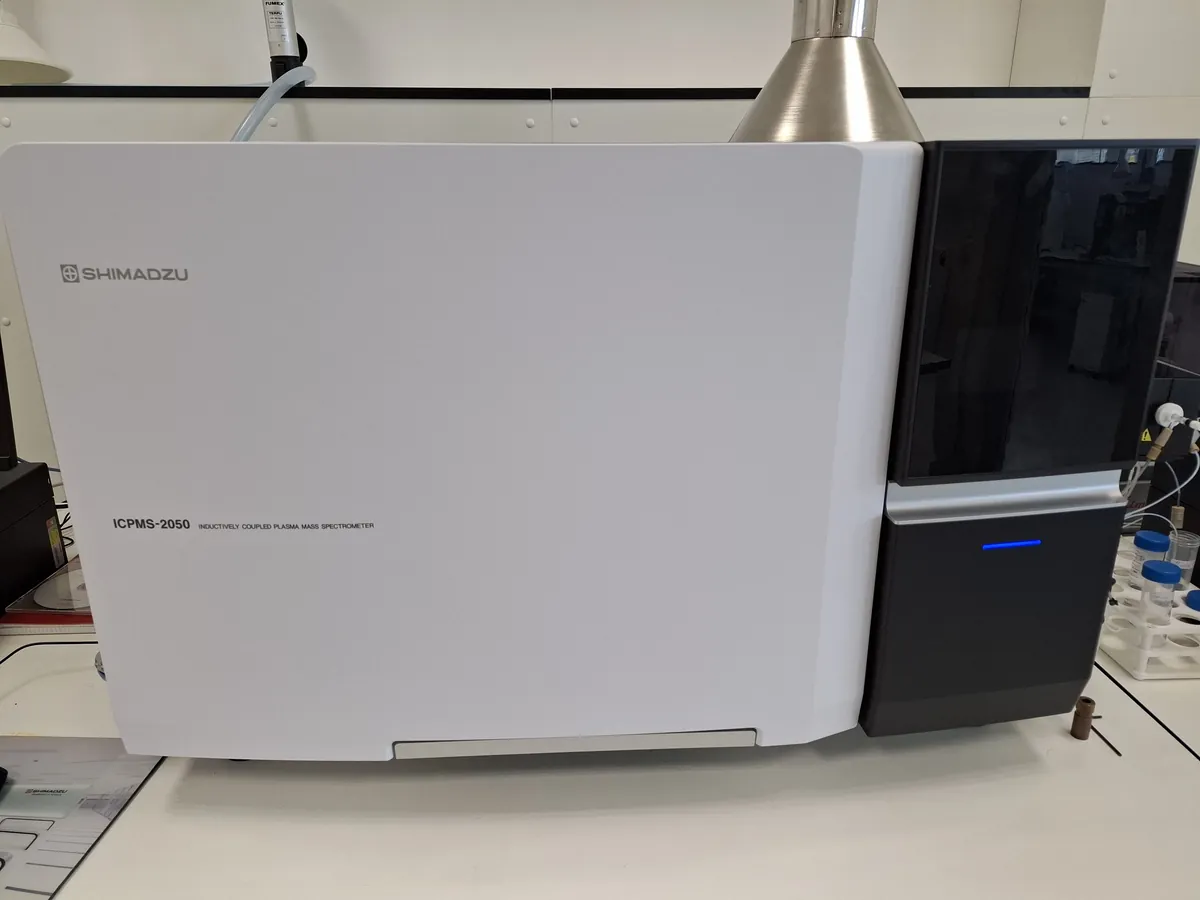
Inductively Coupled Plasma Mass Spectrometer (ICP-MS)
Ionises the sample in an argon plasma and counts the ions of each element by their mass. The most sensitive routine technique for elemental impurities, reaching ng/L levels.
- Pharmaceutical
- Biotech
- Environmental
- Food & beverage
- Semiconductor
- Clinical
TROUBLESHOOTING
Common problems, causes and fixes
Low sensitivity in tune
Likely causes
- • Dirty or worn cones
- • Partly blocked nebuliser
- • Worn pump tubing
- • Dirty ion lenses
What to do
- • Clean or replace cones
- • Clean the nebuliser
- • Replace pump tubing
- • Clean lenses as per manual
High oxide (CeO⁺/Ce⁺) ratio
Likely causes
- • Nebuliser gas flow too high
- • Spray chamber temperature too high
- • Torch position not optimised
What to do
- • Re-tune nebuliser gas flow
- • Check spray chamber cooling
- • Re-optimise torch alignment
High arsenic or selenium in blanks
Likely causes
- • Polyatomic interference (ArCl⁺, ArAr⁺)
- • Contaminated reagents
What to do
- • Use helium collision or reaction mode
- • Use high-purity acids and fresh blank
Mercury carry-over
Likely causes
- • Hg adsorbing to tubing and spray chamber
What to do
- • Add HCl or gold to rinse and solutions
- • Lengthen rinse time
Internal standard recovery falling during run
Likely causes
- • Matrix deposits on cones
- • High dissolved solids
- • Drift
What to do
- • Dilute samples further
- • Clean cones
- • Re-calibrate and repeat affected samples
Vacuum fault
Likely causes
- • Interface or cone O-ring leak
- • Rotary pump oil low or degraded
What to do
- • Check cone seating and O-rings
- • Service the rotary pump
In LimsPulse · Calibration Management
Keep every ICP-MS in control: usage logs, calibration and maintenance schedules, and automatic blocking of overdue instruments.