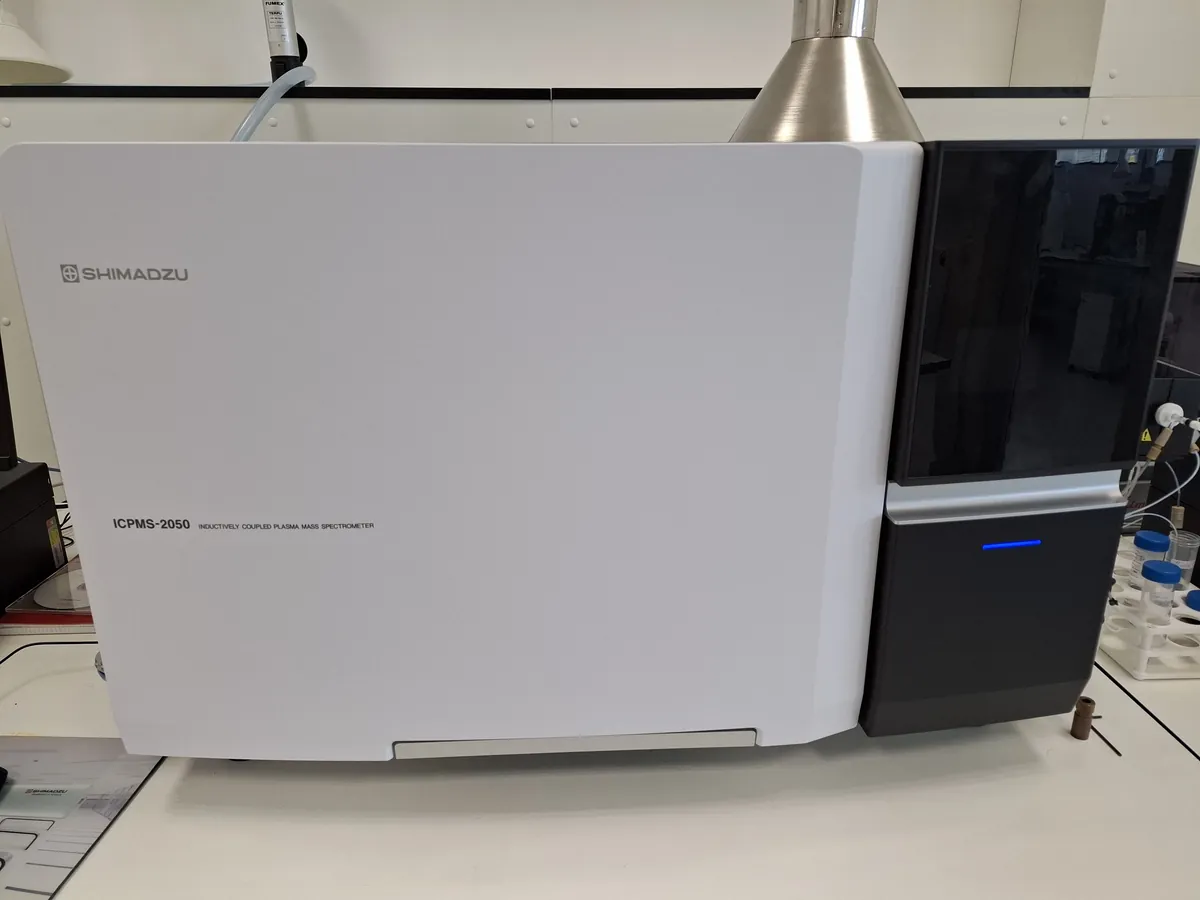
Inductively Coupled Plasma Mass Spectrometer (ICP-MS)
Ionises the sample in an argon plasma and counts the ions of each element by their mass. The most sensitive routine technique for elemental impurities, reaching ng/L levels.
- Pharmaceutical
- Biotech
- Environmental
- Food & beverage
- Semiconductor
- Clinical
ICP-MS calibration procedures
Tuning & mass calibration
Uses a tuning solution of light, medium and heavy elements to check and adjust mass accuracy, peak width, sensitivity and the oxide and doubly charged ion ratios.
Open procedureDetection limit check
Converts the noise of repeated blank measurements into the lowest concentration the ICP-MS can detect for key elements such as Pb, Cd, As and Hg.
Open procedureInstrument qualification (DQ · IQ · OQ · PQ)
- 01
DQ — Design qualification
Defines elements and target limits (based on PDEs and dose), sample matrices, collision/reaction cell needs and data integrity requirements.
- 02
IQ — Installation qualification
Confirms installation, utilities (argon, cell gases, exhaust, chiller, clean power), vacuum, software version and documentation.
- 03
OQ — Operational qualification
Tests mass calibration and resolution, sensitivity, oxide and doubly charged ratios, background, detection limits, stability and detector linearity.
- 04
PQ — Performance qualification
Shows routine fitness through daily tuning and the system suitability and spike recovery checks in the validated <233> procedure.
Keep every ICP-MS in control: usage logs, calibration and maintenance schedules, and automatic blocking of overdue instruments.