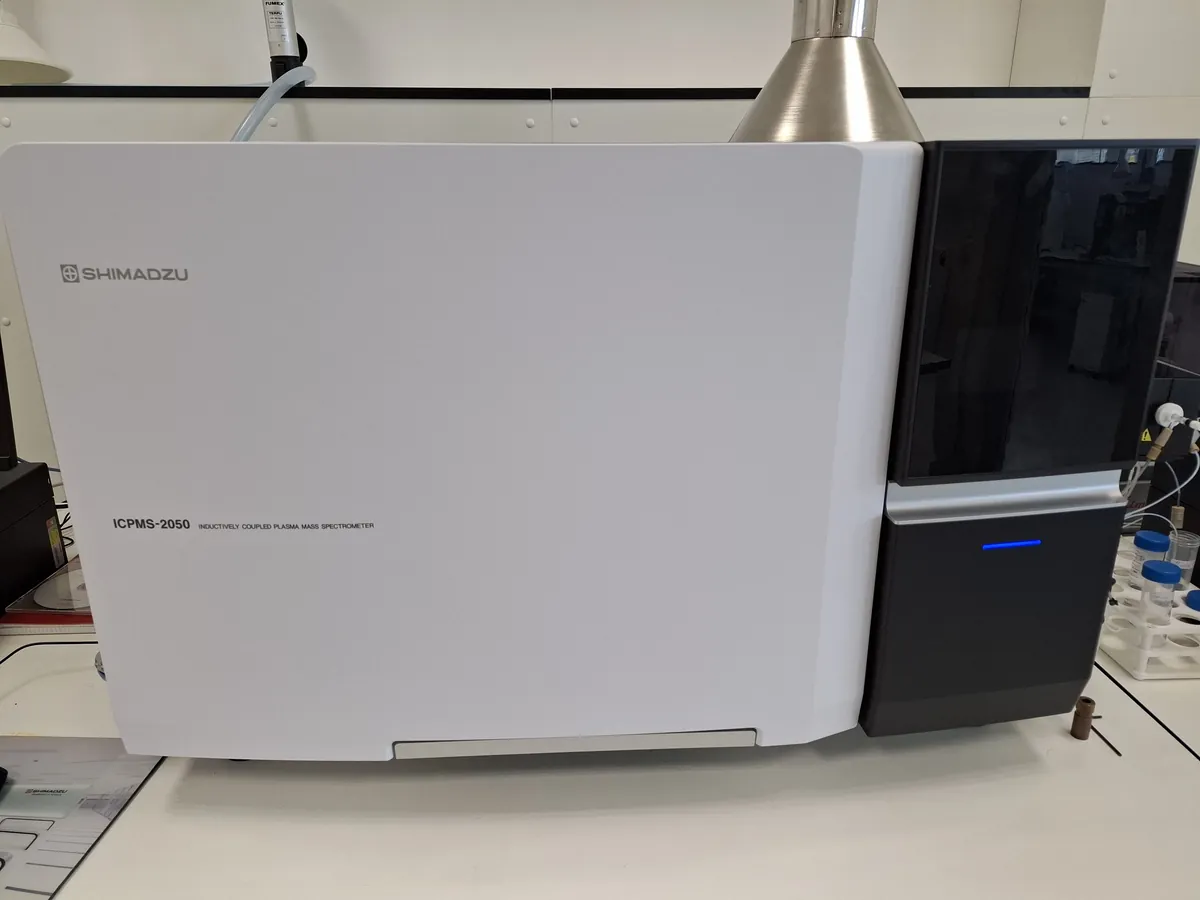
Inductively Coupled Plasma Mass Spectrometer (ICP-MS)
Ionises the sample in an argon plasma and counts the ions of each element by their mass. The most sensitive routine technique for elemental impurities, reaching ng/L levels.
- Pharmaceutical
- Biotech
- Environmental
- Food & beverage
- Semiconductor
- Clinical
Test your ICP-MS knowledge
Multiple-choice questions
Pick an answer to see whether you are right and why.
Q1. How does ICP-MS identify each element?
basicQ2. Which parts extract ions from the plasma into the vacuum?
basicQ3. ⁴⁰Ar³⁵Cl⁺ interferes with which element?
intermediateQ4. Which ratio is checked during tuning to show how many oxide ions the plasma forms?
intermediateQ5. Under ICH Q3D, which elements are Class 1?
intermediateQ6. What is the ICH Q3D control threshold?
intermediateQ7. 0.2000 g of API is digested and made up to 50 mL. The ICP-MS reads 0.80 µg/L Cd (blank 0.00). What is the Cd content?
advancedQ8. In the USP <233> approach, spike recovery for accuracy is typically required to be within:
advanced
Viva questions
Think of your answer first, then open it to compare.
1. Why are internal standards used in ICP-MS?
Matrix components and deposits on the cones change the ion signal during a run. Internal standard elements, added equally to every solution and close in mass to the analytes, suffer the same changes, so ratioing to them corrects for suppression and drift.
2. Why is closed-vessel microwave digestion preferred for elemental impurities?
Sealed vessels reach higher temperatures and pressures, so organic matrices are destroyed completely and quickly. Volatile elements such as mercury and arsenic are not lost, and contamination from the lab environment is low.
3. What is the J value in USP <233>?
J is the concentration of an element at its target limit after the sample is prepared and diluted, expressed in the measured solution (e.g. µg/L). Standards are prepared around J (e.g. 0.5 J and 1.5 J) and spikes are made relative to J.
4. How do you prevent mercury carry-over and loss?
Keep hydrochloric acid (or a little gold) in standards, samples and rinse to keep Hg in solution as a complex, use adequate rinse times, use plastic ware, and never open digestion vessels while hot.
Keep every ICP-MS in control: usage logs, calibration and maintenance schedules, and automatic blocking of overdue instruments.