Hot Air Oven
An electrically heated, insulated cabinet that holds samples or glassware at a set temperature. In QC it is used mainly for loss on drying, drying of reference materials and drying of glassware.
- Pharmaceutical
- Food & beverage
- Chemicals
- Materials testing
- Education
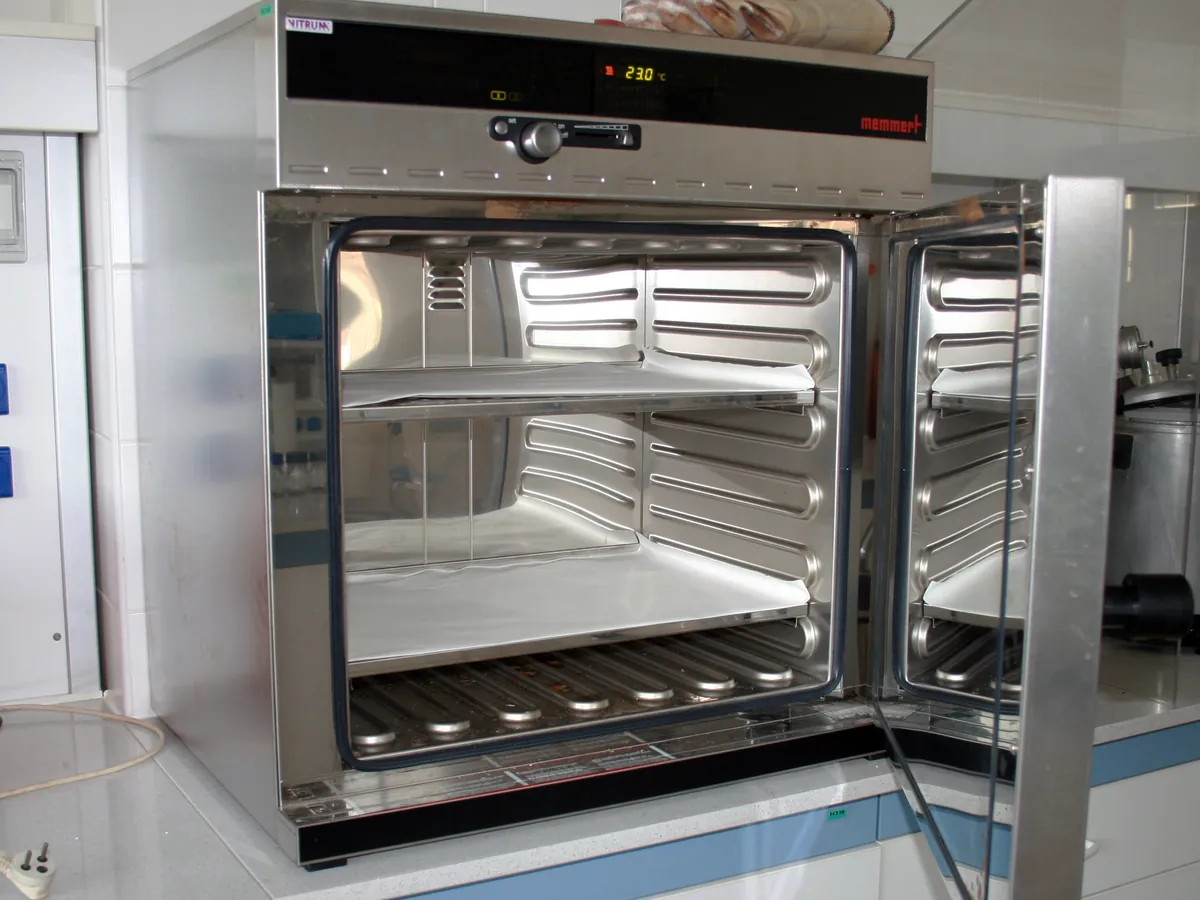
What is Hot air oven?
A hot air oven heats air with electrical elements and circulates it around the chamber, either naturally (by convection currents) or with a fan (forced convection). A temperature sensor and controller keep the chamber close to the set temperature.
In a pharmaceutical QC lab the most common use is the loss on drying (LOD) test, where a sample is dried at a stated temperature, often 105 °C, and the loss in mass is reported. Ovens are also used to dry primary standards before standardisation, to dry glassware and, in suitably qualified ovens, for dry-heat sterilisation.
Because results such as LOD depend directly on temperature, the oven's temperature accuracy and uniformity are calibrated and mapped at regular intervals.
Used for
- Loss on drying of APIs and excipients
- Drying primary standards such as potassium hydrogen phthalate before use
- Drying glassware and equipment parts
- Dry-heat sterilisation of glassware in qualified ovens
- Pre-conditioning of samples or containers before tests
How it works
- 01
Set point
The operator sets the required temperature on the controller.
- 02
Heating
Elements heat the air, controlled by the PID controller.
- 03
Circulation
Air moves by natural convection or a fan, spreading heat through the chamber.
- 04
Sensing
A Pt100 or thermocouple sensor feeds the actual temperature back to the controller.
- 05
Drying
Volatiles leave the sample and are vented through the air outlet.
Advantages
- Simple, robust and inexpensive
- Holds many samples at once
- Wide temperature range, often ambient + 5 °C up to about 250–300 °C
- Low running cost and little maintenance
Limitations
- Not specific to water: LOD includes any volatile matter
- Temperature is not perfectly uniform; door opening disturbs it
- Not suitable for heat-sensitive samples (a vacuum oven at lower temperature is used instead)
- Standard ovens must not be used with flammable solvents
2 calibration procedures
Methods that use Hot air oven
Keep every Hot air oven in control: usage logs, calibration and maintenance schedules, and automatic blocking of overdue instruments.