Hot Air Oven
An electrically heated, insulated cabinet that holds samples or glassware at a set temperature. In QC it is used mainly for loss on drying, drying of reference materials and drying of glassware.
- Pharmaceutical
- Food & beverage
- Chemicals
- Materials testing
- Education
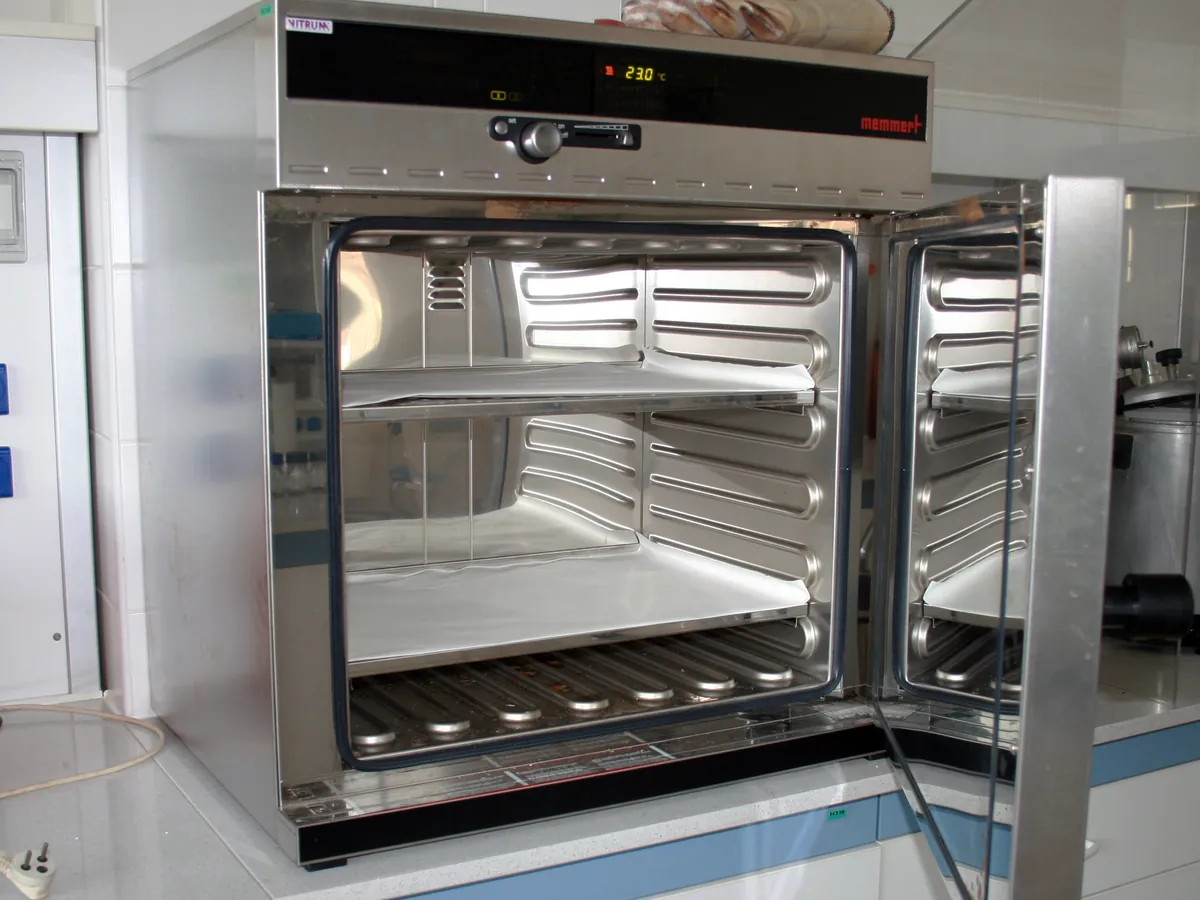
How Hot air oven works
Heating elements warm the air, and the warm air transfers heat to the samples by convection. A controller compares the sensor reading with the set point and switches the heaters to hold the temperature. In LOD, water and other volatiles leave the sample until its mass no longer changes.
The path of a sample
- 01
Set point
The operator sets the required temperature on the controller.
- 02
Heating
Elements heat the air, controlled by the PID controller.
- 03
Circulation
Air moves by natural convection or a fan, spreading heat through the chamber.
- 04
Sensing
A Pt100 or thermocouple sensor feeds the actual temperature back to the controller.
- 05
Drying
Volatiles leave the sample and are vented through the air outlet.
Main parts and what they do
Insulated chamber
Stainless-steel inner chamber with perforated shelves, surrounded by insulation.
Heating elements
Electrical resistance heaters, usually at the bottom or sides of the chamber.
Circulation fan (forced-convection ovens)
Moves air across the shelves for faster heating and better uniformity.
Temperature sensor
Pt100 resistance thermometer or thermocouple used by the controller.
Controller and display
Sets and holds the temperature; many have timers and alarms.
Over-temperature cut-out
Independent safety thermostat that switches the heaters off if the chamber overheats.
Air inlet and exhaust vent
Lets fresh air in and moisture-laden air out, which matters for drying.
Terms every analyst should know
Natural vs forced convection
Natural convection relies on warm air rising and gives gentle air movement, suitable for fine powders. Forced convection uses a fan for faster heating and better uniformity.
Loss on drying (LOD)
The percentage loss in mass of a sample after drying under stated conditions. It counts water and any other volatile matter.
Drying to constant weight
Drying is continued until two consecutive weighings, with a further period of drying between them, differ by no more than a stated small amount, as defined in the pharmacopoeia.
Temperature accuracy vs uniformity
Accuracy is how close the chamber is to the set temperature; uniformity is how much the temperature varies between positions in the chamber.
PID control
The controller adjusts heating in proportion to the error, its history and its rate of change, so the temperature settles without large overshoot.
Keep every Hot air oven in control: usage logs, calibration and maintenance schedules, and automatic blocking of overdue instruments.