Gas Chromatograph (GC)
Separates volatile compounds in a heated capillary column using a flowing inert gas and measures each one as it leaves, usually with a flame ionisation detector. Used in pharma QC for residual solvents, volatile impurities and some assays.
- Pharmaceutical
- Petrochemical
- Food & flavour
- Environmental
- Forensic
- Chemicals
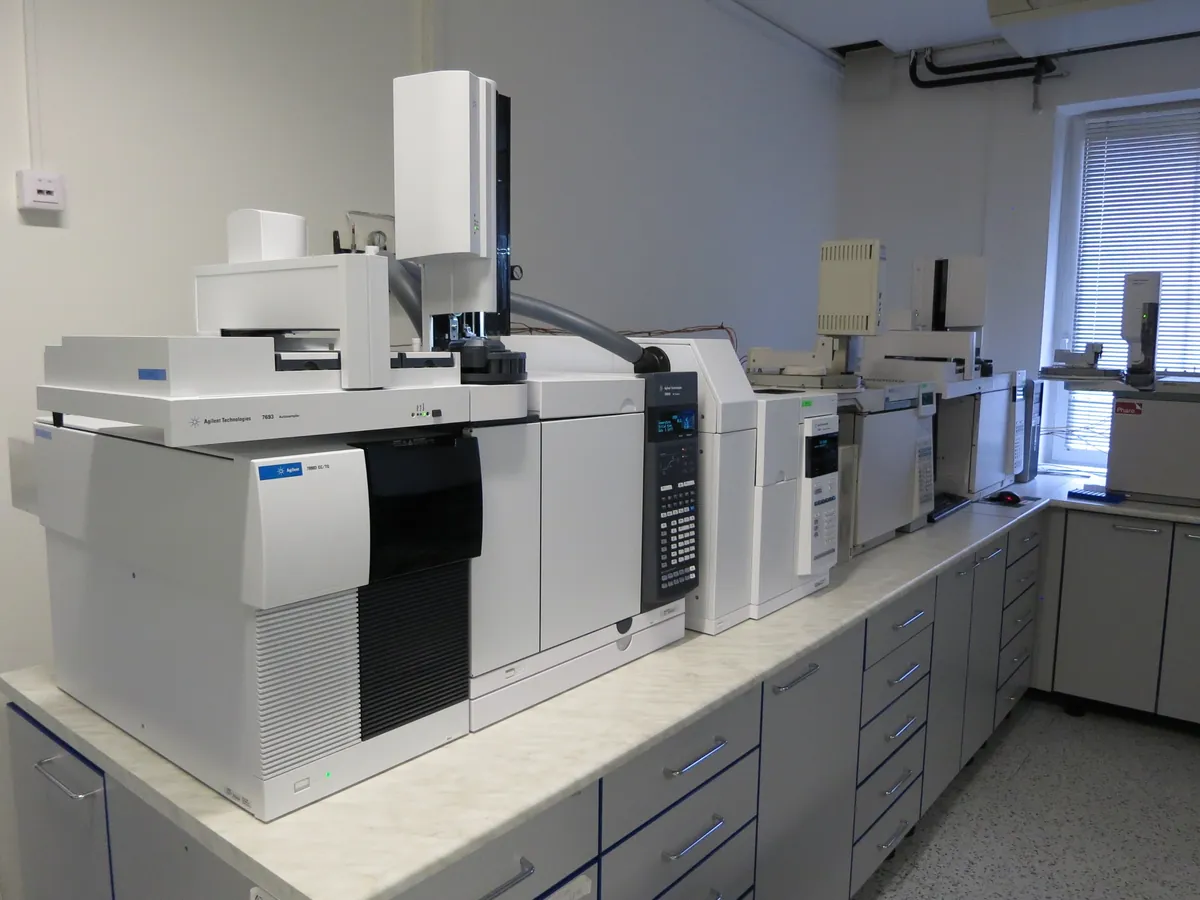
What is GC?
A gas chromatograph vaporises a small sample in a heated inlet and sweeps it into a long, narrow column with a flowing gas (the carrier gas). The inside wall of the column is coated with a thin film of liquid-like polymer (the stationary phase). Each compound spends a different fraction of its time dissolved in that film, so the compounds travel at different speeds and leave the column one after another.
The column sits in an oven whose temperature can be held constant or raised during the run (temperature programming). Low-boiling compounds elute first at low temperature; higher-boiling compounds are pushed out as the oven heats up.
A detector at the column outlet, most often a flame ionisation detector (FID), produces a peak for each compound. As in HPLC, retention time identifies the compound and peak area gives the amount by comparison with a standard.
In a pharmaceutical QC lab GC is used mainly for residual solvents (with a headspace sampler), volatile organic impurities, assay of volatile raw materials, fatty-acid composition of oils, and alcohol content of liquids and tinctures.
Used for
- Residual solvents in APIs, excipients and finished products (headspace GC-FID)
- Purity and related substances of volatile raw materials (e.g. solvents, menthol, camphor)
- Assay of ethanol or other alcohols in liquid formulations
- Fatty-acid composition of oils and lipids (as methyl esters)
- Genotoxic or volatile impurities such as alkyl halides (often GC-MS)
- Cleaning validation for volatile residues
How it works
- 01
Gas supply
Carrier gas (helium, nitrogen or hydrogen) passes through traps and an electronic pressure controller.
- 02
Inlet
The sample is injected through a septum into a hot glass liner (commonly 200–250 °C) and vaporised.
- 03
Split / splitless
In split mode most of the vapour is vented and only a fraction enters the column; splitless sends nearly all of it.
- 04
Column & oven
Compounds separate in a fused-silica capillary column inside a temperature-programmed oven.
- 05
Detector
An FID (or TCD, ECD, MS) produces a signal as each compound elutes.
- 06
Data system
Records the chromatogram, integrates peaks and calculates results with an audit trail.
Advantages
- Very high separating power with capillary columns (often 100,000+ theoretical plates per column)
- FID responds to almost all organic compounds and is linear over a very wide range
- No liquid mobile phase, so little solvent waste
- Fast runs for simple mixtures and easy automation with an autosampler
- Ideal for volatile compounds that HPLC handles poorly, such as solvents
Limitations
- Only for compounds that are volatile and stable at inlet and oven temperatures
- Polar or non-volatile analytes may need derivatisation
- FID gives a poor response for compounds with few C–H bonds (e.g. water, formic acid, highly halogenated solvents)
- Needs a supply of high-purity gases, including flammable hydrogen for the FID
- Inlet consumables (septa, liners) need regular replacement
4 calibration procedures
Methods that use GC
Keep every GC in control: usage logs, calibration and maintenance schedules, and automatic blocking of overdue instruments.