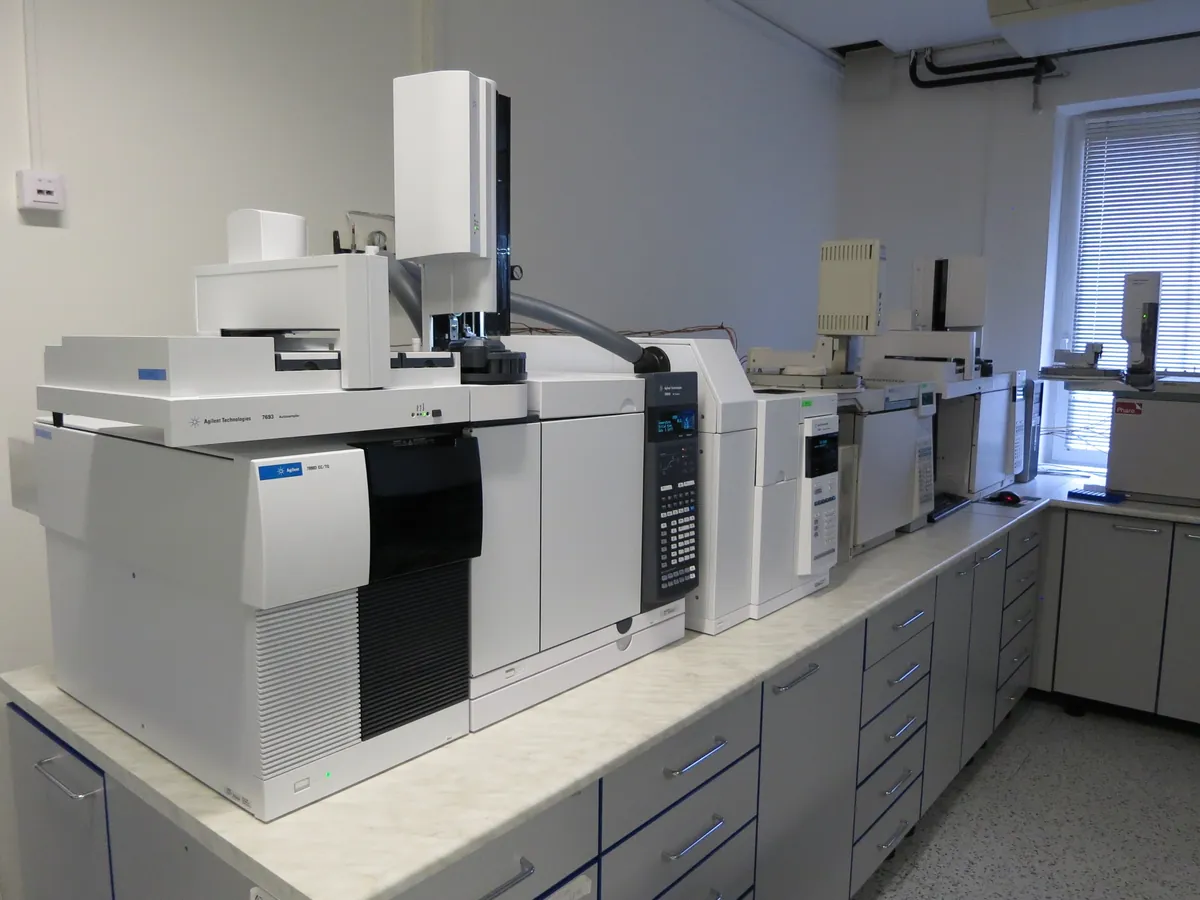
Gas Chromatograph (GC)
Separates volatile compounds in a heated capillary column using a flowing inert gas and measures each one as it leaves, usually with a flame ionisation detector. Used in pharma QC for residual solvents, volatile impurities and some assays.
- Pharmaceutical
- Petrochemical
- Food & flavour
- Environmental
- Forensic
- Chemicals
GC calibration procedures
Oven temperature accuracy
Checks that the column oven reaches and holds the set temperature, using a calibrated temperature probe placed near the column.
Open procedureCarrier gas flow accuracy
Compares the carrier gas flow set by the electronic pressure control with the flow measured by a calibrated flow meter.
Open procedureInjector precision
Checks that the autosampler and inlet deliver the same amount of sample each time, by calculating the %RSD of peak areas from replicate injections.
Open procedureDetector linearity
Checks that FID response is proportional to the amount of analyte across the range used by your methods.
Open procedureInstrument qualification (DQ · IQ · OQ · PQ)
- 01
DQ — Design qualification
Documents what the lab needs (inlet types, detectors, oven range, EPC, headspace compatibility, gas types, CDS with audit trail) and confirms the selected model meets it.
- 02
IQ — Installation qualification
Confirms correct delivery and installation: components and serial numbers, gas lines and regulators leak-checked, venting of split and FID exhausts, software version and documentation.
- 03
OQ — Operational qualification
Tests each module against specification: oven temperature accuracy and stability, carrier gas flow or pressure accuracy, injector precision, detector noise, drift and linearity, and carry-over.
- 04
PQ — Performance qualification
Shows the system performs consistently for its intended use, for example a test mixture or the residual solvents system suitability run on a defined schedule.
Keep every GC in control: usage logs, calibration and maintenance schedules, and automatic blocking of overdue instruments.