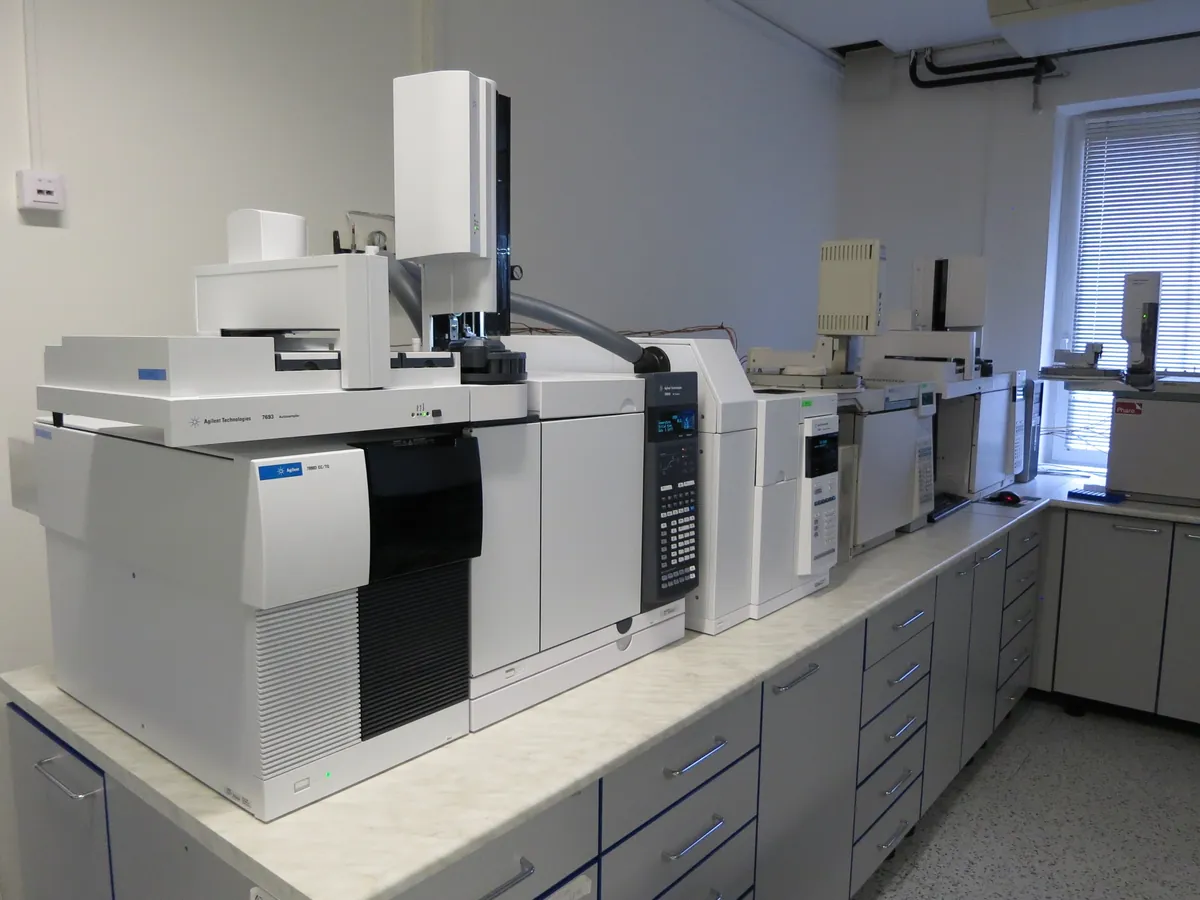
Gas Chromatograph (GC)
Separates volatile compounds in a heated capillary column using a flowing inert gas and measures each one as it leaves, usually with a flame ionisation detector. Used in pharma QC for residual solvents, volatile impurities and some assays.
- Pharmaceutical
- Petrochemical
- Food & flavour
- Environmental
- Forensic
- Chemicals
Test your GC knowledge
Multiple-choice questions
Pick an answer to see whether you are right and why.
Q1. What is the mobile phase in gas chromatography?
basicQ2. Which detector is most widely used for residual solvents by GC?
basicQ3. Which type of compound can be analysed directly by GC?
basicQ4. A split ratio of 1:50 means:
intermediateQ5. Why is temperature programming used in GC?
intermediateQ6. Ghost peaks that look like a regular series of siloxanes in a blank run most likely come from:
intermediateQ7. Before heating the GC oven with a new column fitted, you should:
advancedQ8. After trimming 50 cm from the inlet end of a capillary column, retention times shift earlier. What should you do?
advanced
Viva questions
Think of your answer first, then open it to compare.
1. Compare helium, nitrogen and hydrogen as carrier gases.
Helium is inert and safe with good efficiency over a range of velocities, but it is expensive and supply is limited. Nitrogen is cheap and safe but has a narrow, low optimum velocity, so runs are slower for the same efficiency. Hydrogen gives the fastest runs with a flat van Deemter curve, but it is flammable and can react with some analytes, so it needs leak-tight systems and safety controls.
2. What is the difference between split and splitless injection, and when would you use each?
In split injection most of the vaporised sample is vented and only a small fraction enters the column; it is used for concentrated samples and gives sharp peaks. In splitless injection the split vent is closed for the first minute or so, sending almost all the sample to the column; it is used for trace analysis but needs solvent focusing with a low starting oven temperature.
3. How does an FID work, and which compounds does it not detect well?
The column effluent is burned in a small hydrogen–air flame. Organic compounds form ions in the flame, and a collector electrode measures the resulting current, which is proportional to the number of carbon atoms burned. It responds poorly or not at all to water, permanent gases, carbon dioxide, and compounds with few C–H bonds such as formic acid or highly halogenated solvents.
4. What routine inlet maintenance do you do on a GC and why?
Replace the septum regularly (leaks and bleed), replace or clean the glass liner (non-volatile residue and septum fragments cause tailing and loss of active compounds), replace the O-ring and gold seal as needed, fit new ferrules whenever the column is reinstalled, and trim the front of the column when peak shape degrades. These keep areas precise, retention stable and peaks symmetrical.
Keep every GC in control: usage logs, calibration and maintenance schedules, and automatic blocking of overdue instruments.