Gas Chromatograph (GC)
Separates volatile compounds in a heated capillary column using a flowing inert gas and measures each one as it leaves, usually with a flame ionisation detector. Used in pharma QC for residual solvents, volatile impurities and some assays.
- Pharmaceutical
- Petrochemical
- Food & flavour
- Environmental
- Forensic
- Chemicals
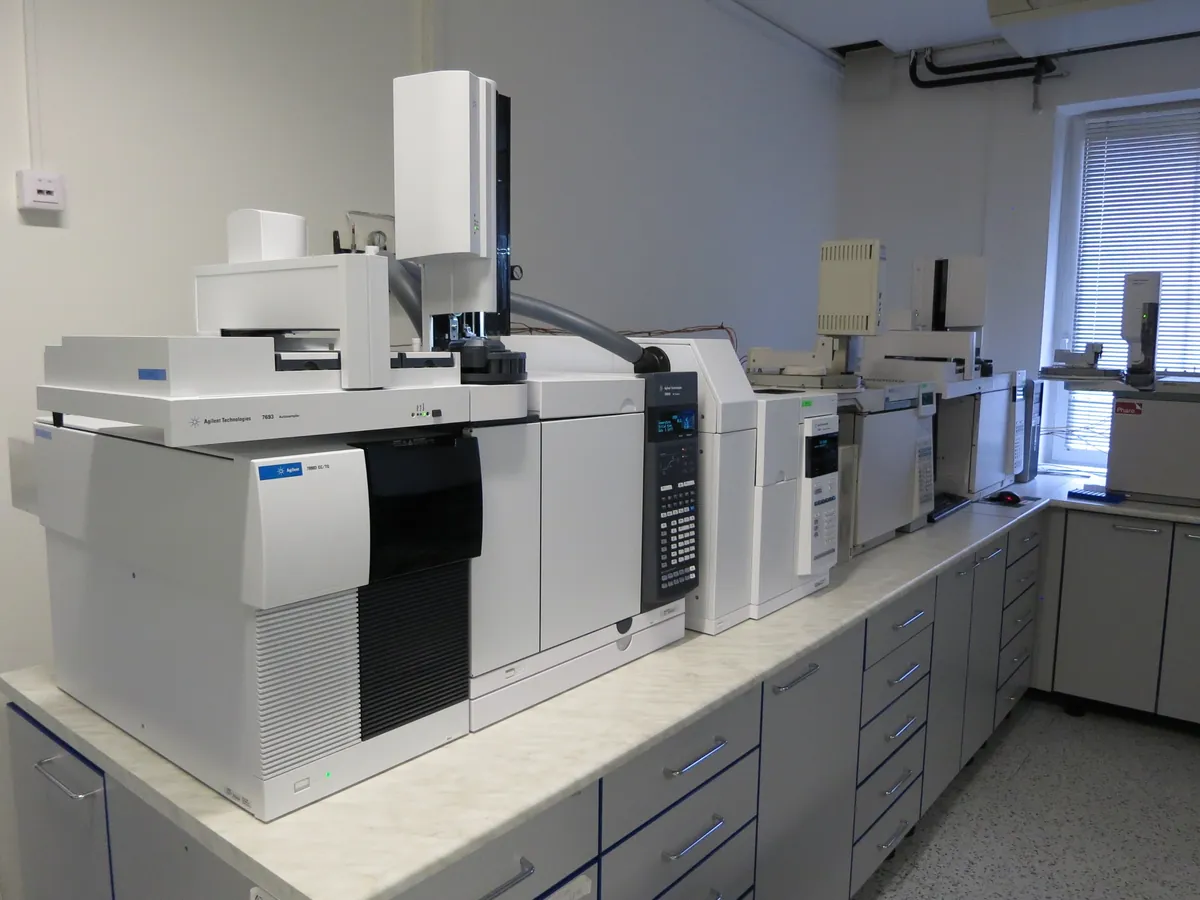
How GC works
Separation is based on partition between a gas mobile phase and a liquid-like stationary phase coated on the column wall. A compound's retention depends mainly on its volatility (boiling point) and on how strongly it interacts with the stationary phase. Raising the oven temperature lowers retention, which is why temperature programming is used to elute a wide boiling range in one run.
The path of a sample
- 01
Gas supply
Carrier gas (helium, nitrogen or hydrogen) passes through traps and an electronic pressure controller.
- 02
Inlet
The sample is injected through a septum into a hot glass liner (commonly 200–250 °C) and vaporised.
- 03
Split / splitless
In split mode most of the vapour is vented and only a fraction enters the column; splitless sends nearly all of it.
- 04
Column & oven
Compounds separate in a fused-silica capillary column inside a temperature-programmed oven.
- 05
Detector
An FID (or TCD, ECD, MS) produces a signal as each compound elutes.
- 06
Data system
Records the chromatogram, integrates peaks and calculates results with an audit trail.
Main parts and what they do
Gas cylinders or generators
Supply carrier gas and detector gases (hydrogen, air, make-up nitrogen) at high purity, typically 99.999%.
Two-stage regulators and gas traps
Reduce cylinder pressure and remove moisture, oxygen and hydrocarbons that damage the column or raise baseline noise.
Electronic pneumatic control (EPC)
Controls inlet pressure, column flow, split flow and detector gas flows precisely.
Autosampler
Rinses a microsyringe, draws the sample and injects a fixed volume (often 1 µL) into the inlet.
Split/splitless inlet
Heated chamber with a septum and glass liner where the sample vaporises and is split or transferred to the column.
Capillary column
Fused-silica tube coated inside with a stationary phase, e.g. 5% phenyl or 6% cyanopropylphenyl polysiloxane, 15–60 m long.
Column oven
Fan-forced oven that holds or ramps temperature accurately from near ambient up to about 350–450 °C.
Detector
FID for most organic analytes; TCD for permanent gases; ECD for halogenated compounds; mass spectrometer for identification.
Chromatography data system (CDS)
Controls the instrument, acquires and integrates data and keeps the audit trail.
Terms every analyst should know
Carrier gas
The inert gas that acts as the mobile phase. Helium is common; hydrogen gives faster runs; nitrogen is cheap but slower for the same efficiency.
Split ratio
Ratio of the gas vented through the split line to the gas entering the column, e.g. 1:5 or 1:50. Higher split ratios give sharper peaks but lower sensitivity.
Temperature programming
Raising the oven temperature at a set rate during the run so early peaks stay resolved and late, high-boiling peaks still elute quickly and sharply.
Retention time and retention factor
Retention time identifies a peak. The retention factor k compares time spent in the stationary phase with time in the gas, and is independent of column length and flow.
Column dimensions
Length, internal diameter and film thickness set efficiency and capacity, e.g. 30 m × 0.32 mm × 1.8 µm. Thick films retain volatile solvents better.
Linear velocity
Carrier gas speed through the column (cm/s). Each gas has an optimum velocity where efficiency is highest (van Deemter curve).
Resolution, plates and tailing
The same system suitability measures as HPLC apply; the formulas are given in USP <621> and Ph. Eur. 2.2.46.
Keep every GC in control: usage logs, calibration and maintenance schedules, and automatic blocking of overdue instruments.