Dissolution Test Apparatus
Measures how fast and how completely the drug is released from a tablet or capsule into a liquid medium held at body temperature. A key quality and release test for oral solid dosage forms.
- Pharmaceutical
- Generic drug development
- Nutraceuticals and dietary supplements
- Veterinary medicines
- Contract research and testing labs
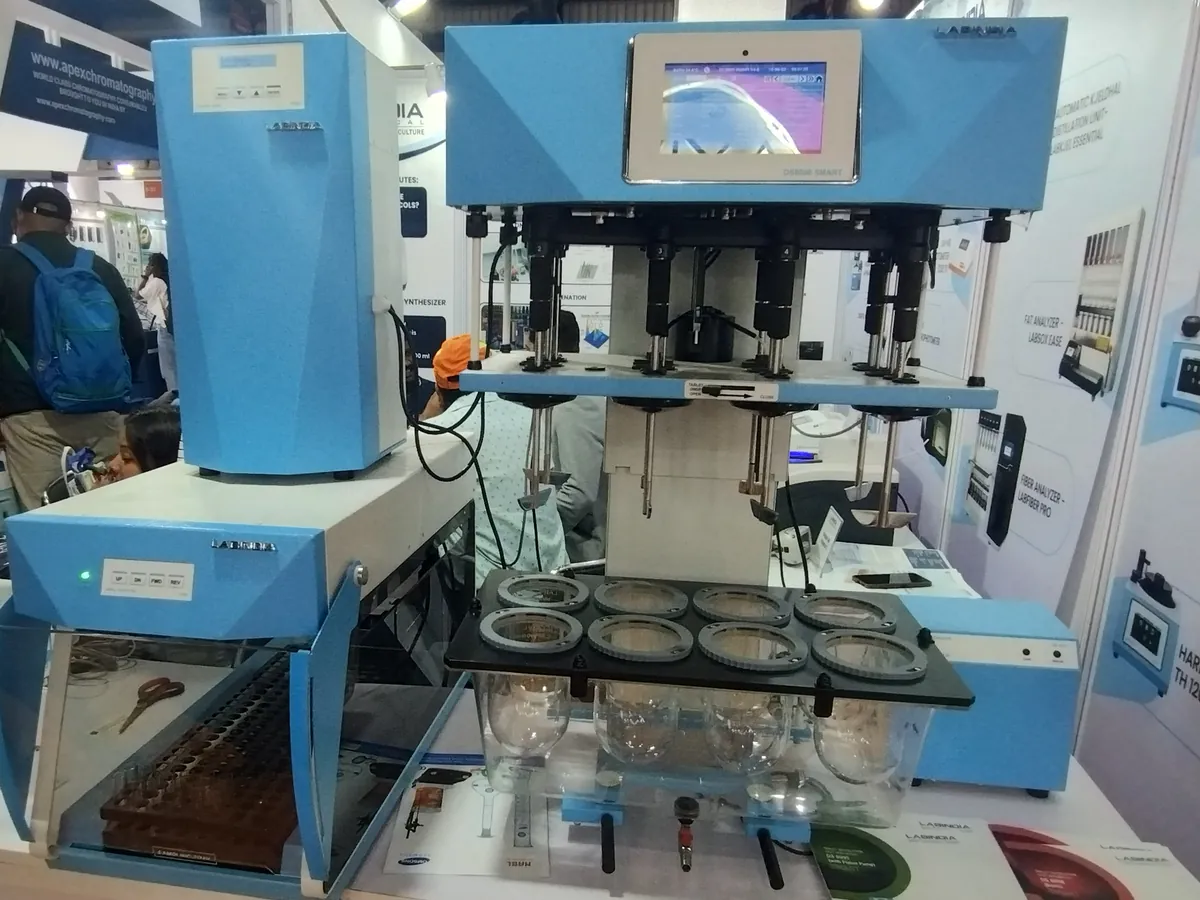
What is Dissolution tester?
A dissolution tester holds a set of glass or plastic vessels (usually six, sometimes seven or eight) in a water bath kept at 37 °C. Each vessel holds a fixed volume of dissolution medium, typically 500 to 1000 mL. A rotating paddle or basket stirs the medium at a fixed speed while one dosage unit releases its drug.
At set times, a portion of the medium is withdrawn from a defined sampling zone, filtered and analysed by UV-Vis spectrophotometry or HPLC. The result is reported as the percentage of the label claim dissolved at each time point.
Dissolution is used for batch release, stability testing and to show that a product performs the same after a change in formulation, process or site. Because the result depends heavily on the hydrodynamics in the vessel, the apparatus must be mechanically calibrated and run carefully every time.
Used for
- Release testing of immediate-release tablets and capsules (single time point, Q value)
- Multi-point profiles for modified-release and delayed-release products
- Stability studies (dissolution at each pull point)
- Comparison of profiles after post-approval changes (f2 similarity)
- Formulation development and bio-relevant media studies
- Investigation of batch-to-batch variability
How it works
- 01
Medium
Prepare and deaerate the specified medium and fill each vessel with the stated volume.
- 02
Equilibrate
Bring the medium to 37 ± 0.5 °C with the paddles or baskets in place.
- 03
Introduce unit
Drop one tablet into each vessel (paddle) or load it into the basket, and start rotation.
- 04
Sample
At each time point withdraw an aliquot from the sampling zone and filter it immediately.
- 05
Analyse
Measure drug concentration by UV-Vis or HPLC against a reference standard.
- 06
Calculate
Express the result as % of label claim dissolved and compare with Q and the stage criteria.
Advantages
- Gives an in vitro measure of drug release that can be linked to in vivo performance
- Standardised apparatus described in all major pharmacopoeias
- Six units tested at once, giving a picture of unit-to-unit variability
- Can be automated with auto-samplers and on-line UV
- Sensitive to formulation and process changes (granulation, compression force, coating)
Limitations
- Results are very sensitive to vibration, dissolved gas, vessel shape, centring and sampling technique
- Single-point tests do not show the full release profile
- Standard media may not reflect conditions in the gut for every drug
- Coning (a mound of undissolved powder under the paddle) can give falsely low results
- Manual sampling is labour-intensive and timing errors add variability
4 calibration procedures
Methods that use Dissolution tester
Keep every Dissolution tester in control: usage logs, calibration and maintenance schedules, and automatic blocking of overdue instruments.