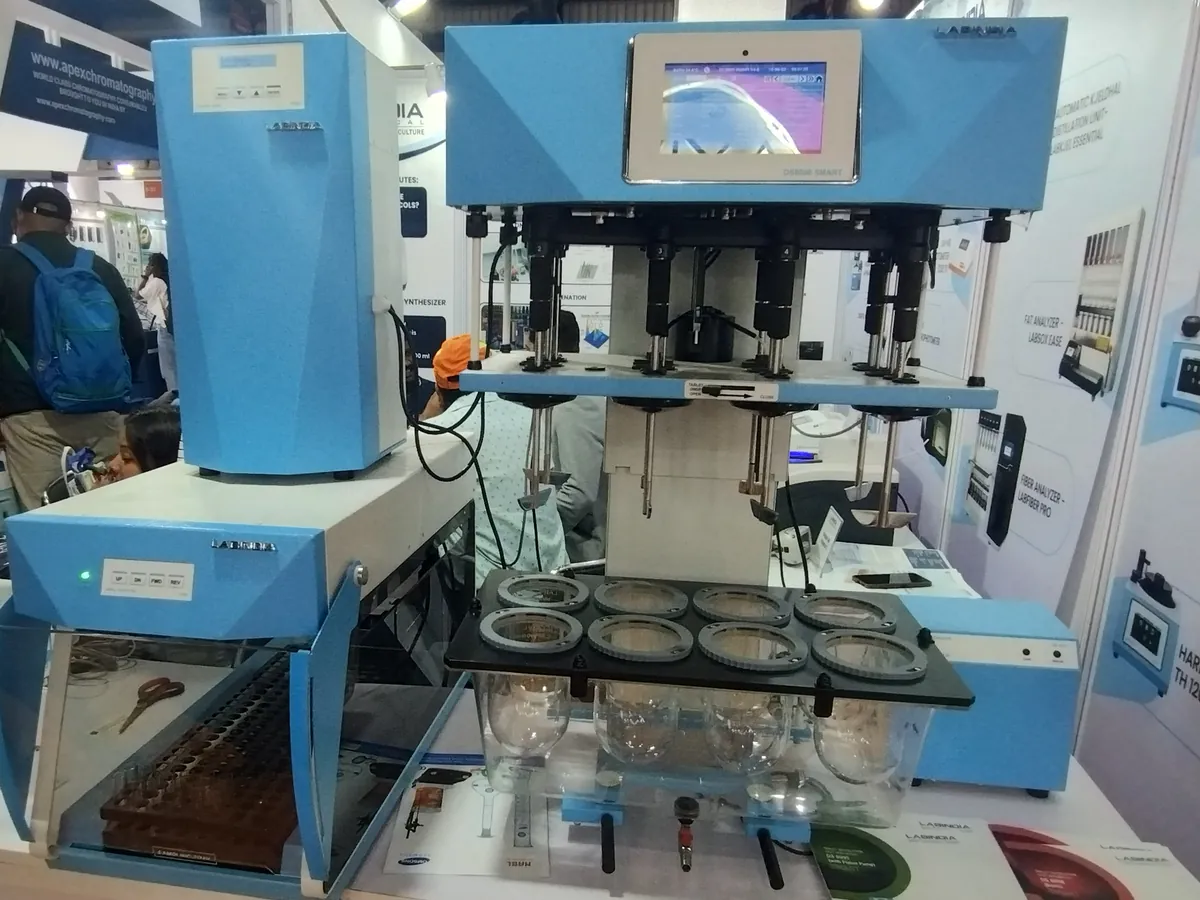
Dissolution Test Apparatus
Measures how fast and how completely the drug is released from a tablet or capsule into a liquid medium held at body temperature. A key quality and release test for oral solid dosage forms.
- Pharmaceutical
- Generic drug development
- Nutraceuticals and dietary supplements
- Veterinary medicines
- Contract research and testing labs
Test your Dissolution tester knowledge
Multiple-choice questions
Pick an answer to see whether you are right and why.
Q1. USP apparatus 2 for dissolution is the:
basicQ2. At what temperature is the dissolution medium normally held for oral dosage forms?
basicQ3. The typical distance between the bottom of the paddle blade and the inside bottom of the vessel is:
basicQ4. Why is dissolution medium deaerated?
intermediateQ5. Q is 80%. At stage S1, what must each of the six units achieve?
intermediateQ6. Where should a manual dissolution sample be withdrawn from?
intermediateQ7. One vessel position gives consistently higher results than the other five. Which is the most likely cause?
advancedQ8. What does the performance verification test (PVT) check that mechanical calibration does not?
advanced
Viva questions
Think of your answer first, then open it to compare.
1. Explain sink conditions and why they matter.
Sink conditions mean the medium volume is large enough, commonly at least three times the volume needed to dissolve the full dose to saturation, that the concentration stays well below saturation. Dissolution then reflects how the formulation releases drug, not the drug's solubility limit, so the test can discriminate between batches.
2. Describe the S1, S2 and S3 acceptance stages.
S1 tests 6 units, each must be at least Q + 5%. If S1 fails, S2 adds 6 units: the mean of 12 must be at least Q and no unit below Q − 15%. If S2 fails, S3 adds 12 units: the mean of 24 must be at least Q, not more than 2 units below Q − 15%, and none below Q − 25%. Failing S3 means the batch fails.
3. What is coning and how would you handle it?
Coning is a mound of undissolved excipient and drug that collects under the paddle in the low-flow zone at the vessel bottom, giving low and variable results. Record the observation and inform the method owner. Changes such as a higher speed or a different vessel design are method changes that need justification and approval; the analyst must not change conditions on their own.
4. List the main checks in a dissolution mechanical calibration.
Shaft wobble, basket wobble, shaft verticality, vessel verticality, centring of the shaft in the vessel, paddle or basket height (25 ± 2 mm), rotation speed and temperature, at every position.
Keep every Dissolution tester in control: usage logs, calibration and maintenance schedules, and automatic blocking of overdue instruments.