COD Digestion Reactor
A dry heating block that holds sealed glass tubes at 150 °C for two hours so that potassium dichromate can oxidise the organic matter in water and wastewater samples. It is the heart of the closed reflux COD test.
- Environmental testing laboratories
- Municipal water and wastewater utilities
- Chemical and pharmaceutical effluent treatment
- Food and beverage processing
- Textile, pulp and paper, and distilleries
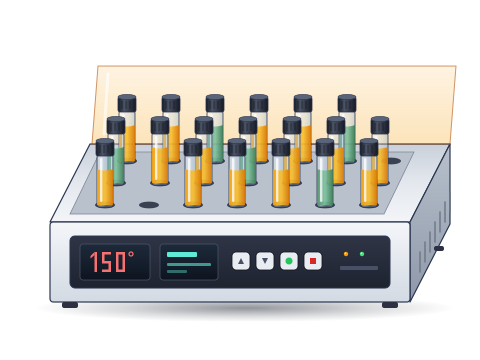
What is COD digester?
Chemical oxygen demand (COD) measures how much oxygen is needed to chemically oxidise the organic matter in a sample. In the closed reflux method a small volume of sample is sealed in a glass tube with acid dichromate and a silver catalyst, then heated in a COD digestion reactor.
The reactor is an aluminium block with drilled holes that fit the tubes (commonly 16 mm or 20 mm diameter). A controller holds the block at 150 °C and a timer runs the standard two-hour digestion. After cooling, the remaining dichromate is measured by titration with ferrous ammonium sulphate, or the colour change is read on a spectrophotometer.
Compared with the older open reflux method using large flasks and condensers, the block reactor uses far less sample and reagent, produces much less hazardous mercury and chromium waste, and lets an analyst digest 15 to 25 samples at once.
Used for
- COD of municipal and industrial wastewater at treatment plant inlets and outlets
- Compliance testing of effluent against discharge consent limits
- Process control of biological treatment (load to aeration tanks)
- Estimating BOD dilutions before setting up a BOD test
- Digestion for total phosphorus and total nitrogen tube tests at other temperatures and times
- Surface water and landfill leachate monitoring
How it works
- 01
Pre-heat
The block is switched on and allowed to reach 150 °C and stabilise.
- 02
Load tubes
Sample, digestion solution (dichromate with mercuric sulphate) and sulphuric acid with silver sulphate are added to a tube, which is capped tightly and mixed.
- 03
Digest
Tubes are placed in the block and heated at 150 °C for 2 hours.
- 04
Cool
Tubes are removed to a rack and cooled to room temperature, letting any precipitate settle.
- 05
Measure
The remaining dichromate is titrated with ferrous ammonium sulphate, or the absorbance is read on a spectrophotometer.
Advantages
- Small sample and reagent volumes, so less hazardous waste
- Many samples digested together at a uniform temperature
- Sealed tubes reduce loss of volatile organics
- Simple to operate with a programmable temperature and timer
- Pre-filled commercial vials make results consistent between analysts
Limitations
- Chloride is oxidised by dichromate and gives a positive error unless masked with mercuric sulphate
- Some compounds (for example pyridine and certain aromatics) are not fully oxidised
- Suspended solids are hard to sub-sample in only 2 to 3 mL, so homogenisation is critical
- Uses toxic hexavalent chromium, concentrated sulphuric acid and often mercury salts
- The block only heats the sample; a titration set-up or spectrophotometer is still needed to finish the test
2 calibration procedures
Methods that use COD digester
Keep every COD digester in control: usage logs, calibration and maintenance schedules, and automatic blocking of overdue instruments.